

Blogs
Acrylic Sheet Cutting: Laser vs CNC vs Saw Cutting

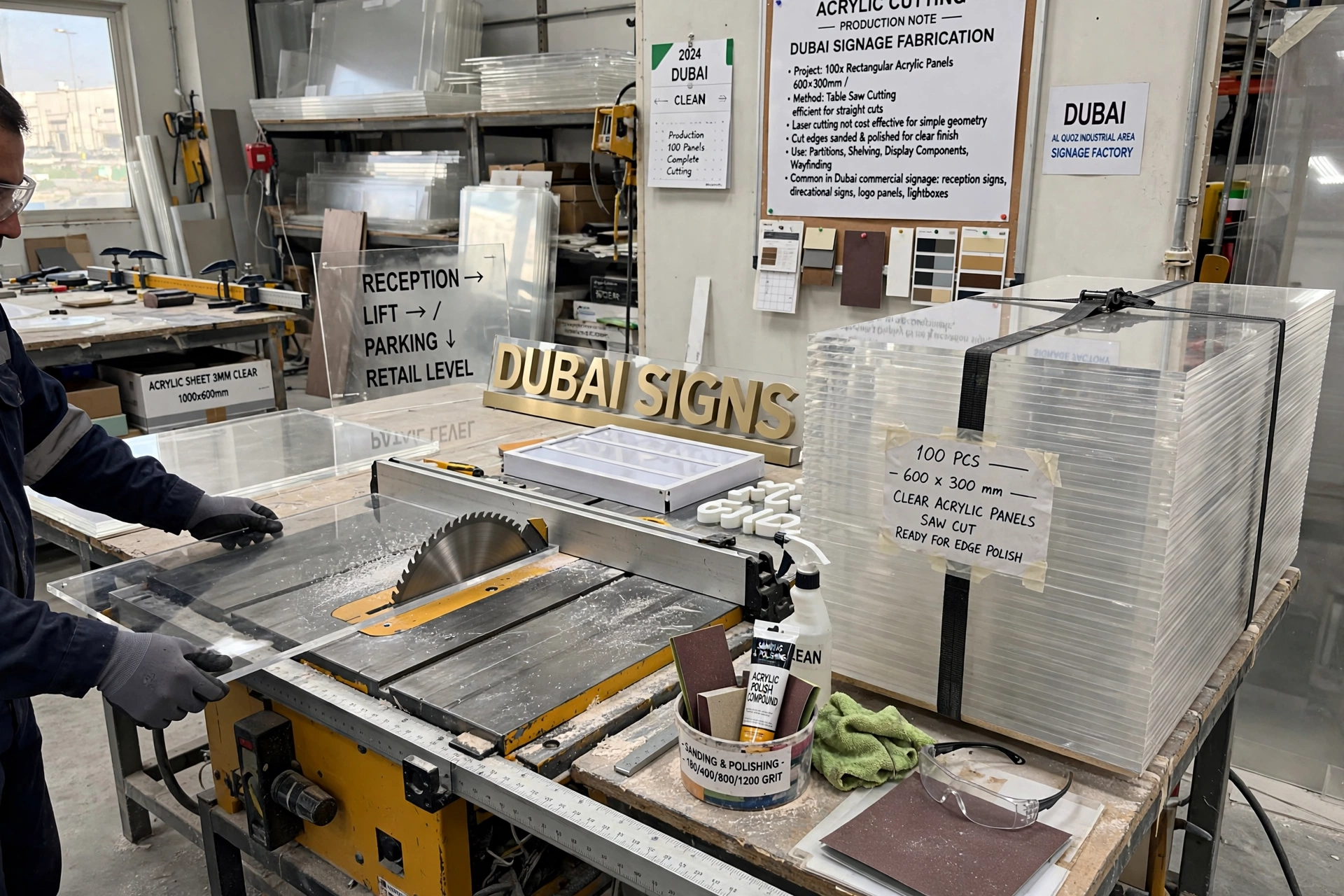
Acrylic sheet is one of the most versatile plastic materials used in signage, retail displays, exhibition stands, interior decoration, architectural features, lightboxes, furniture components, protective panels, and point-of-sale displays. Its combination of transparency, colour variety, lightweight construction, weather resistance, and fabrication flexibility makes it suitable for both indoor and outdoor applications.
However, choosing the right cutting method can significantly affect the quality of the finished acrylic product. Laser cutting, CNC routing, and saw cutting each have different advantages. The best method depends on the acrylic thickness, shape, quantity, edge appearance, dimensional requirements, production speed, and final application.
For businesses in Dubai, Sharjah, Abu Dhabi, and other parts of the UAE, understanding these differences can help when ordering acrylic signage, display components, architectural panels, illuminated letters, partitions, or custom-fabricated acrylic products.
Why the Acrylic Cutting Method Matters
The cutting process does more than simply separate one piece of acrylic from another. It influences the edge quality, dimensions, surface condition, shape accuracy, finishing requirements, and overall appearance of the finished component.
A straight rectangular panel may require a completely different cutting method from an intricate logo or a decorative architectural pattern.
For example, a large transparent acrylic panel for a partition may be efficiently cut with a table saw or panel saw. A complex retail display component may be better suited to CNC routing. Small decorative letters or intricate patterns can often benefit from laser cutting.
The material thickness also plays an important role. Thin acrylic behaves differently from thick acrylic during machining and thermal cutting.
Therefore, selecting the cutting technique should begin with the final application rather than simply choosing the most advanced machine available.
Understanding Acrylic Sheet
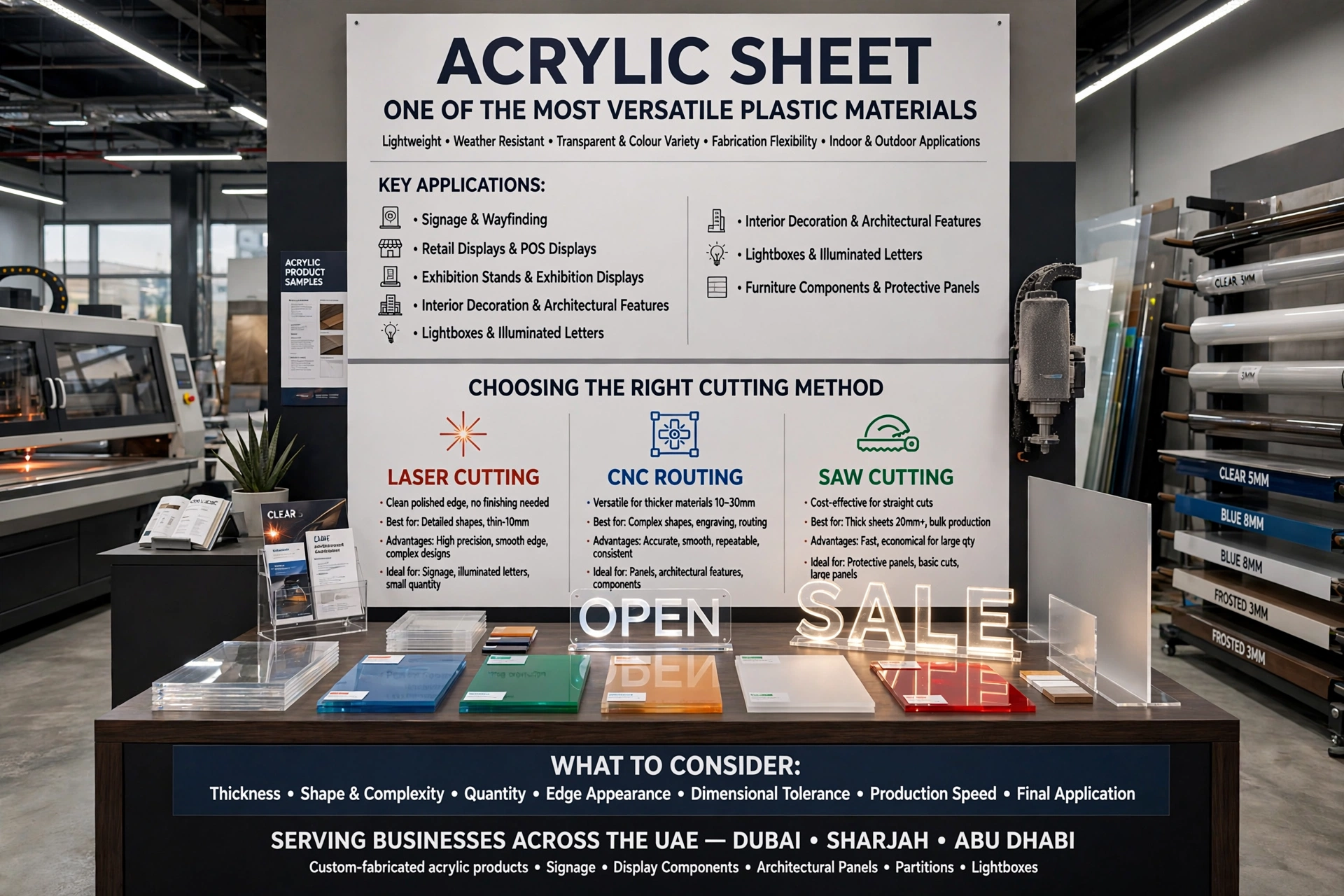
Acrylic is a thermoplastic material commonly known as polymethyl methacrylate, or PMMA. It is available in many forms, including clear, coloured, frosted, translucent, mirrored, fluorescent, textured, and specialty grades.
Clear acrylic is particularly popular for displays and architectural applications because it provides excellent visual clarity while being lighter than glass.
Coloured acrylic can be used for signage, branding, decorative panels, retail fixtures, and furniture.
Frosted and translucent acrylic can provide privacy or diffuse light.
Fluorescent acrylic is frequently used where strong visual impact is required.
The characteristics of the particular acrylic sheet should be considered before selecting the cutting process.
Laser Cutting Acrylic Sheets
Laser cutting uses a concentrated beam of energy to cut through acrylic. The process is computer-controlled and can produce highly detailed shapes.
It is especially useful for intricate designs, letters, logos, decorative patterns, and smaller components where precision is important.
One of the major advantages of laser cutting is that the cutting path can be controlled digitally. A computer-generated design can be converted into a cutting file, allowing complex shapes to be produced consistently.
Advantages of Laser Cutting
Laser cutting can provide very fine detail.
It is particularly suitable for:
- Acrylic letters
- Logos
- Decorative patterns
- Intricate shapes
- Small components
- Exhibition displays
- Point-of-sale displays
- Model components
- Lightbox elements
- Decorative screens
Because the cutting tool does not physically contact the acrylic in the same way as a saw blade or router, very small and intricate shapes can be produced.
Laser cutting can also provide a smooth-looking edge on suitable acrylic materials.
Laser-Cut Acrylic Edges
One of the distinctive characteristics of laser-cut acrylic is the appearance of the edge.
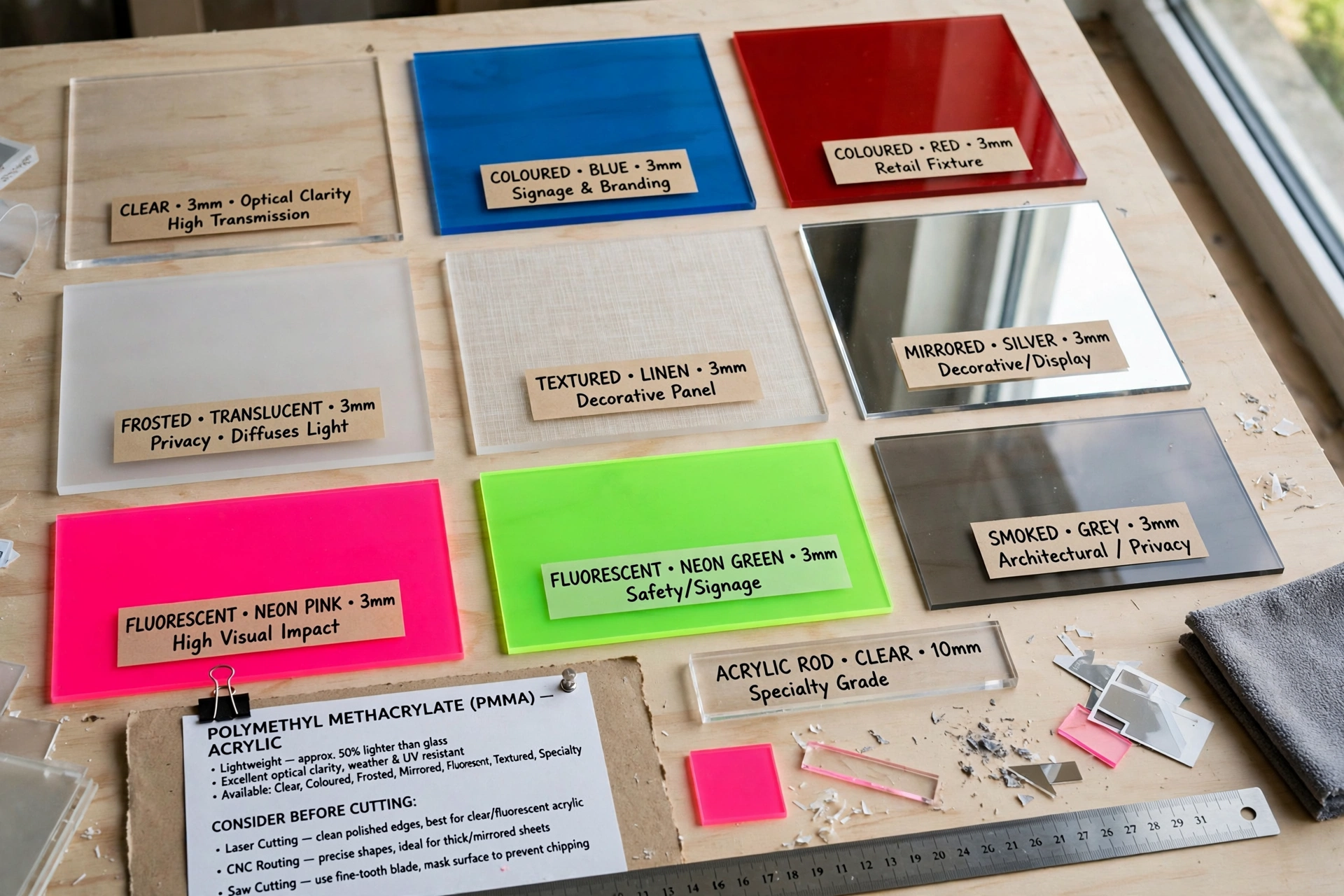
When the laser is correctly adjusted, the acrylic edge can become smooth and glossy because the heat from the laser melts the material along the cutting path.
This can be particularly attractive with clear acrylic.
For illuminated signage and display components, a polished-looking edge can also interact effectively with LED illumination.
However, the final appearance depends on the machine, material, thickness, power settings, cutting speed, ventilation, and operator experience.
Incorrect settings can produce excessive heat, residue, frosting, or inconsistent edges.
Limitations of Laser Cutting
Laser cutting is not automatically the best solution for every acrylic project.
Very thick acrylic may require specialized equipment or multiple passes.
Heat-sensitive designs can also require careful parameter control.
The process may create heat-affected areas around the cutting path.
In addition, the machine size limits the dimensions of the sheet or component that can be processed.
For large, thick, or very simple acrylic panels, another cutting method may be more practical.
CNC Cutting and Routing Acrylic
CNC cutting uses computer-controlled machinery to move a cutting tool across the acrylic sheet.
Unlike laser cutting, CNC machining physically removes material using a rotating cutter.
CNC routing is particularly useful for larger components, thicker sheets, three-dimensional profiles, grooves, holes, countersinks, and complex shapes that require mechanical machining.
Advantages of CNC Acrylic Cutting
CNC routing provides considerable flexibility.
It can be used for:
- Large acrylic panels
- Thick acrylic sheets
- Custom signage
- Furniture components
- Retail displays
- Architectural panels
- Decorative screens
- Templates
- Holes and cut-outs
- Grooves
- Recesses
- Custom profiles
The same digital design can be reproduced repeatedly, making CNC routing suitable for commercial production.
The operator can also select different cutting tools depending on the required edge profile and machining operation.
CNC Cutting and Edge Quality
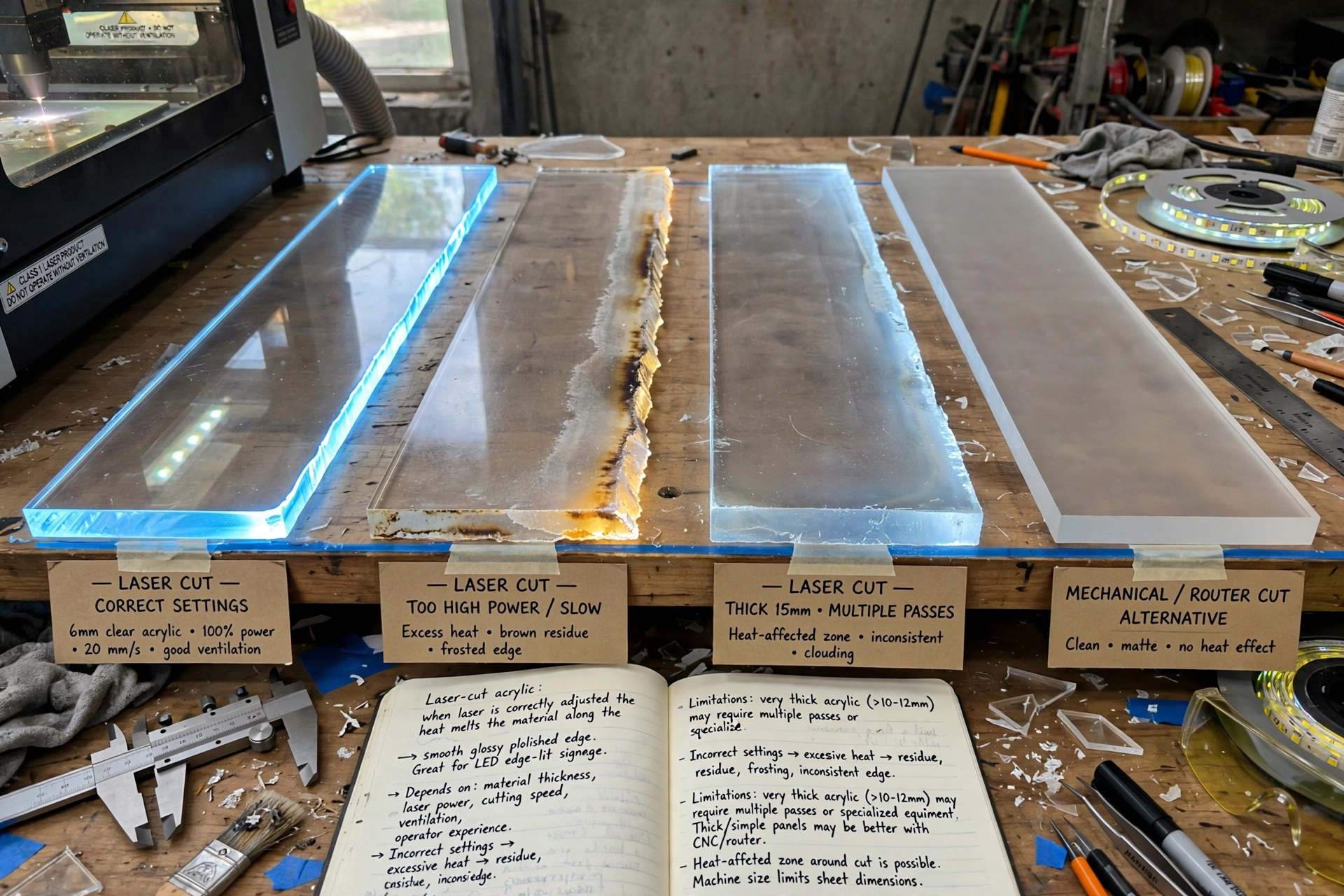
A CNC-cut acrylic edge may show tool marks depending on the cutter and machine settings.
The quality depends on factors such as:
- Cutter geometry
- Tool sharpness
- Spindle speed
- Feed rate
- Acrylic thickness
- Workholding
- Cutting strategy
A properly machined edge can be very clean, but additional sanding or polishing may be required when a highly transparent or glossy edge is desired.
This is particularly relevant for clear acrylic components used in premium displays or illuminated products.
CNC Routing for Thick Acrylic
CNC routing becomes especially useful as acrylic thickness increases.
A thick acrylic panel may require holes, curves, internal cut-outs, or complicated profiles that would be difficult to achieve with conventional saw cutting.
CNC equipment can follow programmed paths and create repeatable components.
This makes it useful for architectural fabrication, custom furniture, retail fixtures, exhibition structures, and specialized signage.
Saw Cutting Acrylic Sheets
Saw cutting remains one of the most practical methods for producing straight acrylic panels.
Circular saws, table saws, panel saws, and other suitable cutting equipment can be used depending on the sheet size and production requirements.
For straightforward rectangular cuts, saw cutting can be fast and economical.
It is particularly suitable when the design does not contain complex curves or intricate details.
Advantages of Saw Cutting
Saw cutting is useful for:
- Straight cuts
- Large sheets
- Rectangular panels
- Large partitions
- Shelving
- Protective panels
- Basic signage components
- Furniture panels
- Simple fabrication work
For a project requiring many large rectangular pieces, saw cutting can often be more practical than laser or CNC processing.
The cutting process is also relatively straightforward for experienced fabricators.
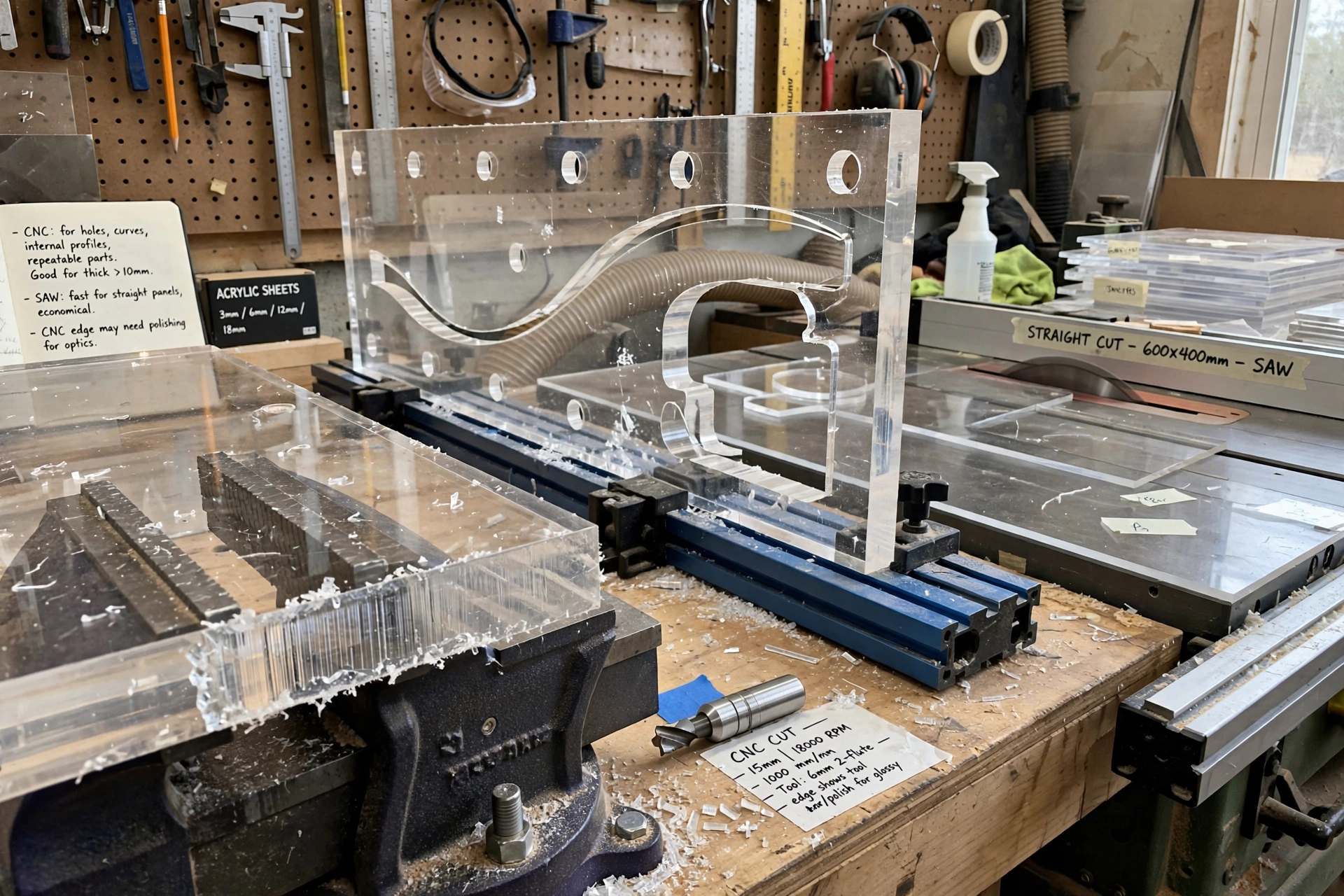
Laser vs CNC vs Saw Cutting: Which Is Better?
There is no universal winner.
Each method is suited to different requirements.
| Requirement | Laser Cutting | CNC Cutting | Saw Cutting |
|---|---|---|---|
| Intricate shapes | Excellent | Excellent | Limited |
| Straight cuts | Excellent | Good | Excellent |
| Thick acrylic | Limited depending on equipment | Excellent | Excellent |
| Small detailed parts | Excellent | Very good | Limited |
| Large panels | Equipment dependent | Excellent | Excellent |
| Holes and grooves | Limited | Excellent | Limited |
| Glossy-looking edges | Often excellent | Requires finishing | Usually requires finishing |
| Complex profiles | Excellent | Excellent | Limited |
| Simple rectangular panels | Good | Good | Excellent |
| Repeated production | Excellent | Excellent | Excellent |
The appropriate choice depends on the specific project.
When Laser Cutting Is the Better Choice
Laser cutting is usually attractive when the design contains intricate details.
Suppose a retail brand needs hundreds of small acrylic letters for a display system. Laser cutting can reproduce the shapes consistently.
The same applies to decorative screens containing complex patterns.
Laser cutting is also useful when the edge itself contributes to the visual effect.
Clear acrylic letters with polished-looking laser-cut edges can produce an attractive appearance when illuminated.
When CNC Cutting Is the Better Choice
CNC routing is often the stronger option for thicker materials and larger fabricated components.
It is particularly valuable when the project involves more than simple cutting.
For example, an acrylic display might require:
- Circular holes
- Internal cut-outs
- Grooves
- Recesses
- Countersinks
- Curved edges
- Multiple thicknesses
- Custom profiles
A CNC machine can combine several machining operations within the same digital workflow.
This makes it particularly useful for custom fabrication
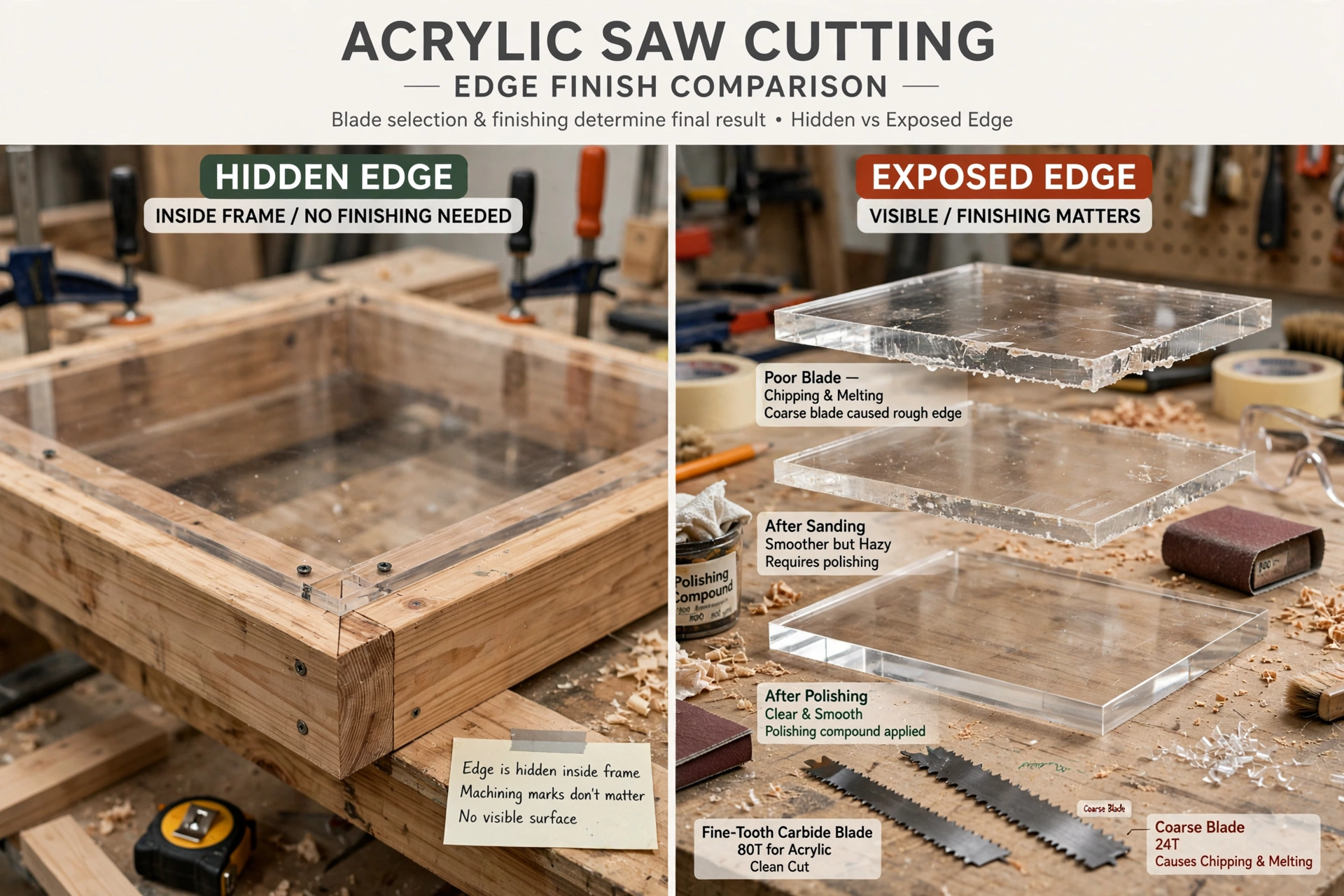
When Saw Cutting Is the Better Choice
Saw cutting is ideal when the design is straightforward.
Imagine a project requiring 100 transparent acrylic panels measuring specific rectangular dimensions.
There may be little benefit in using laser cutting for such a simple shape.
A suitable saw can produce straight cuts efficiently.
The edges can then be sanded or polished if they are visible.
For construction, interior fit-out, partitions, shelving, and basic display components, saw cutting can be an efficient solution.
Acrylic Cutting for Signage
Acrylic is widely used in commercial signage throughout Dubai and the UAE.
It can be fabricated into:
- 3D letters
- Flat-cut letters
- Illuminated signs
- Directional signs
- Reception signs
- Logo panels
- Wayfinding systems
- Retail graphics
- Lightboxes
The appropriate cutting method depends on the sign design.
Intricate logos can benefit from laser cutting.
Large panels may be CNC routed or saw cut.
Thick dimensional letters may require CNC machining.
The finishing process should also be considered because exposed edges can influence the overall appearance of the sign.
Acrylic Cutting for Retail Displays
Retail environments often require custom acrylic components.
Acrylic shelves, product stands, risers, holders, dividers, display boxes, and promotional fixtures can all be fabricated from sheet material.
Laser cutting can produce small holders and detailed components.
CNC routing can create larger display structures.
Saw cutting can efficiently produce simple shelves and panels.
The final design should consider how customers interact with the display.
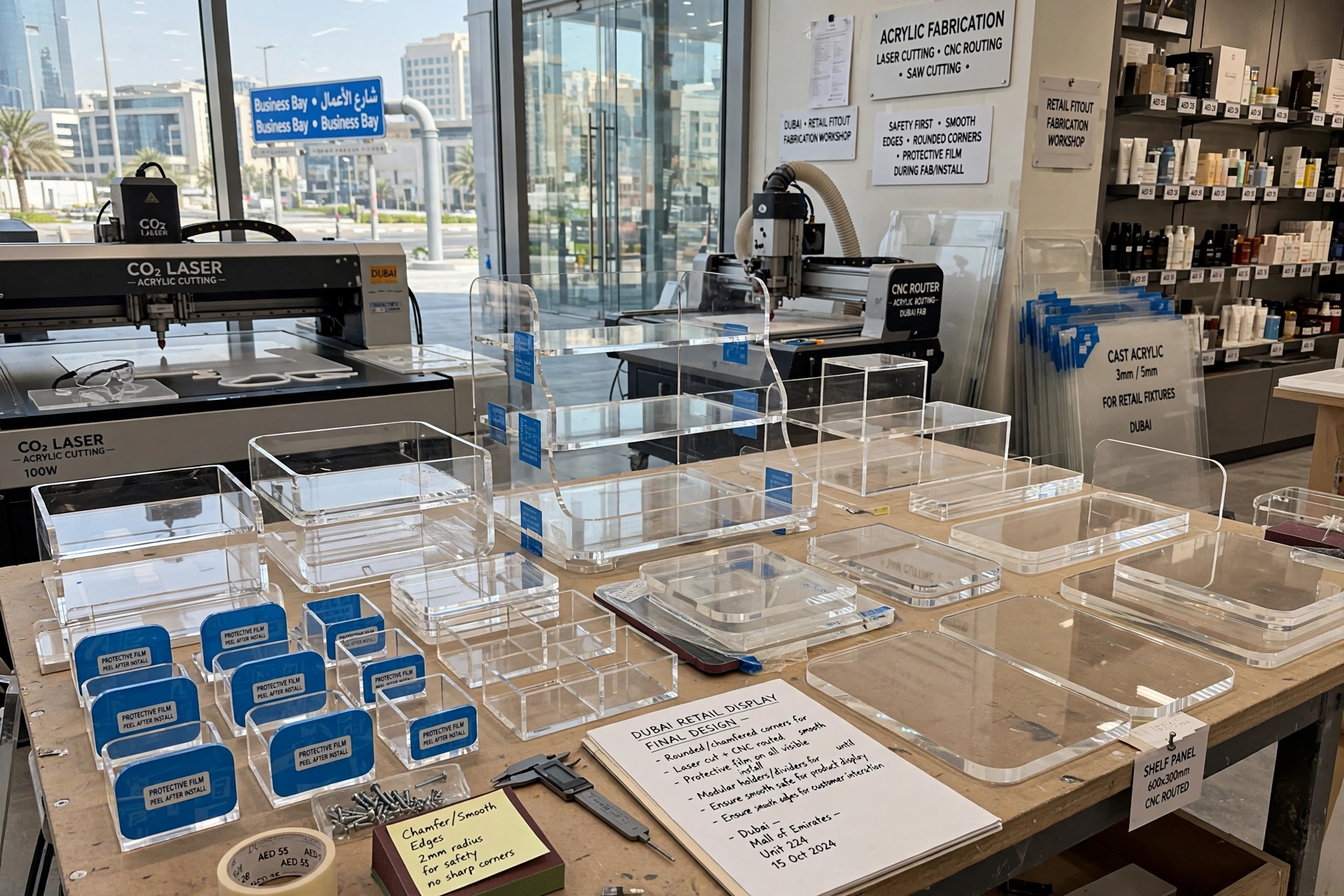
Edges should be smooth and safe.
Corners may need to be rounded or chamfered.
Visible surfaces should be protected from scratches during fabrication and installation.
Acrylic Cutting for Exhibition Stands
Exhibition stands often require customized components that can be assembled quickly.
Acrylic is useful because it is lightweight and can be fabricated into visually striking forms.
Laser-cut logos, CNC-routed panels, clear shelves, branded display boxes, and decorative components can all be combined.
Dubai’s exhibition and events sector creates significant demand for temporary and reusable display structures.
The fabrication method should therefore consider both appearance and installation requirements.
Acrylic Cutting for Interior Design
Interior designers use acrylic for partitions, decorative panels, furniture elements, lighting features, room dividers, wall details, and display installations.
CNC routing is useful when custom profiles are required.
Laser cutting is suitable for decorative patterns.
Saw cutting works well for straight architectural panels.
The material can also be combined with timber, metal, glass, LED lighting, and other interior materials.
In hospitality and retail environments, acrylic can provide a contemporary appearance while allowing designers to introduce colour, transparency, texture, and illumination.
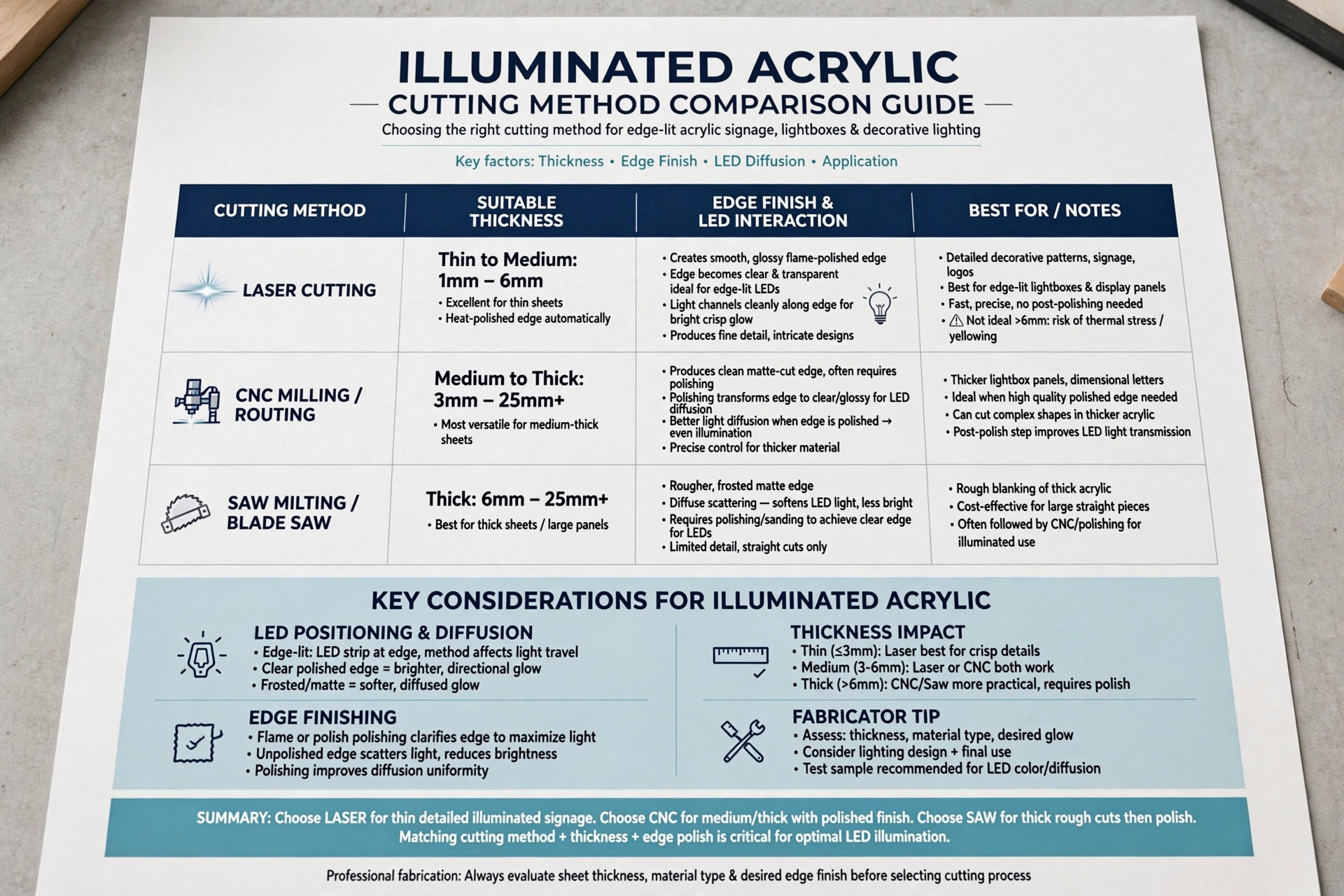
Acrylic Cutting for LED and Illuminated Applications
Illuminated acrylic applications require careful consideration of the edge.
Clear and translucent acrylic can interact with LED lighting in different ways.
Laser cutting may produce attractive edges for certain illuminated components.
CNC-cut acrylic can be polished afterward to achieve a clearer finish.
The positioning of LEDs, sheet thickness, diffusion characteristics, and edge finishing can all influence the final result.
For signage, lightboxes, display systems, and decorative lighting, the cutting method should therefore be selected together with the lighting design.
Acrylic Thickness and Cutting Method
Thickness is one of the most important factors when choosing a cutting technique.
Thin acrylic can be suitable for laser cutting, especially when detailed shapes are required.
Medium-thickness sheets can often be processed using laser, CNC, or saw methods depending on the application.
Thicker sheets may be more practical to machine with CNC equipment or saws.
However, equipment capabilities vary.
A professional fabricator should assess the exact sheet thickness, dimensions, material type, and desired edge finish before selecting the cutting process.
Accuracy and Repeatability
For commercial projects, consistency is often as important as the first finished piece.
A display system containing dozens of acrylic components should have consistent dimensions.
CNC and laser systems can both provide strong repeatability because they follow digital cutting paths.
Saw cutting can also provide excellent consistency when appropriate guides, fixtures, and professional equipment are used.
The production method should therefore be selected according to the required tolerances and quantity.
Finishing After Acrylic Cutting
Cutting is only one stage of acrylic fabrication.
Depending on the method, the finished component may require:
- Sanding
- Deburring
- Edge polishing
- Flame polishing
- Buffing
- Drilling
- Bending
- Bonding
- Cleaning
- Protective film removal
A laser-cut edge may require little additional work.
A CNC- or saw-cut edge may require more finishing when exposed.
The final appearance should always be considered when evaluating the cutting method.
Choosing an Acrylic Sheet Cutting Supplier
Choosing the right material and fabrication partner is important when the finished acrylic component needs to meet specific dimensional and visual requirements.
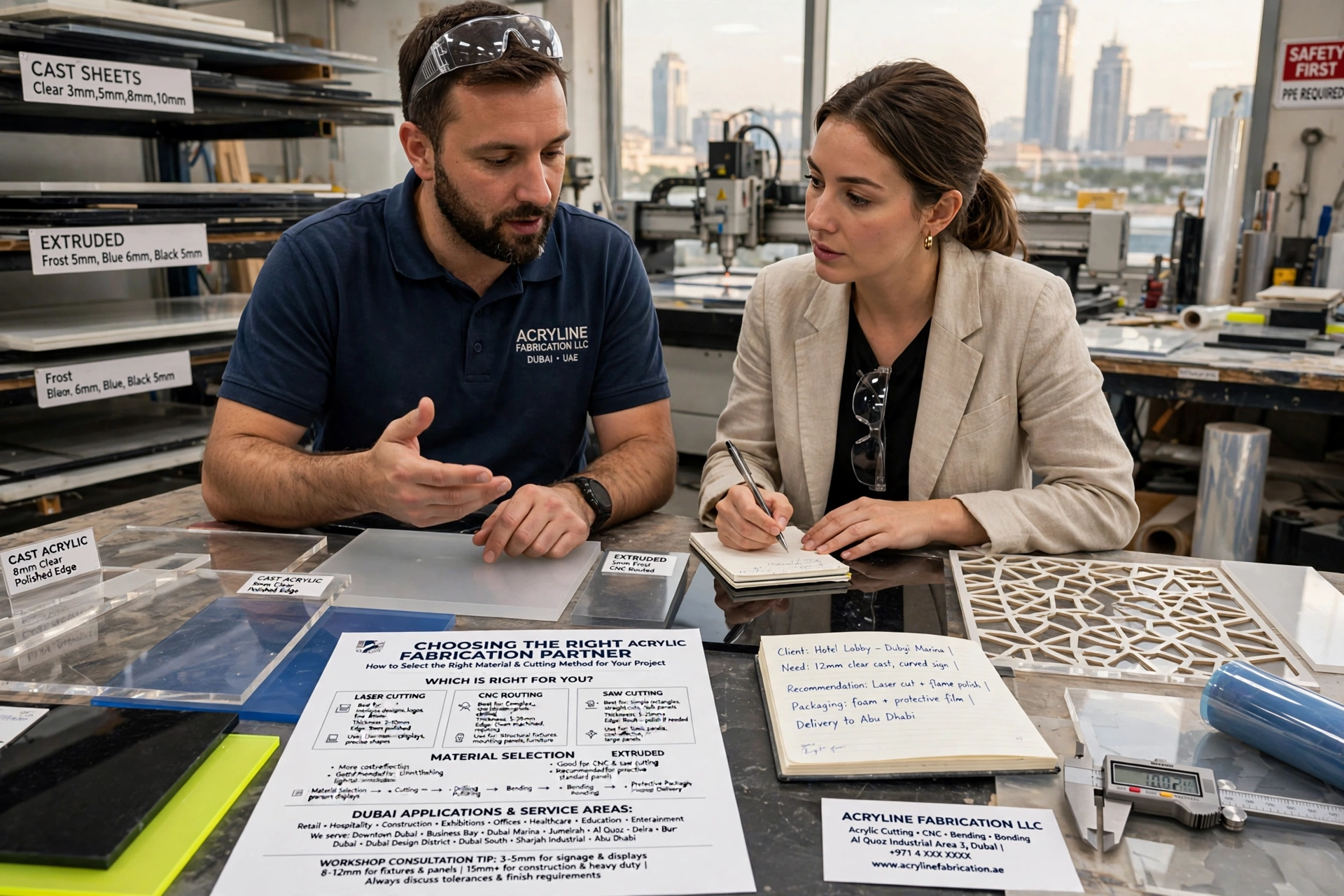
An experienced Acrylic Sheet Cutting Supplier can help determine whether laser cutting, CNC routing, or saw cutting is appropriate for a particular project.
The supplier should understand the differences between cast and extruded acrylic, available sheet thicknesses, colours, finishes, fabrication tolerances, edge finishing, and application requirements.
For commercial projects, it is also useful to discuss the complete process rather than requesting cutting alone.
This may include material selection, cutting, drilling, polishing, bending, bonding, protective packaging, and delivery.
Acrylic Cutting in Dubai and the UAE
Dubai has a diverse commercial environment where acrylic fabrication is used across retail, hospitality, construction, exhibitions, offices, healthcare, education, and entertainment.
Areas such as Downtown Dubai, Business Bay, Dubai Marina, Jumeirah, Al Quoz, Deira, Bur Dubai, Dubai Design District, and Dubai South contain businesses and projects where custom fabricated materials are frequently required.
Sharjah’s industrial areas also support manufacturing, signage, fabrication, and commercial fit-out activities.
Abu Dhabi similarly has demand for acrylic products across retail, corporate, hospitality, government, and construction environments.
Because projects can range from small custom signs to large commercial installations, the cutting method needs to be matched to the actual application.
How to Choose the Right Acrylic Cutting Method
Before selecting a cutting process, consider the following questions:
What shape is required?
Simple rectangles can be efficiently saw cut, while intricate shapes may benefit from laser or CNC.
How thick is the acrylic?
Thickness can influence which equipment is practical.
Does the edge need to be visible?
If yes, edge quality and polishing requirements become more important.
Are holes or grooves required?
CNC machining may be particularly useful.
How many pieces are required?
Production quantity can influence efficiency and setup costs.
Does the component require a decorative pattern?
Laser or CNC cutting may be suitable.
Will the acrylic be illuminated?
The edge finish and material characteristics become particularly important.
Does the finished piece require additional fabrication?
Drilling, bending, bonding, engraving, and polishing may influence the best cutting method.
Frequently Asked Questions
Is laser cutting better than CNC for acrylic?
Neither method is universally better. Laser cutting is particularly effective for intricate designs and detailed shapes, while CNC routing is highly useful for thick acrylic, large components, grooves, holes, and custom profiles.
Is saw cutting suitable for acrylic sheets?
Yes. Saw cutting is highly practical for straight cuts and large rectangular panels. The resulting edge may require sanding or polishing when it will remain visible.
Which acrylic cutting method gives the best edge?
The result depends on the material and machine settings. Laser cutting can produce a glossy-looking edge, while CNC and saw-cut edges can be mechanically polished to achieve a refined finish.
Can thick acrylic be laser cut?
It depends on the thickness and capabilities of the laser equipment. For thicker acrylic, CNC routing or saw cutting may be more appropriate.
Can CNC cutting create holes in acrylic?
Yes. CNC machining is well suited to holes, slots, grooves, recesses, curves, and other custom features.
Which method is best for acrylic signage?
The best method depends on the sign. Laser cutting is excellent for detailed letters and shapes, while CNC routing can be suitable for thick dimensional components and large panels.
Does acrylic need polishing after cutting?
Not always. Some laser-cut edges may already have a smooth appearance. Saw- and CNC-cut edges may require additional sanding or polishing if a highly refined visible edge is required.
Conclusion
Laser cutting, CNC cutting, and saw cutting all have an important place in acrylic fabrication.
Laser cutting is particularly effective for intricate designs, detailed letters, logos, decorative patterns, and smaller precision components.
CNC cutting provides excellent flexibility for thick acrylic, large components, holes, grooves, profiles, and complex fabrication.
Saw cutting remains an efficient and practical choice for straight cuts, rectangular panels, shelving, partitions, and other straightforward applications.
The best method is therefore determined by the material, thickness, shape, dimensions, quantity, edge requirements, finishing requirements, and intended use.
For projects in Dubai, Sharjah, Abu Dhabi, and throughout the UAE, discussing these factors with an experienced acrylic fabricator can help ensure that the cutting method matches the final application. Good fabrication does not stop at cutting the sheet; accurate dimensions, clean edges, suitable finishing, careful handling, and proper packaging all contribute to the quality of the final product.
Whether the requirement is a detailed acrylic logo, a transparent retail display, a large architectural panel, an illuminated sign, or a custom exhibition component, choosing the right cutting method at the beginning can make the entire fabrication process more efficient and produce a cleaner, more professional result.