

Blogs
How to Choose the Right Acrylic Sheet Size for Your Project


Choosing the correct acrylic sheet size is an important part of planning any fabrication, signage, display, interior, or architectural project. Acrylic is available in different sheet dimensions, thicknesses, colours, finishes, and grades, so selecting a panel simply because it appears large enough can lead to unnecessary waste, difficult fabrication, weak components, or higher project costs.
The ideal sheet size depends on the finished dimensions, cutting pattern, acrylic thickness, installation method, transportation requirements, and intended application. A clear acrylic panel for a retail display may have completely different requirements from an acrylic partition, illuminated sign, protective screen, exhibition component, or architectural feature.
For projects in Dubai, Abu Dhabi, Sharjah, and other parts of the UAE, climate, transportation, building access, and local fabrication requirements can also influence the most practical sheet dimensions.
Why Acrylic Sheet Size Matters
Acrylic sheet size affects much more than the amount of material available for a project. The dimensions of the original panel determine how efficiently individual components can be cut and how much material remains after fabrication.
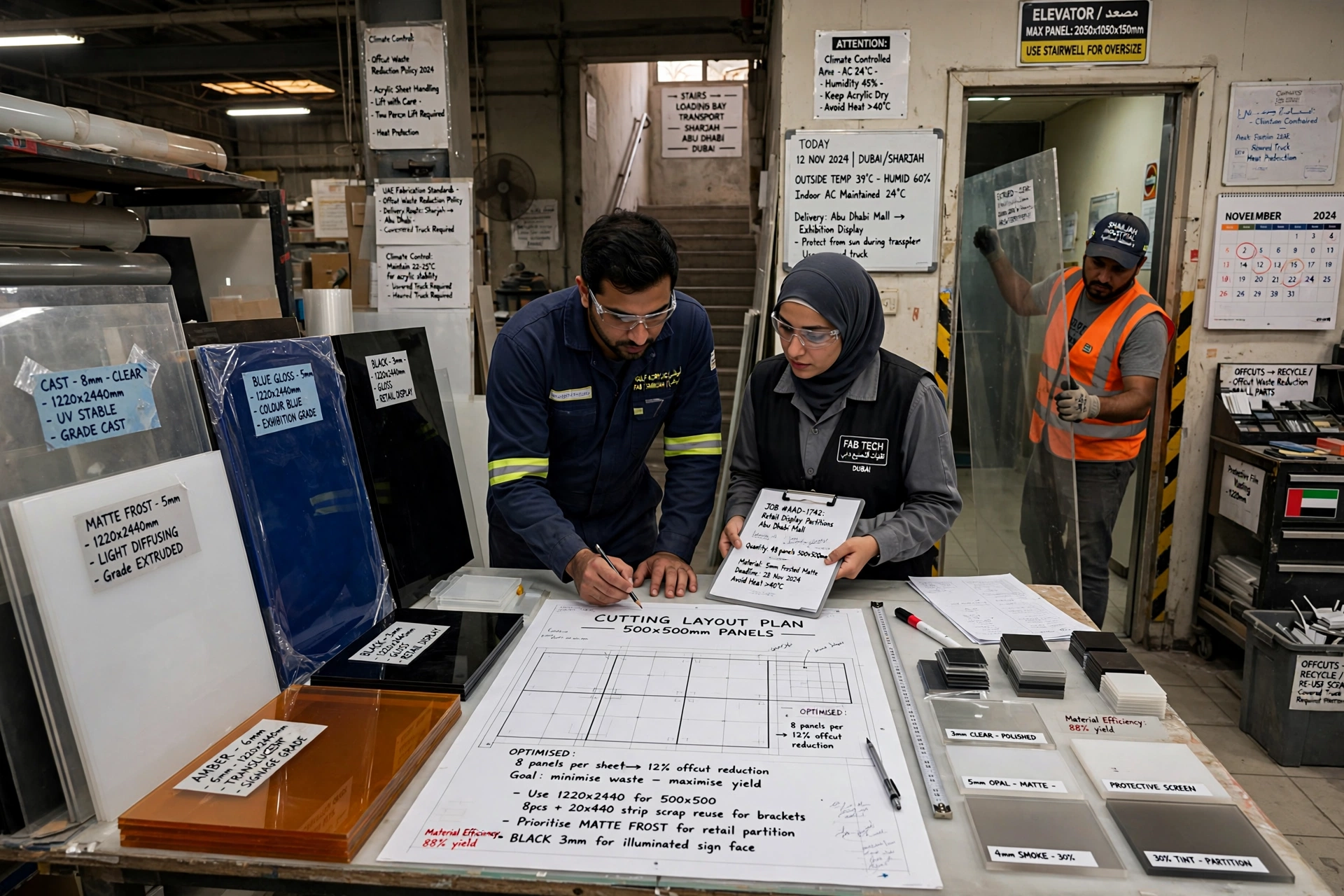
For example, if a project requires several panels measuring 500 × 500 mm, selecting a sheet that accommodates multiple pieces in one cutting layout can reduce offcuts. Conversely, choosing a sheet that is too small may require additional joints, multiple panels, or unnecessary connections.
Sheet size can also affect handling. A large acrylic panel may be suitable for a factory fabrication environment but difficult to move through a narrow doorway, elevator, staircase, or corridor.
The right choice therefore balances finished dimensions, material efficiency, fabrication requirements, handling, transportation, and installation.
Understanding Standard Acrylic Sheet Dimensions
Acrylic manufacturers and suppliers offer sheets in various standard and custom dimensions. Common commercial sizes can include large rectangular panels suitable for fabrication, signage, glazing alternatives, displays, partitions, and interior applications.
The exact dimensions available depend on the manufacturer, acrylic type, thickness, colour, finish, and local stock.
Rather than assuming that one standard size is appropriate for every application, it is better to begin with the required finished component dimensions.
Once those dimensions are known, the fabricator can determine which available sheet provides the most efficient cutting layout.
Start With the Finished Product
The first step in selecting an acrylic sheet is to define the final product.
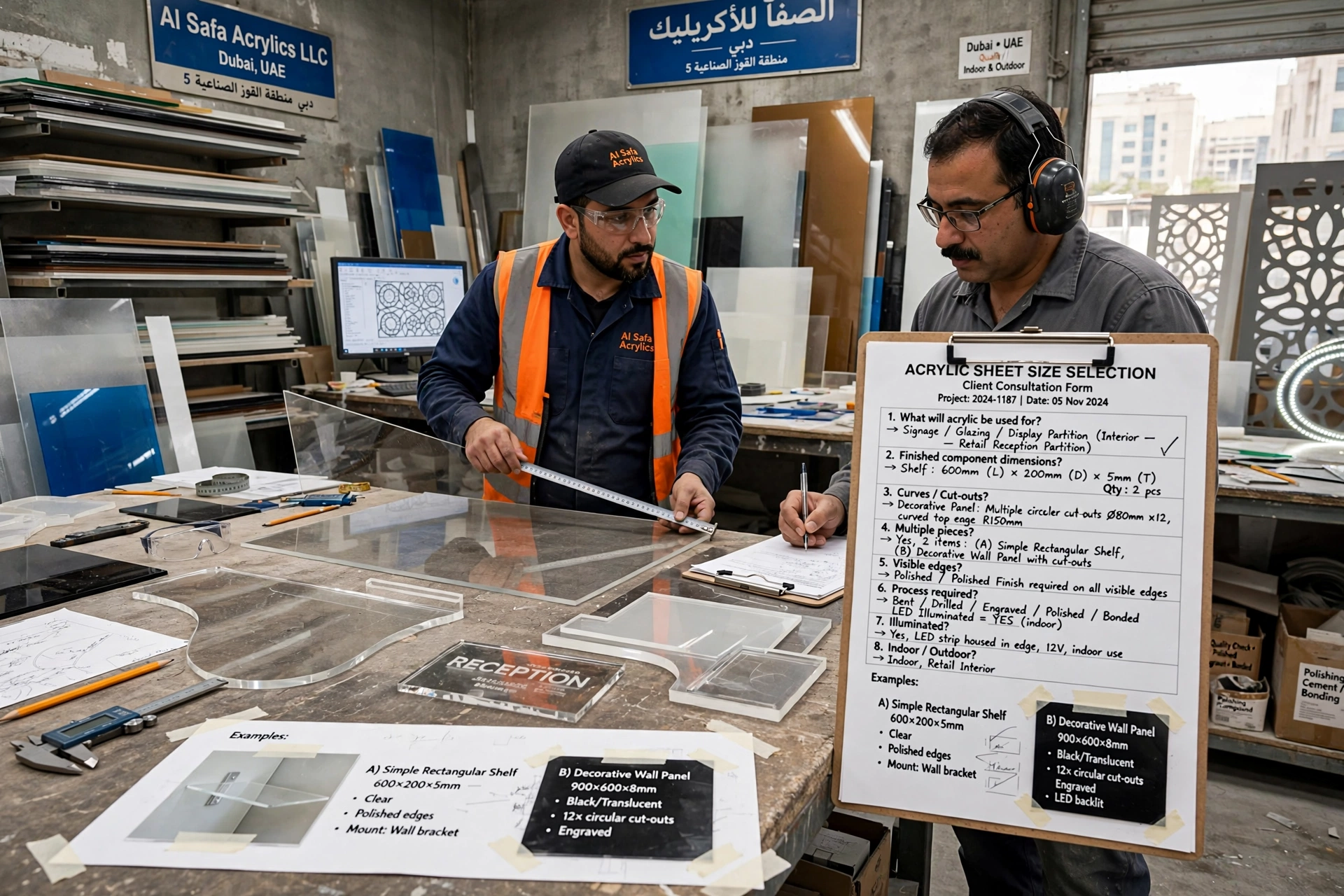
Ask:
What will the acrylic be used for?
How long and wide should the finished component be?
Will it require curves or internal cut-outs?
Will multiple pieces be produced from one sheet?
Will the edges remain visible?
Will the acrylic be bent, drilled, engraved, polished, or bonded?
Will it be illuminated?
Will the component be installed indoors or outdoors?
These questions help determine both the sheet size and thickness.
For example, a simple rectangular shelf requires different planning from a decorative acrylic wall panel containing multiple cut-outs.
Measure the Required Dimensions Carefully
Accurate measurements are essential before purchasing acrylic.
Measurements should normally include:
- Overall length
- Overall width
- Required thickness
- Internal openings
- Holes
- Cut-outs
- Curved sections
- Edge allowances
- Installation clearances
Do not automatically order a sheet with dimensions identical to the finished product.
The fabrication process requires consideration of cutting lines and potential material loss.
If a finished panel needs to measure 1200 × 600 mm, the fabricator may need to consider how the piece will be cut, held, finished, and installed before determining the most appropriate starting sheet.
Consider Cutting Allowances
Cutting acrylic is a precision process, but the cutting method can influence the final dimensions and edge condition.
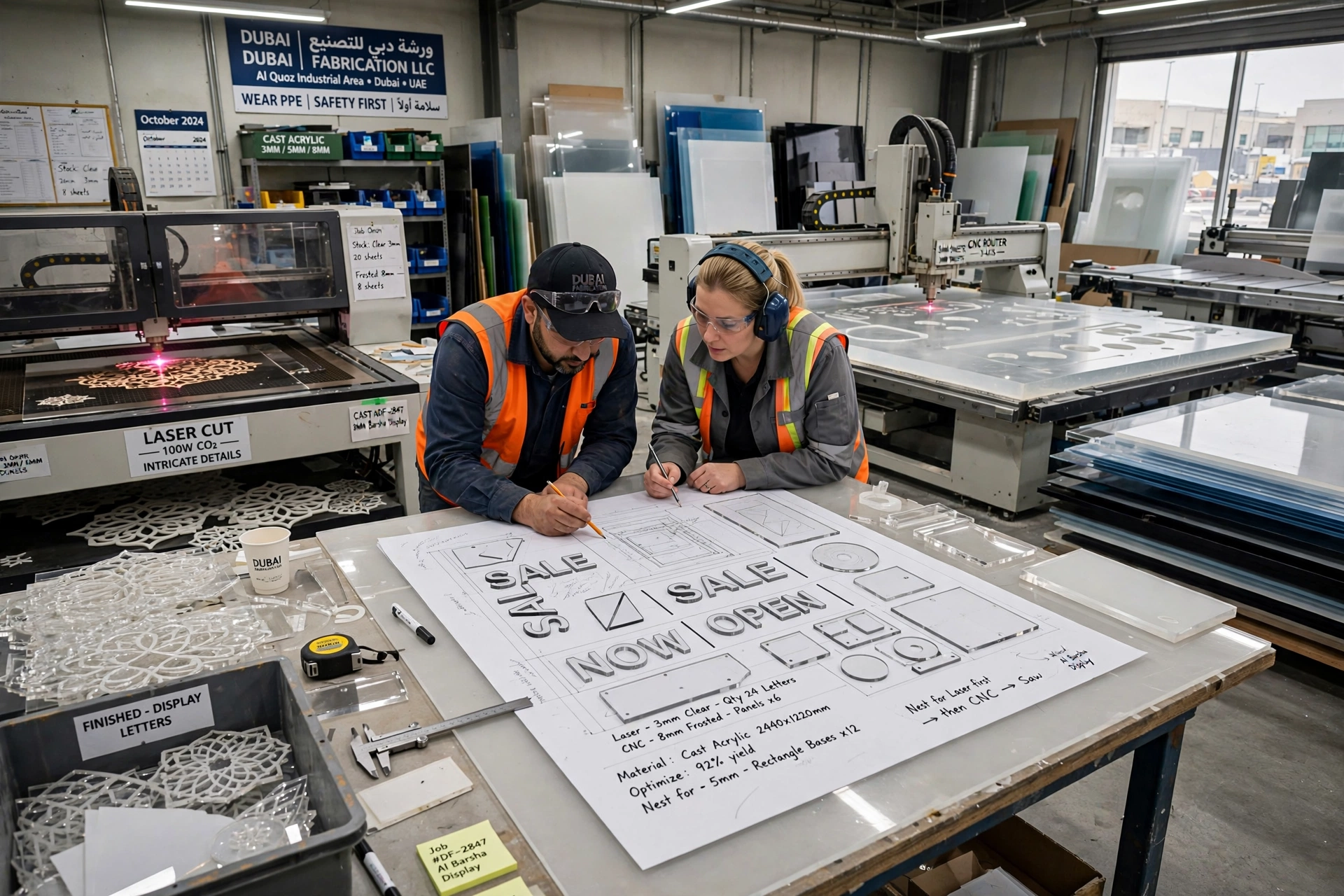
Laser cutting, CNC routing, and saw cutting each have different characteristics.
Laser cutting can be particularly effective for intricate shapes and detailed designs.
CNC routing is useful for large components, thick sheets, holes, grooves, and complex profiles.
Saw cutting is highly practical for straight cuts and rectangular panels.
The selected method should be considered when planning the sheet dimensions.
Think About Material Nesting
“Nesting” refers to arranging multiple components on a sheet to make efficient use of the available material.
This is especially important for commercial fabrication.
Suppose a project requires dozens of acrylic letters or multiple display components. Instead of cutting each component from a separate sheet, the parts can potentially be arranged efficiently on one or more larger panels.
Good nesting can reduce:
- Material waste
- Number of sheets required
- Cutting time
- Handling
- Production costs
However, the layout must still allow appropriate spacing between parts and sufficient room for cutting and finishing.
Choose Sheet Size Based on the Application
Different applications require different approaches to acrylic sheet sizing.
Acrylic Sheets for Signage
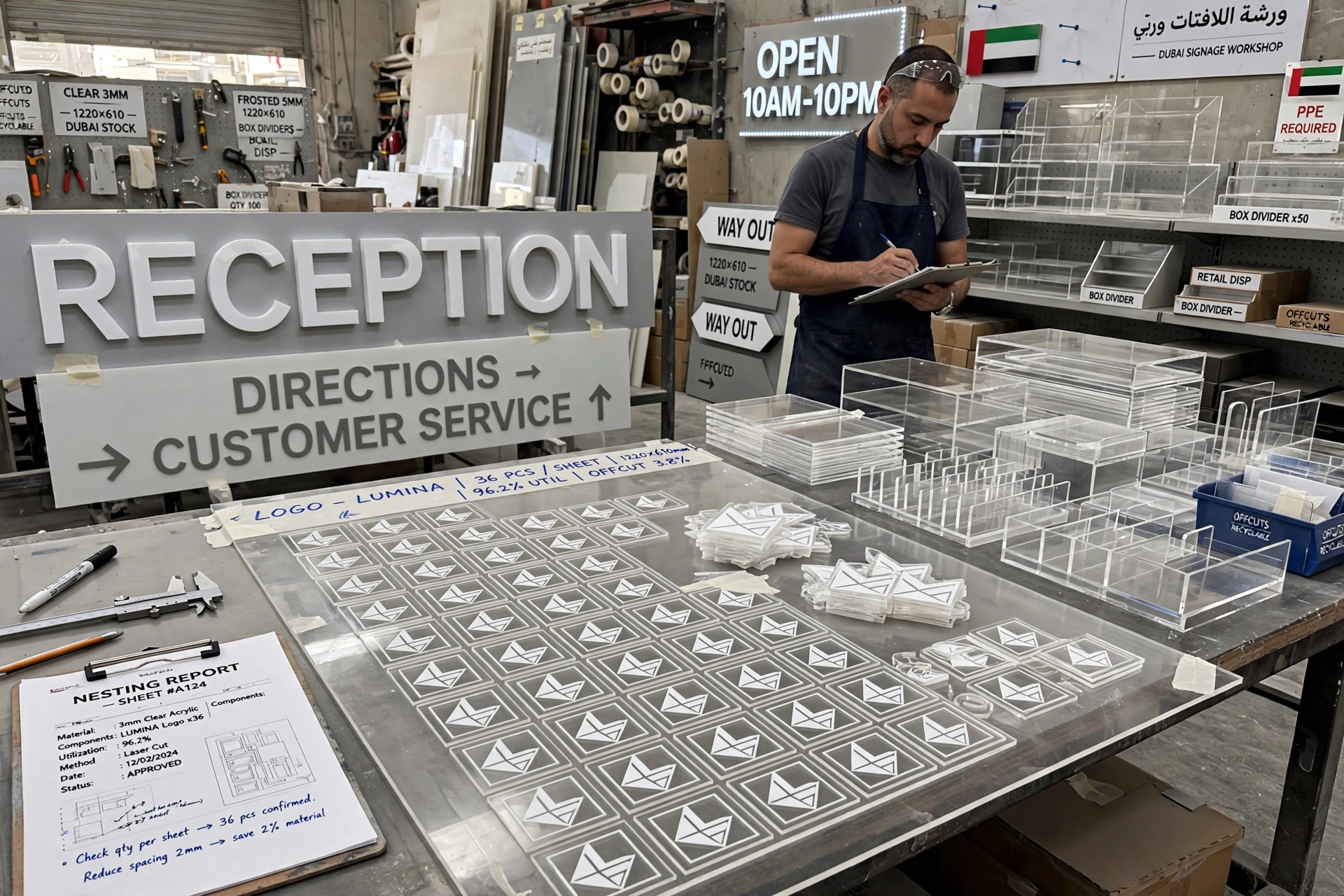
Acrylic is widely used for commercial signage, including reception signs, directional signs, illuminated letters, logos, wall-mounted signs, and retail branding.
For signage, sheet dimensions should be based on the overall design rather than simply selecting the largest available panel.
A logo containing many small components may benefit from a larger sheet because multiple pieces can be nested efficiently.
Large flat signs may require a panel that closely matches the final sign dimensions.
The sign’s mounting method should also be considered.
Acrylic Sheets for Retail Displays
Retail displays often involve shelves, product holders, risers, boxes, dividers, and branded fixtures.
These components may be relatively small but require multiple identical pieces.
In such cases, sheet utilization becomes particularly important.
A supplier or fabricator can determine how many components can be produced from each sheet and whether changing the component orientation can reduce offcuts.
For premium retail displays, the visible edge and surface condition should also be considered.
Acrylic Sheets for Partitions
Acrylic can be used for decorative partitions, protective screens, privacy panels, room dividers, and interior architectural features.
Large partitions may require larger sheets to reduce the number of joints.
However, very large panels can become difficult to transport and install.
Building access is therefore an important consideration.
A panel may physically fit the required wall opening but still be impossible to move through the building without special handling.
This is particularly relevant in high-rise buildings, hotels, offices, apartments, and commercial properties in Dubai.
Acrylic Sheets for Furniture
Acrylic is sometimes used in tables, shelving, display furniture, cabinets, side panels, and decorative furniture components.
Furniture requires more careful consideration of both sheet size and thickness.
Large unsupported panels may flex depending on their dimensions and loading.
For this reason, selecting the correct sheet thickness is just as important as selecting the correct dimensions.
The design may also require bending, bonding, edge polishing, drilling, or reinforcement.
Acrylic Sheets for Interior Design
Interior designers use acrylic for wall panels, decorative screens, room dividers, furniture elements, lighting features, display installations, and custom architectural details.
Projects in areas such as Dubai Marina, Downtown Dubai, Business Bay, Jumeirah, Palm Jumeirah, Dubai Hills Estate, Dubai Design District, and Al Barsha may involve different transportation and installation conditions.
A large decorative panel may look ideal during design development but become difficult to transport through an existing building.
For renovation projects, sheet dimensions should therefore be checked against actual site access.
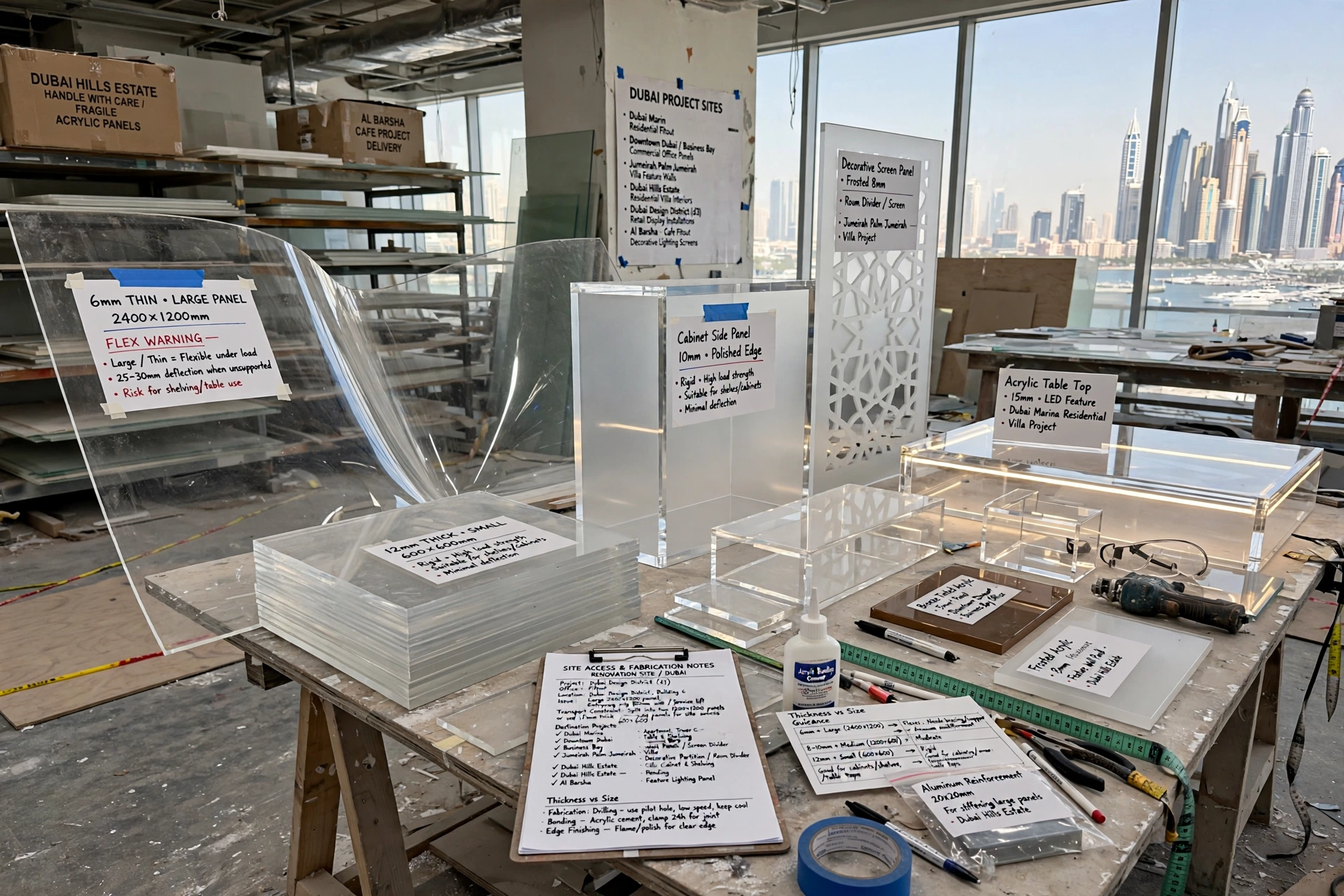
Consider Acrylic Thickness Alongside Sheet Size
Sheet size and thickness should never be considered separately.
A large thin sheet may behave very differently from a smaller thick panel.
Thickness influences:
- Rigidity
- Weight
- Flexibility
- Impact resistance
- Machining
- Bending
- Structural support
- Appearance
For example, a large acrylic partition may require greater thickness or additional framing depending on its application.
A small decorative component may work perfectly with a thinner sheet.
The correct thickness depends on how the finished component will be used and supported.
Clear Acrylic Sheet Size Selection
Clear acrylic is frequently chosen when transparency and visual clarity are important.
It can be used for:
- Display cases
- Shelves
- Protective screens
- Architectural panels
- Signage
- Retail displays
- Lightboxes
- Decorative installations
With clear acrylic, edge quality can be particularly noticeable.
If a large panel will have exposed edges, the cutting and finishing process should be considered before deciding on the sheet dimensions.
A well-planned sheet can minimize unnecessary joints and create cleaner finished edges.
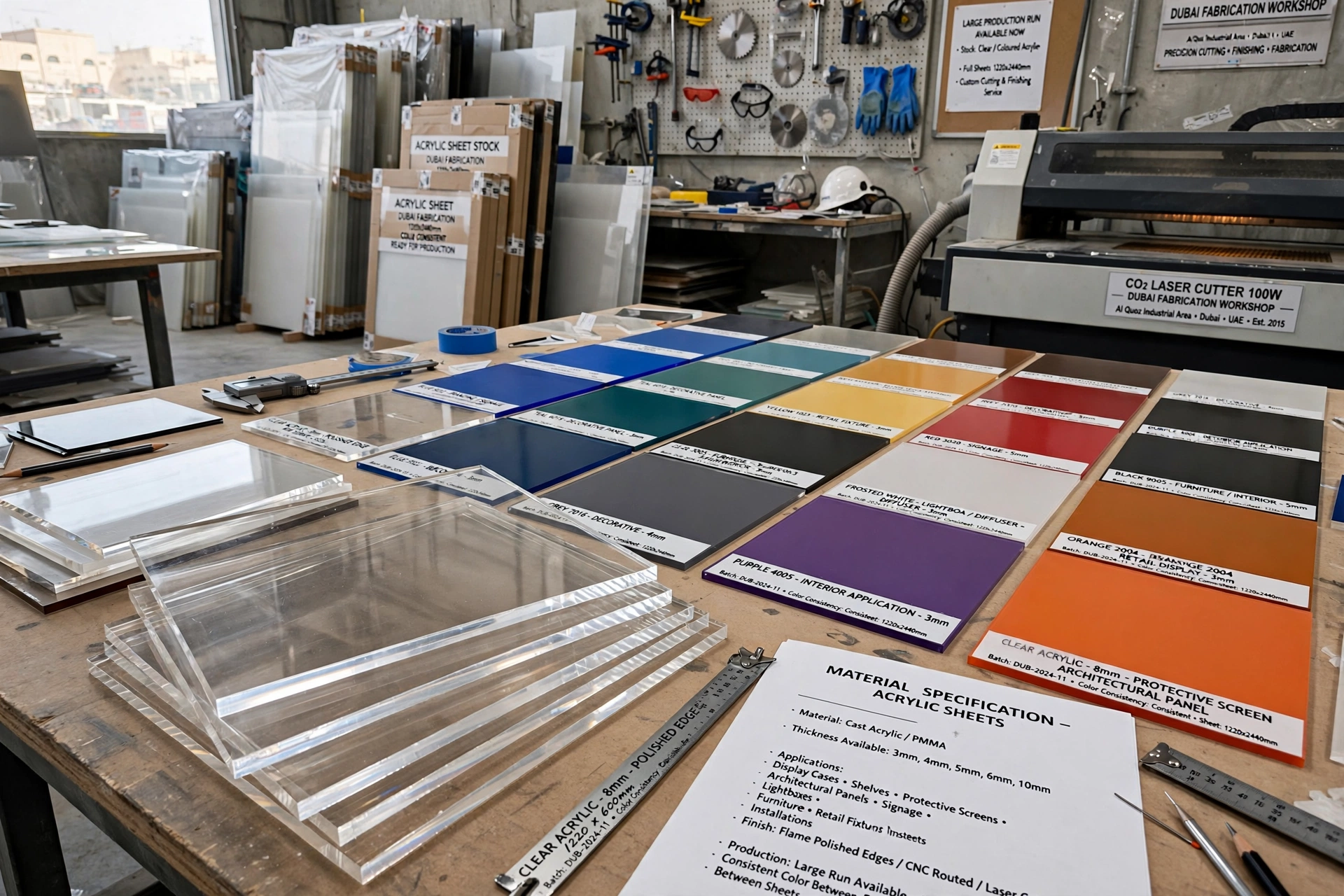
Coloured Acrylic Sheet Size Selection
Coloured acrylic is available in many shades and finishes.
It can be used for branding, signage, decorative panels, furniture, retail fixtures, and interior applications.
For coloured acrylic, the sheet size should be selected according to the number and dimensions of components required.
When producing branded elements, colour consistency between sheets can also be important.
The supplier should confirm the material specification and availability before a large production run.
Translucent and Frosted Acrylic
Translucent and frosted acrylic can be used when light diffusion or privacy is required.
These materials are often found in:
- Lightboxes
- Decorative partitions
- Lighting features
- Privacy screens
- Interior panels
- Retail installations
For illuminated applications, the sheet dimensions need to account for the complete lightbox or lighting assembly rather than the acrylic panel alone.
The positioning of LEDs, frame dimensions, ventilation, and access for maintenance can all affect the final panel size.
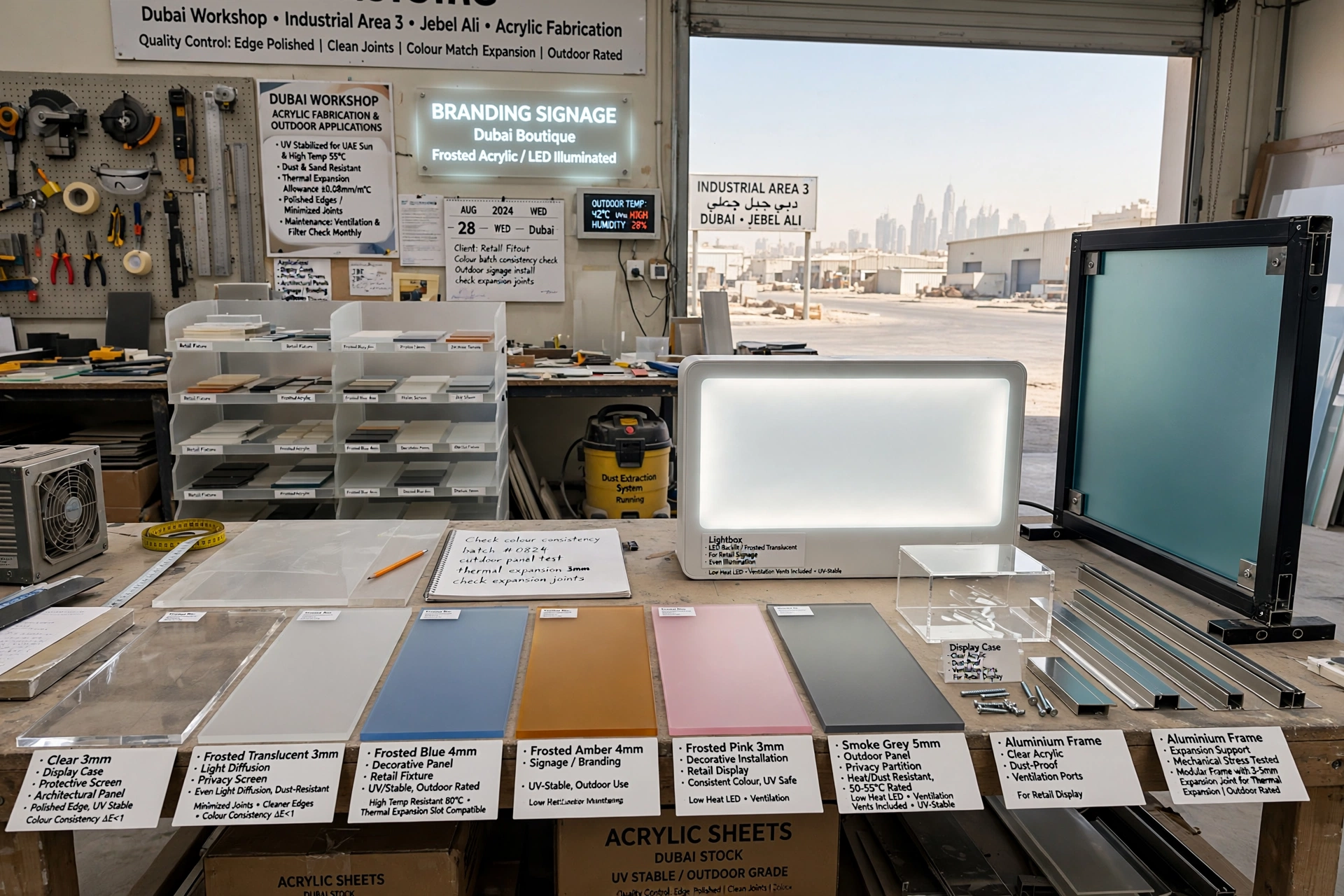
Acrylic Sheet Size for Outdoor Applications
Outdoor acrylic applications require additional consideration.
Acrylic can be used for exterior signage, display elements, protective panels, and architectural applications, but the complete system must be designed according to environmental exposure.
In the UAE, high temperatures, intense sunlight, dust, and outdoor conditions can influence material selection and installation.
Large exterior panels may also experience greater movement and mechanical stress.
Mounting, framing, fixing points, expansion considerations, and support should therefore be evaluated along with sheet dimensions.
Consider Transportation Before Ordering Large Sheets
One of the most overlooked factors in acrylic sheet selection is transportation.
A large sheet may fit the design perfectly but present logistical problems.
Consider:
- Delivery vehicle
- Loading area
- Building entrance
- Lift dimensions
- Staircases
- Corridors
- Door openings
- Installation location
- Number of workers required
This is especially important for projects in high-rise buildings across Dubai Marina, Downtown Dubai, Jumeirah, Business Bay, and other dense urban areas.
Sometimes using two smaller panels is more practical than transporting one extremely large panel.
Consider Elevator and Door Dimensions
Before ordering a large acrylic sheet for an interior project, measure the access route.
The sheet must be able to enter the building and reach the installation area.
Important measurements include:
- Entrance door width
- Door height
- Elevator width
- Elevator depth
- Elevator door opening
- Corridor width
- Staircase dimensions
- Turning points
This simple check can prevent expensive fabrication and delivery problems.
How Sheet Size Affects Material Waste
Acrylic is a valuable fabrication material, so minimizing unnecessary waste can improve project efficiency.
Waste can occur because of:
- Poor nesting
- Incorrect measurements
- Incorrect orientation
- Excessive cutting margins
- Design changes
- Damaged panels
- Incorrect sheet selection
A professional cutting plan can arrange components efficiently and identify how many sheets are actually required.
This is particularly useful for projects involving repeated components.
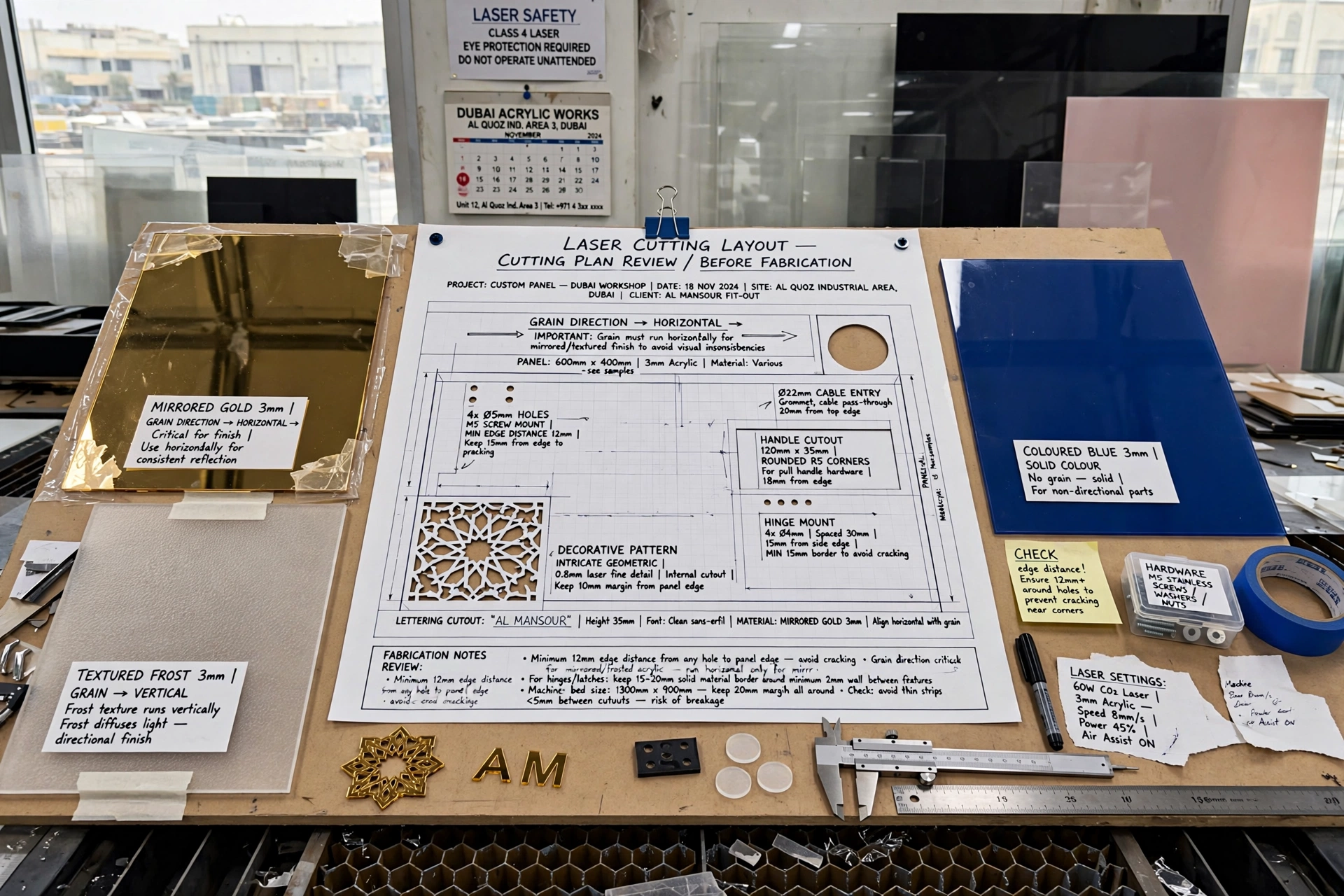
Sheet Orientation Matters
Acrylic sheets may need to be oriented in a particular direction depending on the design, finish, grain-like textures, surface patterns, or manufacturing characteristics.
For standard clear acrylic, orientation may be less visually significant.
For textured, mirrored, coloured, or specialty acrylic, orientation can affect the final appearance.
The cutting layout should therefore be reviewed before fabrication begins.
Allow for Holes and Cut-Outs
Acrylic projects frequently require holes for screws, fittings, cables, handles, hinges, or mounting hardware.
These features must be included in the design before the sheet is cut.
The location of each hole should consider edge distance and the intended fixing method.
Poorly positioned holes can weaken a panel or create cracking.
For large panels, the relationship between cut-outs and the surrounding material becomes particularly important.
Acrylic Sheet Size for Laser Cutting
Laser cutting is particularly useful when the design contains intricate shapes.
The sheet should be large enough to accommodate the complete cutting layout while leaving appropriate margins.
Laser cutting can produce:
- Letters
- Logos
- Decorative patterns
- Small components
- Internal cut-outs
- Custom shapes
The maximum workable dimensions depend on the laser equipment.
Therefore, the available machine bed size should be considered before choosing a sheet format for a large project.
Acrylic Sheet Size for CNC Cutting
CNC routers can process larger components and are particularly useful for thick acrylic.
When planning CNC fabrication, consider the machine’s working area.
A sheet may need to be divided into sections if it exceeds the available cutting bed.
This can introduce joints that may not have been part of the original design.
For large architectural panels, it is therefore useful to discuss machine capabilities before finalizing dimensions.
Acrylic Sheet Size for Saw Cutting
Saw cutting is particularly suitable for large rectangular panels.
It can be efficient for:
- Shelves
- Partitions
- Protective screens
- Display panels
- Flat signage
- Furniture components
When the design consists primarily of straight lines, a saw may provide an efficient fabrication solution.
The final edges can then be sanded or polished depending on the application.
Choosing Between One Large Sheet and Multiple Smaller Sheets
Sometimes one large sheet appears to be the obvious choice.
However, multiple smaller sheets can provide practical advantages.
Smaller panels may be easier to:
- Transport
- Store
- Handle
- Install
- Replace
- Protect during delivery
The decision should consider both fabrication efficiency and installation requirements.
For a large wall installation, for example, fewer joints may create a cleaner visual result.
For a modular retail display, multiple smaller panels may be more convenient.
How to Calculate Acrylic Sheet Requirements
A basic calculation begins with the required component dimensions.
For example, if a project requires ten panels measuring 600 × 400 mm, the total theoretical area can be calculated.
However, the actual sheet requirement will be higher because components cannot always be arranged perfectly without waste.
Cutting paths, spacing, sheet edges, orientation, and unusable offcuts all need to be considered.
For this reason, professional nesting software or fabrication planning can provide a more accurate material estimate.
Don’t Choose a Sheet Based Only on Price
The cheapest sheet is not necessarily the most economical option.
A low-cost panel may create more waste if its dimensions do not suit the project.
Similarly, purchasing a very large sheet may increase handling and storage costs.
The better approach is to evaluate:
Material cost + cutting efficiency + waste + fabrication + finishing + transportation + installation.
This gives a more realistic understanding of the overall project cost.
Working With an Acrylic Supplier
An experienced acrylic supplier can help identify available sheet dimensions and recommend a practical material format.
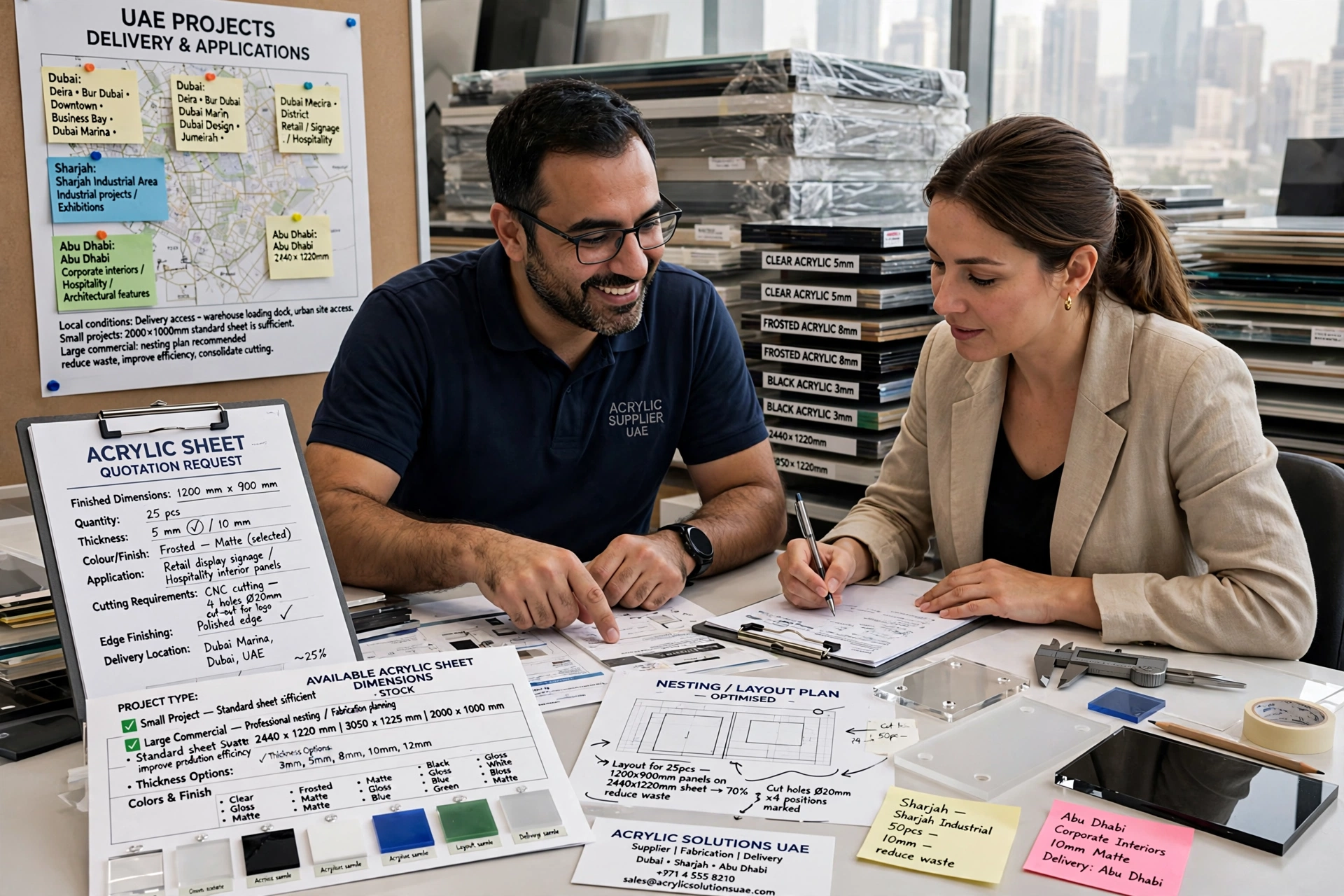
When requesting a quotation, provide as much information as possible.
Include:
- Finished dimensions
- Quantity
- Thickness
- Colour
- Finish
- Application
- Cutting requirements
- Holes or cut-outs
- Edge finishing
- Delivery location
This allows the supplier to recommend a suitable sheet rather than simply quoting a generic panel.
Choosing the Right Acrylic Sheet Size
The Right Acrylic Sheet Size depends on the relationship between the finished component, material thickness, cutting method, quantity, installation environment, and transportation requirements.
For small projects, a standard sheet may be sufficient.
For large commercial projects, professional nesting and fabrication planning can significantly reduce material waste and improve production efficiency.
The correct sheet should provide enough material for the finished component without creating unnecessary offcuts or logistical problems.
Acrylic Sheet Requirements in Dubai, Sharjah and Abu Dhabi
Acrylic fabrication is widely used throughout the UAE for signage, retail, hospitality, exhibitions, interiors, offices, architectural features, and commercial installations.
Dubai projects can range from small retail displays in Deira and Bur Dubai to large commercial installations around Downtown Dubai, Business Bay, Dubai Marina, Jumeirah, and Dubai Design District.
Sharjah has strong demand for fabricated acrylic components across industrial, commercial, retail, and signage applications.
Abu Dhabi also uses acrylic for corporate interiors, hospitality, retail, exhibitions, signage, and architectural applications.
Local project conditions can affect the most practical sheet size, particularly when delivery access and installation logistics are complicated.
Frequently Asked Questions
What is the best acrylic sheet size?
There is no single best size. The appropriate size depends on the finished dimensions, cutting layout, thickness, application, quantity, transportation, and installation requirements.
Should I buy a larger acrylic sheet than I need?
A larger sheet can be useful when multiple components need to be cut from the same panel, but excessive size can increase waste, handling difficulty, and transportation requirements.
How do I reduce acrylic sheet waste?
Plan the cutting layout before purchasing material. Arrange components efficiently, consider sheet orientation, and select dimensions that allow multiple pieces to fit together effectively.
Does acrylic thickness affect sheet size?
Yes. Thickness affects weight, rigidity, handling, machining, and installation. Large panels may require a thicker material or additional structural support depending on their application.
Can large acrylic sheets be used for partitions?
Yes, but the panel dimensions, thickness, support, fixing system, transportation route, and installation conditions should all be considered.
Is clear acrylic available in large sheets?
Large clear acrylic panels are available, although exact dimensions depend on the manufacturer, thickness, material type, and local stock.
What information should I give an acrylic supplier?
Provide the required finished dimensions, quantity, thickness, colour, finish, cutting requirements, holes or cut-outs, edge finishing requirements, and delivery location.
Conclusion
Choosing an acrylic sheet is not simply a matter of selecting the biggest available panel. The most suitable size is determined by the complete fabrication and installation process.
Start with the finished dimensions, then consider the required thickness, cutting method, number of components, nesting efficiency, edge finishing, transportation, building access, and installation requirements.
For complex commercial projects, professional fabrication planning can help reduce material waste while ensuring that every component can be produced and installed efficiently.
Whether the project involves a retail display in Dubai Marina, an architectural panel in Downtown Dubai, signage in Deira, an office installation in Business Bay, or a custom interior feature in Abu Dhabi or Sharjah, careful sheet-size selection can improve both the appearance and practicality of the finished acrylic product.