
Blogs
How Acrylic Sheets Are Used to Make 3D Letters: A Complete Guide for Qatar

Walk through the commercial streets of Doha, visit a shopping mall in Lusail or look at the entrance of a modern office building in West Bay, and you will notice one thing: businesses are paying more attention to how their signs look.
A good business sign does more than display a company name. It helps customers recognise a brand, makes a shop easier to find and gives a business a professional appearance. This is one reason 3D lettering has become a popular choice for retail shops, restaurants, hotels, offices and commercial buildings across Qatar.
One of the most widely used materials for making 3D letters is acrylic.
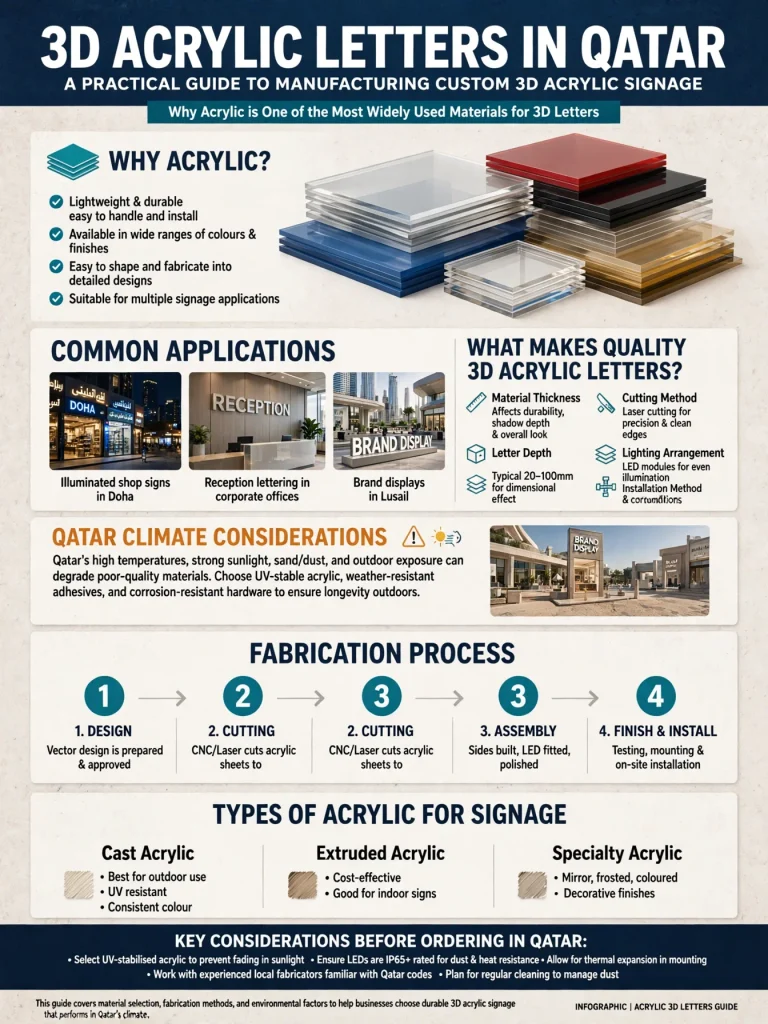
Acrylic sheets are popular because they are lightweight, available in different colours, easy to shape and suitable for several signage applications. They can be cut into detailed letters, combined with LED lighting and fitted with different materials to create attractive three-dimensional signs.
From illuminated shop signs in Doha to reception lettering in corporate offices and brand displays in Lusail, acrylic offers sign makers plenty of design options.
However, producing good-quality 3D acrylic letters involves more than cutting a sheet into the shape of a word. The material thickness, cutting method, letter depth, side construction, lighting arrangement and installation method all affect the final result.
Qatar’s climate also needs to be considered. High temperatures, strong sunlight, dust and outdoor exposure can affect the performance of signage materials if they are not selected correctly.
In this guide, we explain how acrylic sheets supplier in Qatar are used to manufacture 3D letters, which acrylic types are suitable, how fabrication works and what businesses in Qatar should consider before ordering custom signage.
What Are 3D Acrylic Letters?
3D acrylic letters are raised letters manufactured using acrylic sheets and other supporting materials. Unlike flat printed signs, these letters have depth and stand away from the background surface.
They are commonly used for company names, shop signs, building signage, reception logos, hotel branding, restaurant signs and illuminated advertising displays.
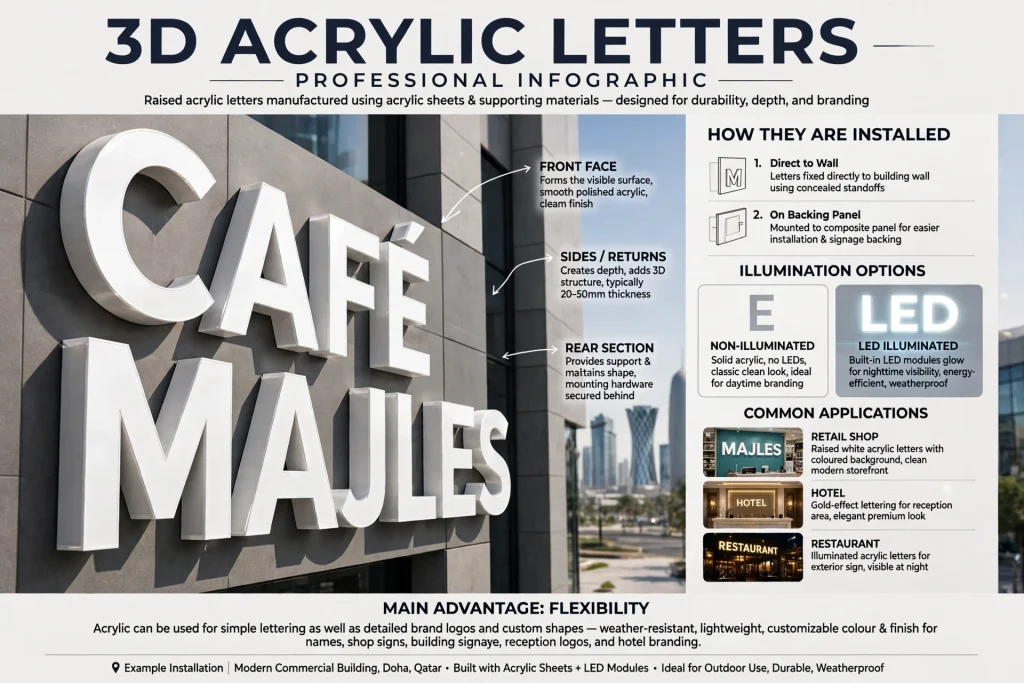
A typical 3D acrylic letter consists of several parts.
The front face forms the visible surface of the letter. The sides, also called returns, create its depth. The rear section provides support and helps the letter maintain its shape.
Depending on the design, the letters may be fixed directly to a wall or installed on a backing panel.
Some acrylic letters are non-illuminated, while others contain LED modules to produce a glowing effect.
A close-up of professionally fabricated 3D acrylic letters with polished edges installed on a modern commercial building in Doha.
For example, a retail shop may use raised white acrylic letters with a coloured background. A hotel may choose gold-effect lettering for its reception area, while a restaurant may use illuminated acrylic letters to make its exterior sign visible at night.
The main advantage is flexibility. Acrylic can be used for simple lettering as well as detailed brand logos and custom shapes.
Why Acrylic Sheets Are Used for 3D Letter Manufacturing
Acrylic is widely used in the signage industry because it offers a useful balance of appearance, strength, weight and workability.
It is also known as PMMA, which stands for polymethyl methacrylate. In the sign-making industry, it is often called acrylic glass or Perspex, although Perspex is a brand name rather than the general name for every acrylic product.
Compared with ordinary glass, acrylic is lighter and easier to cut into custom shapes. It is available in different colours, thicknesses, finishes and levels of transparency.
Here are some reasons sign makers use acrylic for three-dimensional lettering.
1. Lightweight Construction
Weight matters when installing signs on shopfronts, building walls and indoor reception areas.
Acrylic is considerably lighter than glass, making it easier to handle during fabrication and installation.
Lightweight letters can also reduce the load on the supporting structure, although the complete sign weight, fixing system and wall material must always be checked.
This is useful for businesses in Qatar that need large company names or decorative lettering on commercial building entrances.
2. Available in Different Colours
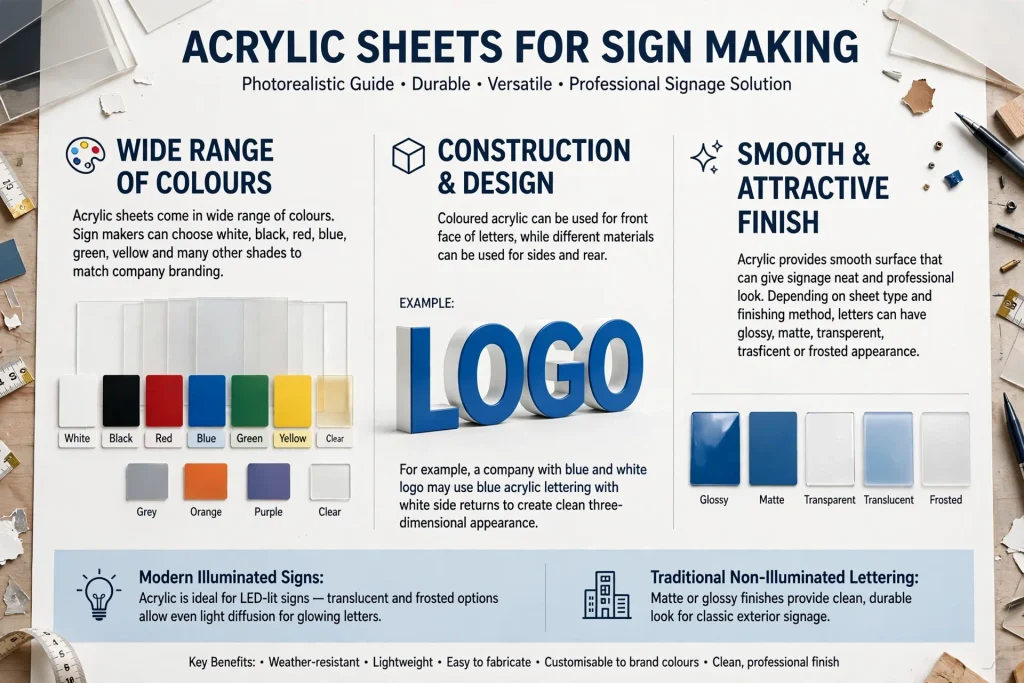
Acrylic sheets come in a wide range of colours.
Sign makers can choose white, black, red, blue, green, yellow and many other shades to match a company’s branding.
Coloured acrylic can be used for the front face of the letters, while different materials can be used for the sides and rear.
For example, a company with a blue and white logo may use blue acrylic lettering with white side returns to create a clean three-dimensional appearance.
3. Smooth and Attractive Finish
Acrylic provides a smooth surface that can give signage a neat and professional look.
Depending on the sheet type and finishing method, letters can have a glossy, matte, transparent, translucent or frosted appearance.
This makes acrylic suitable for both modern illuminated signs and traditional non-illuminated lettering.
4. Easy to Cut into Different Shapes
Acrylic sheets can be processed using CNC routers, laser cutting machines and other suitable fabrication equipment.
This makes it possible to create detailed letters, curved shapes, logos and decorative brand elements.
A sign maker can reproduce different typefaces and custom logo designs without relying only on standard lettering sizes.
5. Suitable for LED Illumination
Certain acrylic sheets are designed to transmit and diffuse light.
These materials are commonly used for front-lit and backlit signage.
For example, translucent white acrylic can be used as the front face of an illuminated 3D letter. LED modules fitted inside the letter illuminate the face, making the sign visible after dark.
The correct acrylic type is important because ordinary opaque sheets will not provide the same light transmission.
6. Suitable for Indoor and Outdoor Signage
Acrylic is used in both indoor and outdoor signage.
It can be suitable for exterior applications when the correct grade, thickness, colour, fixing method and UV performance are selected.
For outdoor signs in Qatar, the fabricator should also consider heat exposure, direct sunlight, dust and thermal expansion.
The material should be selected according to the actual installation conditions rather than appearance alone.
Different Types of Acrylic Sheets Used for 3D Letters
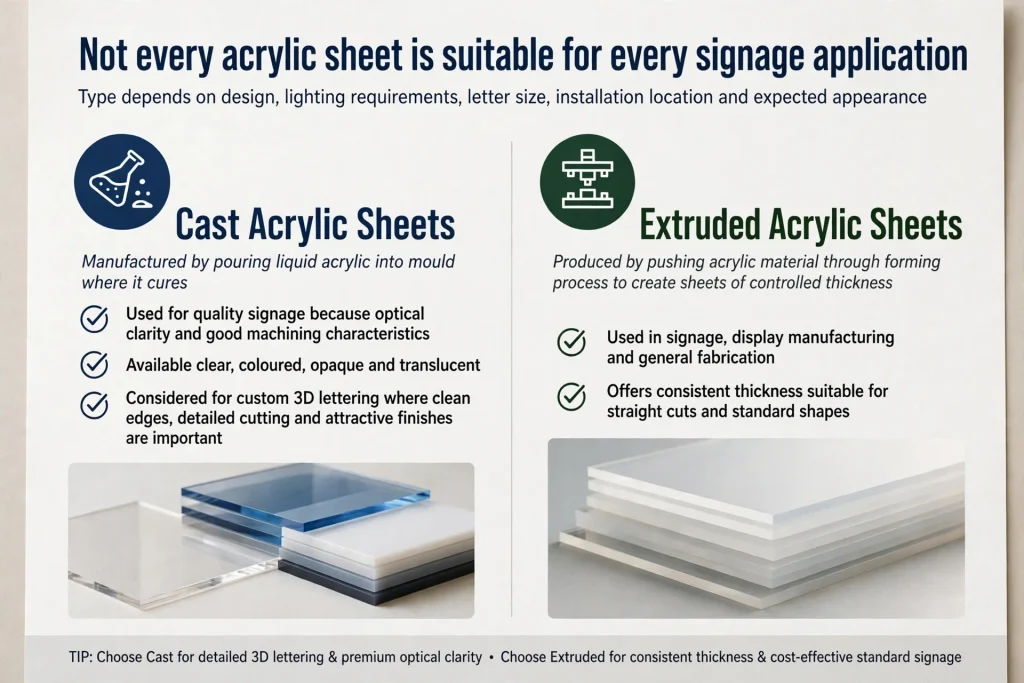
Not every acrylic sheet is suitable for every signage application.
The type of sheet used depends on the design, lighting requirements, letter size, installation location and expected appearance.
Understanding the main acrylic options helps businesses choose the right material for their signs.
Cast Acrylic Sheets
Cast acrylic is manufactured by pouring liquid acrylic material into a mould, where it is allowed to cure.
It is commonly used for quality signage and fabrication work because of its optical clarity and good machining characteristics.
Cast acrylic is available in clear, coloured, opaque and translucent options.
It is often considered for custom 3D lettering where clean edges, detailed cutting and attractive surface finishes are important.
Extruded Acrylic Sheets
Extruded acrylic is produced by pushing acrylic material through a forming process to create sheets of a controlled thickness.
It is commonly used in signage, display manufacturing and general fabrication.
Extruded acrylic can offer consistent thickness and is often suitable for applications involving straight cuts and standard shapes.
The choice between cast and extruded acrylic should depend on the fabrication process and the manufacturer’s recommendations.
Transparent Acrylic Sheets
Transparent acrylic allows light to pass through and is often used for decorative signs, layered lettering and special lighting effects.
It can also be used with printed graphics or coloured backing materials.
However, clear acrylic does not automatically provide an illuminated appearance. The lighting arrangement and the design of the complete letter determine the final effect.
Opaque Coloured Acrylic Sheets
Opaque acrylic sheets are available in different solid colours.
They are commonly used for non-illuminated letters and signs where the main requirement is a particular brand colour or surface appearance.
For example, black, white, red and blue acrylic can be used to manufacture raised company names for office reception walls and retail interiors.
Translucent Acrylic Sheets
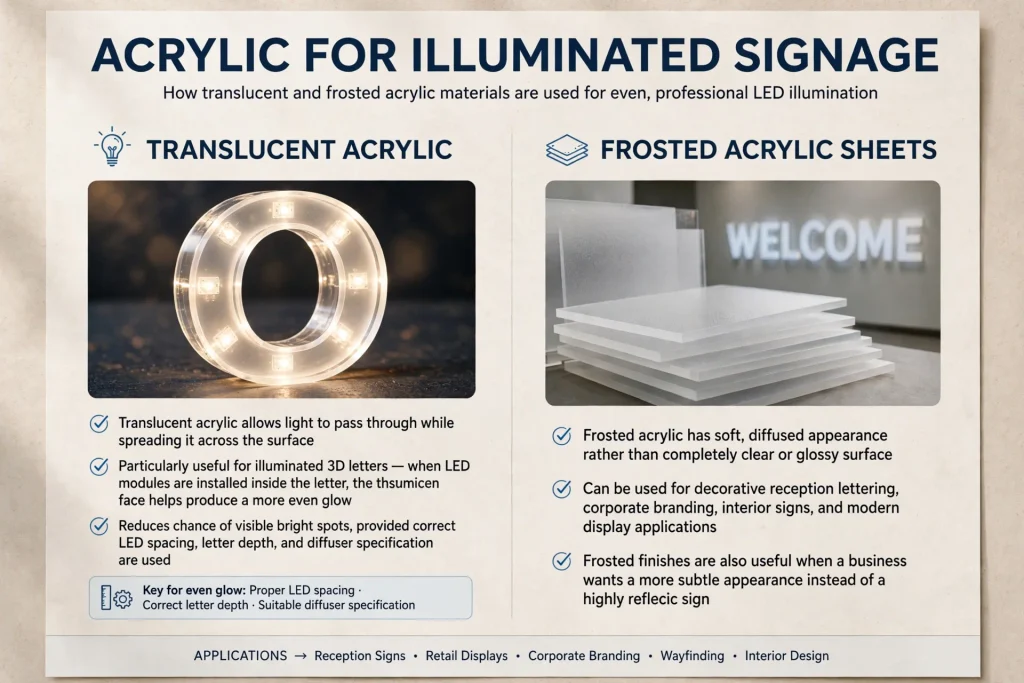
Translucent acrylic allows light to pass through while spreading it across the surface.
It is particularly useful for illuminated 3D letters.
When LED modules are installed inside the letter, the translucent face helps produce a more even glow.
This reduces the chance of visible bright spots, provided the correct LED spacing, letter depth and diffuser specification are used.
Frosted Acrylic Sheets
Frosted acrylic has a soft, diffused appearance rather than a completely clear or glossy surface.
It can be used for decorative reception lettering, corporate branding, interior signs and modern display applications.
Frosted finishes are also useful when a business wants a more subtle appearance instead of a highly reflective sign.
How Acrylic Sheets Are Used to Manufacture 3D Letters
The production of 3D acrylic letters involves several stages. Each stage has an effect on the appearance, accuracy and durability of the finished sign.
A professional sign maker normally starts with the customer’s artwork and then prepares the design for cutting and assembly.
Step 1: Preparing the Letter Design
The first step is preparing the company name, logo or lettering design.
The artwork is normally supplied in a vector format such as AI, EPS, SVG or a suitable PDF.
Vector artwork is useful because it allows the sign maker to scale the design without losing the quality of the outlines.
The fabricator checks the letter dimensions, font style, spacing and overall proportions.
For example, a company may need its name manufactured as 500 mm-high letters for an exterior shop sign. The artwork must be prepared at the correct size before cutting.
At this stage, the sign maker also decides whether the letters will be illuminated or non-illuminated.
Step 2: Selecting the Acrylic Thickness
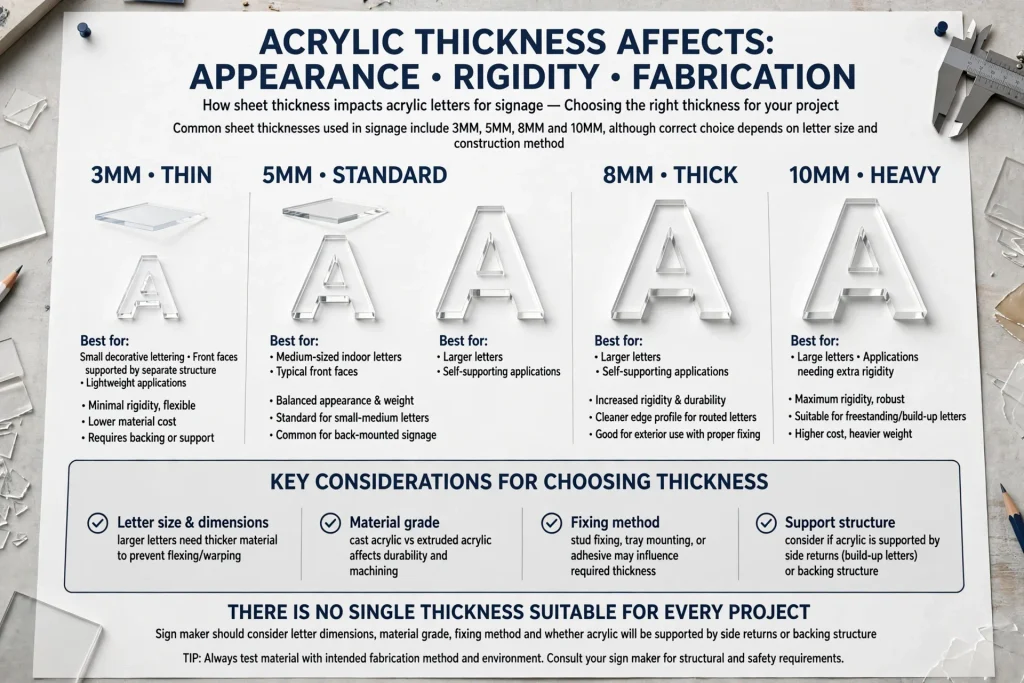
Acrylic thickness affects the appearance, rigidity and fabrication requirements of the letters.
Common sheet thicknesses used in signage include 3 mm, 5 mm, 8 mm and 10 mm, although the correct choice depends on the letter size and construction method.
Thinner sheets may be suitable for smaller decorative lettering or front faces supported by a separate structure.
Thicker sheets may be considered for larger letters or applications where additional rigidity is needed.
There is no single thickness suitable for every project.
A sign maker should consider the letter dimensions, material grade, fixing method and whether the acrylic will be supported by side returns or a backing structure.
Step 3: Cutting Acrylic Sheets
Industrial CNC laser cutting machine cutting custom acrylic letters from a coloured acrylic sheet in a professional sign manufacturing workshop.
Once the artwork and material have been approved, the acrylic sheet is prepared for cutting.
There are several methods used to manufacture acrylic letters.
Laser cutting uses a focused laser beam to cut acrylic into detailed shapes. It is useful for intricate lettering and small design features. The correct machine settings and material type are important to achieve clean edges.
CNC routing uses a computer-controlled cutting tool to remove material from the acrylic sheet. It is suitable for larger letters, thicker sheets and different fabrication requirements.
Mechanical cutting may also be used for straight cuts and certain simpler fabrication tasks.
The cutting method depends on the material thickness, required accuracy, letter size and production equipment.
After cutting, the letters are checked for correct dimensions and clean edges.
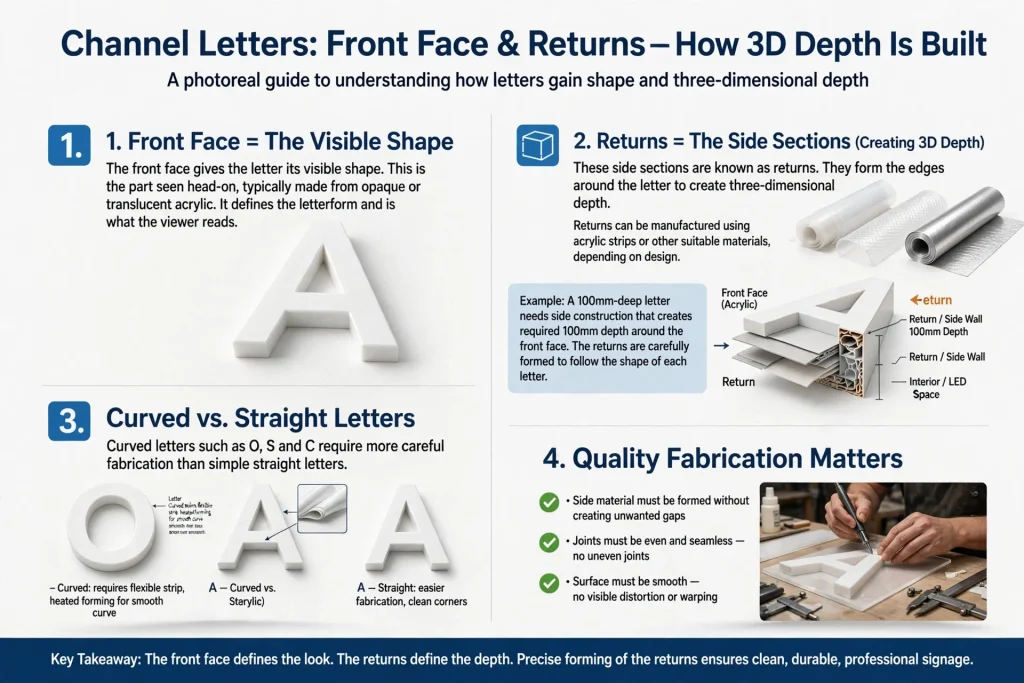
Step 4: Preparing the Letter Returns
The front face gives the letter its visible shape, but the sides create the three-dimensional depth.
These side sections are known as returns.
Returns can be manufactured using acrylic strips or other suitable materials, depending on the design.
For example, a 100 mm-deep letter needs side construction that creates the required depth around the front face.
The returns are carefully formed to follow the shape of each letter.
Curved letters such as O, S and C require more careful fabrication than simple straight letters.
The side material must be formed without creating unwanted gaps, uneven joints or visible distortion.
Step 5: Assembling the Letter
The next stage is joining the front face and side returns.
The fabricator uses a suitable acrylic bonding method or mechanical assembly system according to the design.
The joints should be neat and secure.
Poor bonding can cause visible gaps, weak corners or separation during handling and installation.
For illuminated letters, the construction must also allow sufficient internal space for the lighting components.
The rear section may be made from acrylic, aluminium composite material or another suitable backing material depending on the sign design.
Step 6: Finishing and Polishing
After assembly, the letters are cleaned and inspected.
Cut edges may be polished where required to achieve a smooth appearance.
The surface should be free from unwanted scratches, adhesive marks and dust.
Protective films should be handled carefully during fabrication to reduce the risk of damage.
The final finish depends on the customer’s requirements. Some letters have glossy faces, while others use matte or frosted surfaces.
Step 7: Adding LED Lighting
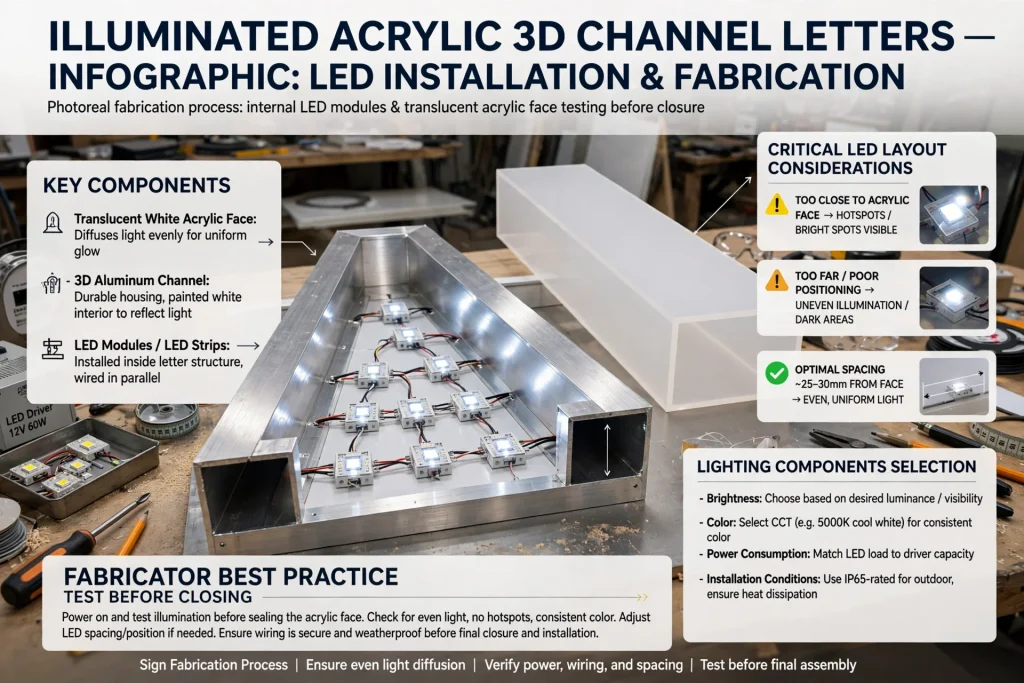
Illuminated acrylic 3D channel letters showing internal LED modules and a translucent white front face during sign fabrication.
If the letters are designed to illuminate, LED modules or suitable LED strips are installed inside the letter structure.
The lighting components must be selected according to the required brightness, colour, power consumption and installation conditions.
The LED layout is important.
If the modules are too close to the acrylic face, bright spots may become visible. If they are too far away or poorly positioned, the illumination may appear uneven.
The fabricator should test the lighting before the letter is closed and prepared for installation.
Step 8: Final Inspection and Installation
The finished letters are checked for dimensions, surface quality, lighting performance and structural condition.
The sign maker then prepares the fixing system.
Depending on the project, the letters may be installed using studs, spacers, suitable adhesives, brackets or a backing panel.
The installation method must match the wall material and the total weight of the sign.
For outdoor signs, the installer should also consider wind loading, exposure to heat and the need for suitable electrical protection.
Front-Lit, Back-Lit and Halo-Lit Acrylic Letters
Lighting design changes the appearance of 3D acrylic letters.
There are three common illumination styles used in commercial signage.
Front-Lit Acrylic Letters
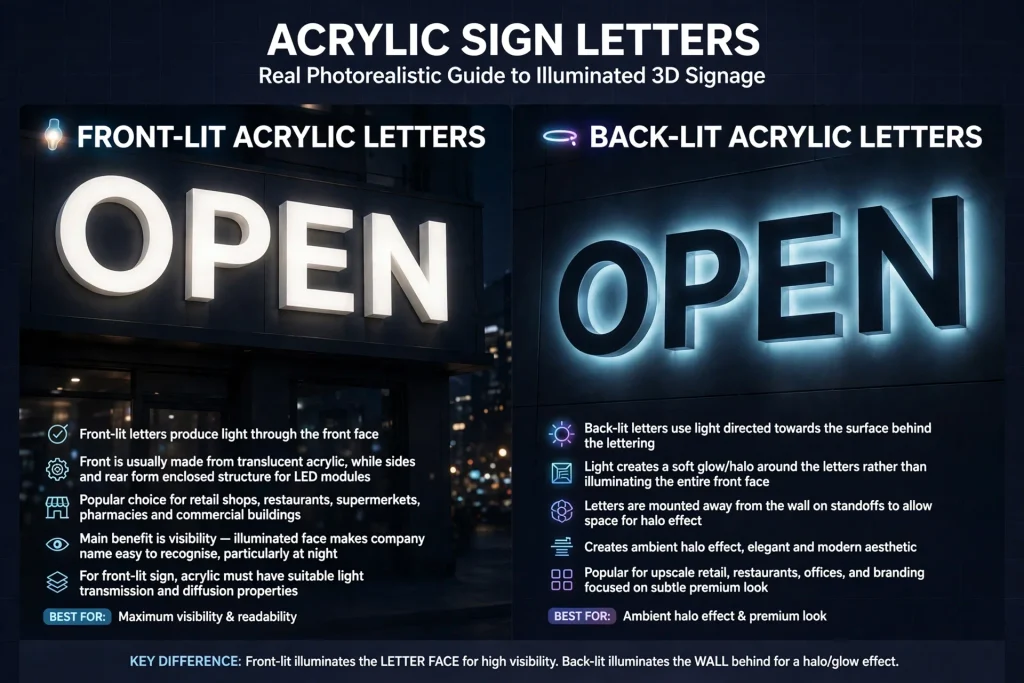
Bright front-lit 3D acrylic shop sign letters with evenly illuminated white faces at night.
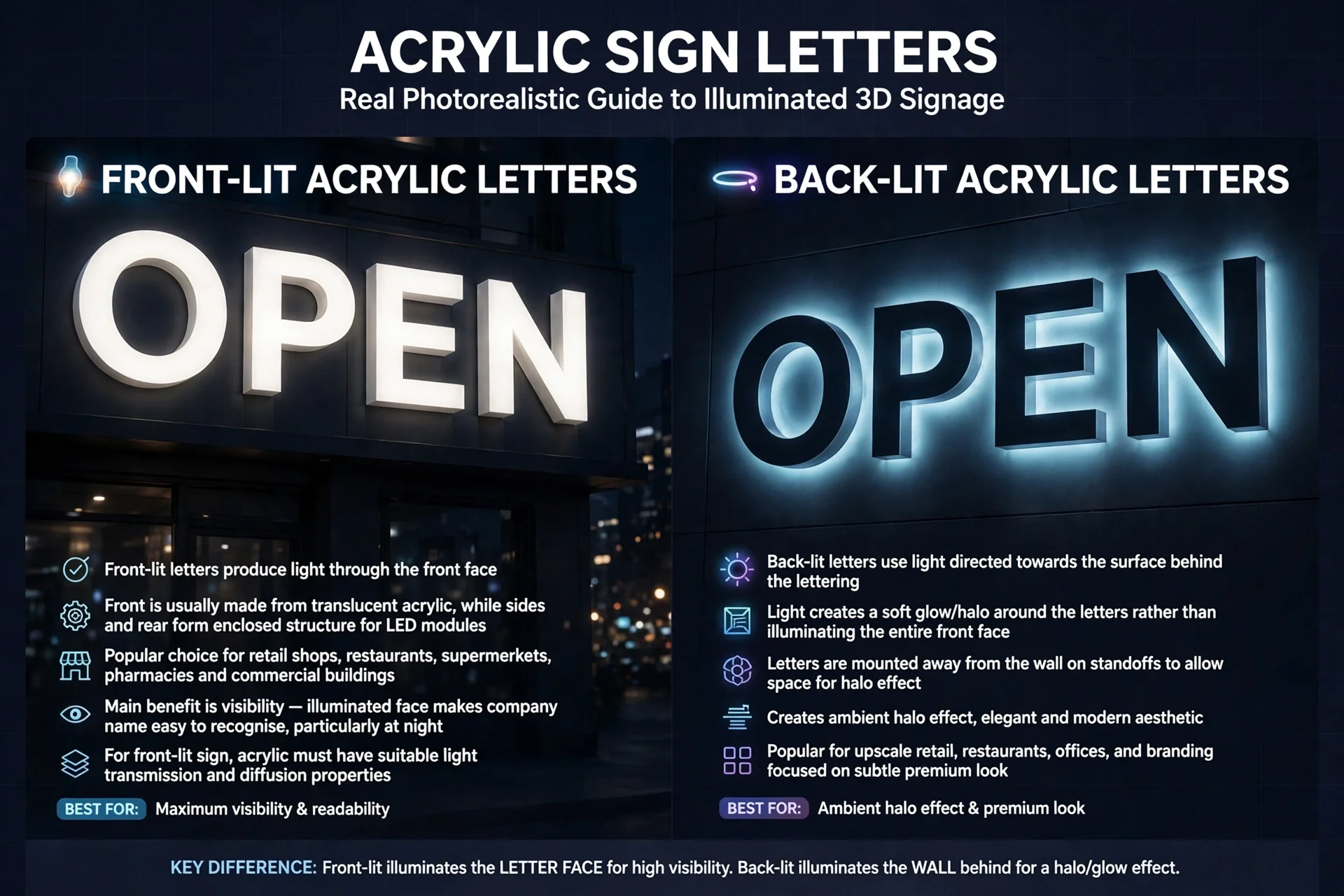
Front-lit letters produce light through the front face of the letter.
The front is usually made from translucent acrylic, while the sides and rear form an enclosed structure for the LED modules.
This is a popular choice for retail shops, restaurants, supermarkets, pharmacies and commercial buildings.
The main benefit is visibility. The illuminated face makes the company name easy to recognise, particularly at night.
For a front-lit sign, the acrylic must have suitable light transmission and diffusion properties.
Back-Lit Acrylic Letters
Backlit three-dimensional acrylic letters mounted away from a wall with soft light illuminating the background.</image_placeholder>
Back-lit letters use light directed towards the surface behind the lettering.
The light creates a glow around the letters rather than illuminating the entire front face.
This style is often used in offices, hotels, reception areas and premium retail interiors.
It can create a clean and elegant appearance.
The mounting distance between the letters and the background affects the final lighting effect.
Halo-Lit Letters
Halo-lit lettering is a popular form of backlit signage.
LED modules are fitted inside the letter structure and direct light towards the wall behind the letters.
The result is a soft outline or halo around each letter.
It works particularly well with metallic-looking, opaque or solid-colour front faces.
Acrylic can be used in different parts of the construction, depending on the design and desired lighting effect.
Combination Lighting
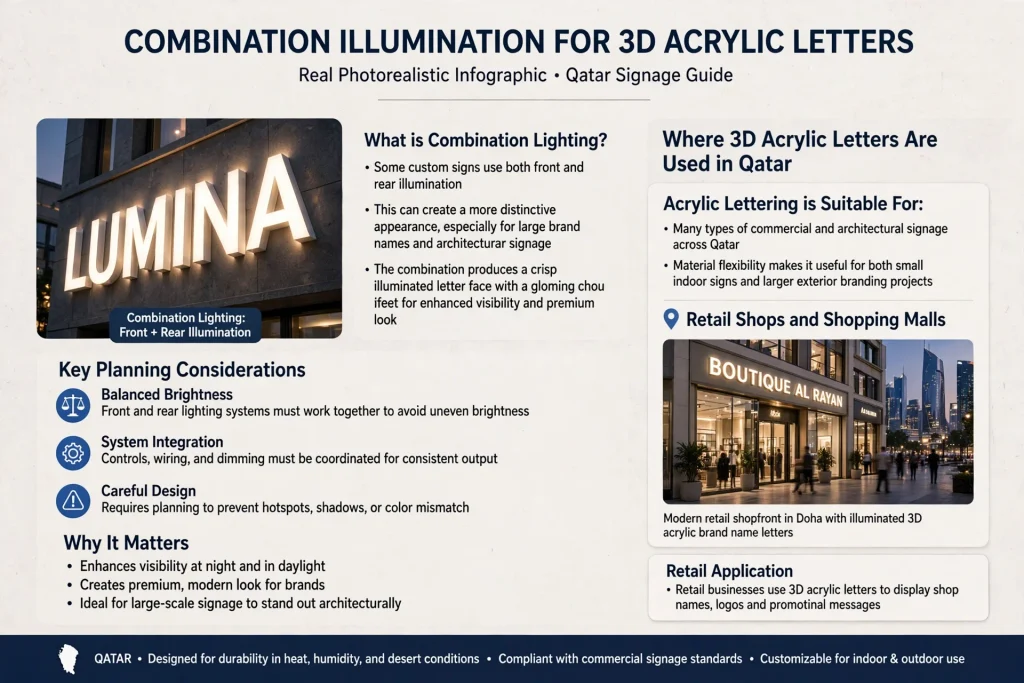
Some custom signs use both front and rear illumination.
This can create a more distinctive appearance, especially for large brand names and architectural signage.
However, combination lighting requires careful planning because the front and rear lighting systems must work together without creating uneven brightness.
Where 3D Acrylic Letters Are Used in Qatar
Acrylic lettering is suitable for many types of commercial and architectural signage across Qatar.
The material’s flexibility makes it useful for both small indoor signs and larger exterior branding projects.
Retail Shops and Shopping Malls
Modern retail shopfront in Doha with illuminated 3D acrylic brand name letters.
Retail businesses use 3D acrylic letters to display shop names, logos and promotional messages.
Shopping destinations such as Place Vendôme in Lusail, Doha Festival City and Villaggio Mall contain many different retail environments where professional branding plays an important role.
Acrylic letters can be installed above shop entrances, on feature walls and behind retail counters.
Coloured and illuminated lettering helps businesses maintain consistent brand presentation.
Restaurants and Cafes
Restaurants and cafes use acrylic letters for exterior signs, menu displays and interior branding.
A coffee shop may choose warm white halo-lit lettering, while a fast-food restaurant may use bright coloured front-lit letters.
In busy commercial areas of Doha, attractive signage can help customers recognise a business from a distance.
For exterior restaurant signage, the acrylic grade, fixing system and LED components should be suitable for outdoor exposure.
Hotels and Hospitality Businesses
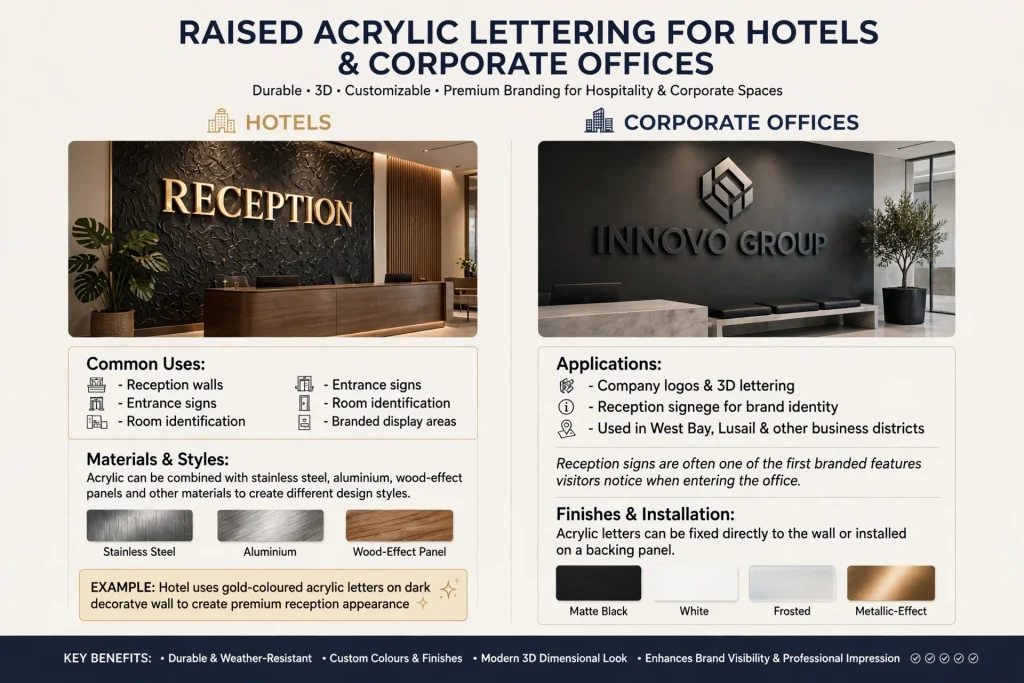
Hotels often use raised lettering for reception walls, entrance signs, room identification and branded display areas.
Acrylic can be combined with stainless steel, aluminium, wood-effect panels and other materials to achieve different design styles.
For example, a hotel may use gold-coloured acrylic letters on a dark decorative wall to create a premium reception appearance.
Corporate Offices
Corporate office reception wall featuring raised acrylic company logo and three-dimensional lettering.</image_placeholder>
Corporate offices in West Bay, Lusail and other business districts use 3D lettering to display company names and logos.
Reception signs are often one of the first branded features visitors notice when entering an office.
Acrylic letters can be fixed directly to the wall or installed on a backing panel.
Matte black, white, frosted and metallic-effect finishes are common design choices.
Hospitals and Clinics
Healthcare facilities use acrylic lettering for reception signs, department names, room identification and wayfinding.
The material can be manufactured in different colours to support clear identification of departments and services.
For healthcare environments, the surface finish and cleaning compatibility should be considered.
Exhibition Stands and Events
Qatar hosts business exhibitions, trade shows and corporate events throughout the year.
Events at the Doha Exhibition and Convention Center and other exhibition venues often require temporary branded displays.
Lightweight acrylic lettering can be used for exhibition stand names, company logos and product displays.
For temporary installations, the fixing system should allow safe assembly and removal without damaging the display structure.