

Blogs
Trade Show Booth Branding Ideas for Construction Companies

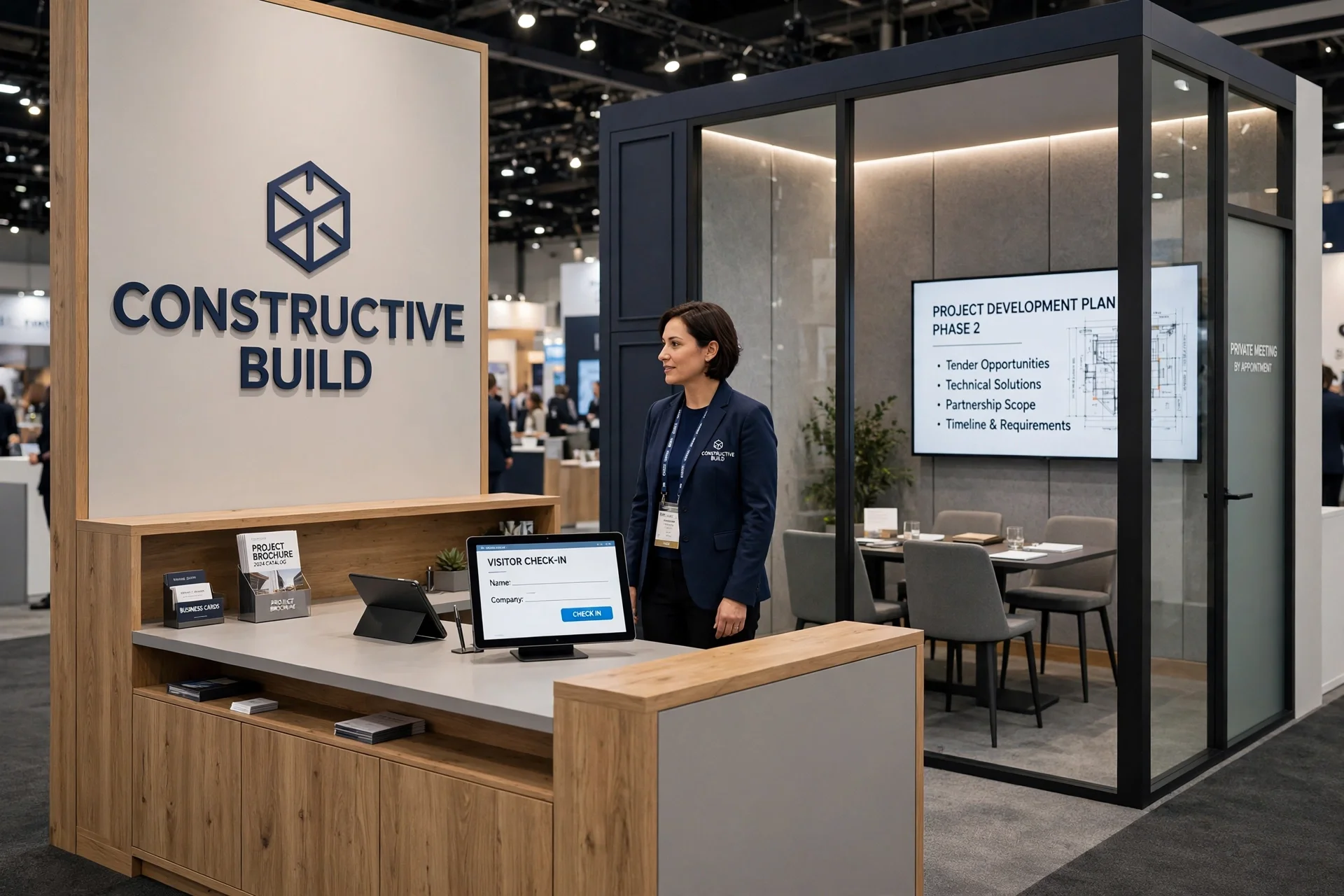
Trade shows give construction companies an opportunity to present their capabilities directly to developers, consultants, architects, engineers, contractors, suppliers and potential clients. However, simply placing a company logo on an exhibition wall is rarely enough to create a memorable presence. A construction trade show booth should communicate expertise, project experience, technical capability and brand identity within seconds.
In the UAE, construction exhibitions attract companies involved in building construction, civil engineering, MEP services, infrastructure, real estate development, architecture, interior fit-out, building materials and construction technology. Events held at venues such as Dubai World Trade Centre and Dubai Exhibition Centre bring together professionals from across the region.
A successful booth therefore needs more than attractive graphics. It should combine architectural branding, clear messaging, project photography, material samples, digital displays, lighting, visitor interaction and an efficient space plan. The objective is to help visitors understand what the company does, why its services matter and how they can start a conversation.
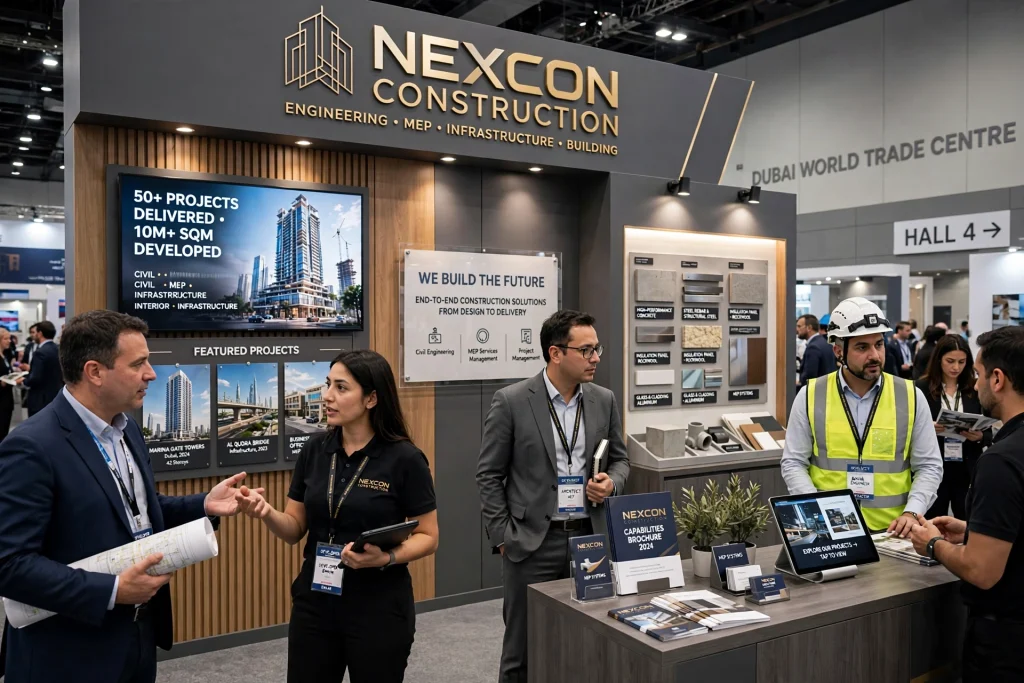
Why Booth Branding Matters for Construction Companies
Construction is a visual industry, but many construction services are difficult to demonstrate physically. A contractor may specialise in structural works, civil engineering, waterproofing, façade installation, MEP contracting, fit-out or infrastructure projects.
An exhibition booth provides a physical environment where these capabilities can be translated into visual communication.
Instead of presenting a long list of services, companies can use project photographs, technical diagrams, material samples and concise messages to demonstrate real capabilities.
Strong booth branding also helps visitors remember a company after the exhibition. A clear visual identity, consistent colour palette, readable signage and focused messaging can make follow-up conversations easier.
Start With a Clear Construction Brand Message
Before selecting booth graphics or furniture, construction companies should establish the main message they want visitors to remember.
A company offering multiple construction services should avoid filling every wall with lengthy descriptions. Instead, the booth can communicate a central proposition such as commercial construction, infrastructure development, MEP contracting, industrial construction, fit-out or specialist engineering.
Supporting messages can then explain individual capabilities.
For example, a construction contractor might structure its booth around:
- Building construction
- Civil engineering
- MEP contracting
- Infrastructure
- Industrial projects
- Fit-out and refurbishment
- Project management
This hierarchy allows visitors to understand the business without reading every piece of text.
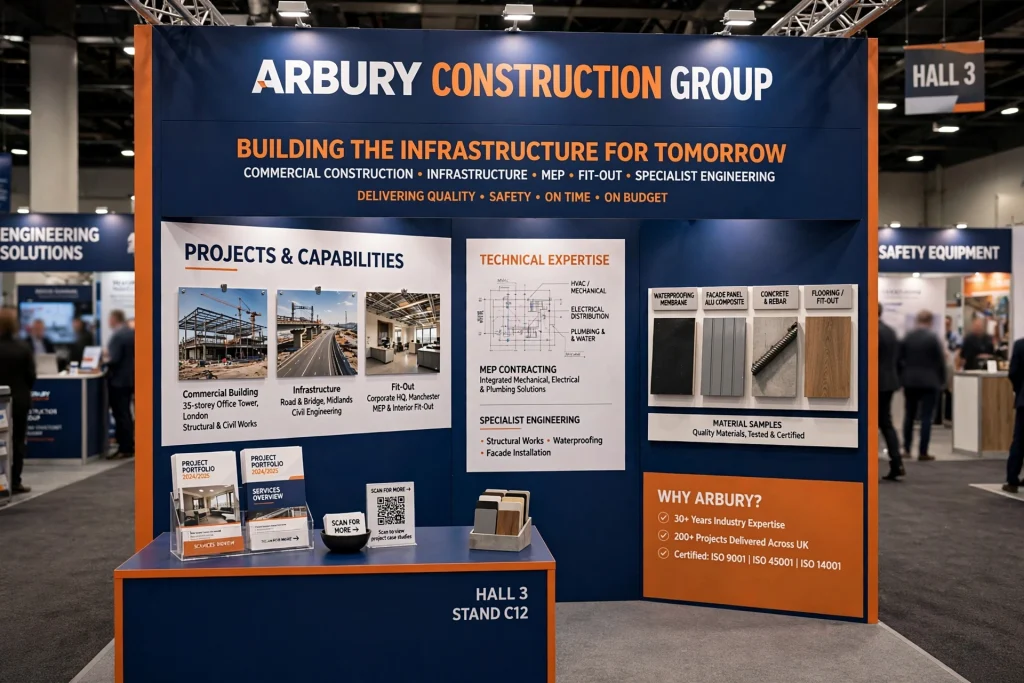
Use Real Construction Project Photography
Construction companies have an advantage over many industries because completed projects can become powerful branding assets.
High-quality photographs of commercial buildings, villas, warehouses, industrial facilities, infrastructure projects, interiors and engineering installations can make an exhibition booth much more credible.
Rather than using generic stock photographs, companies can showcase their actual work whenever permissions allow.
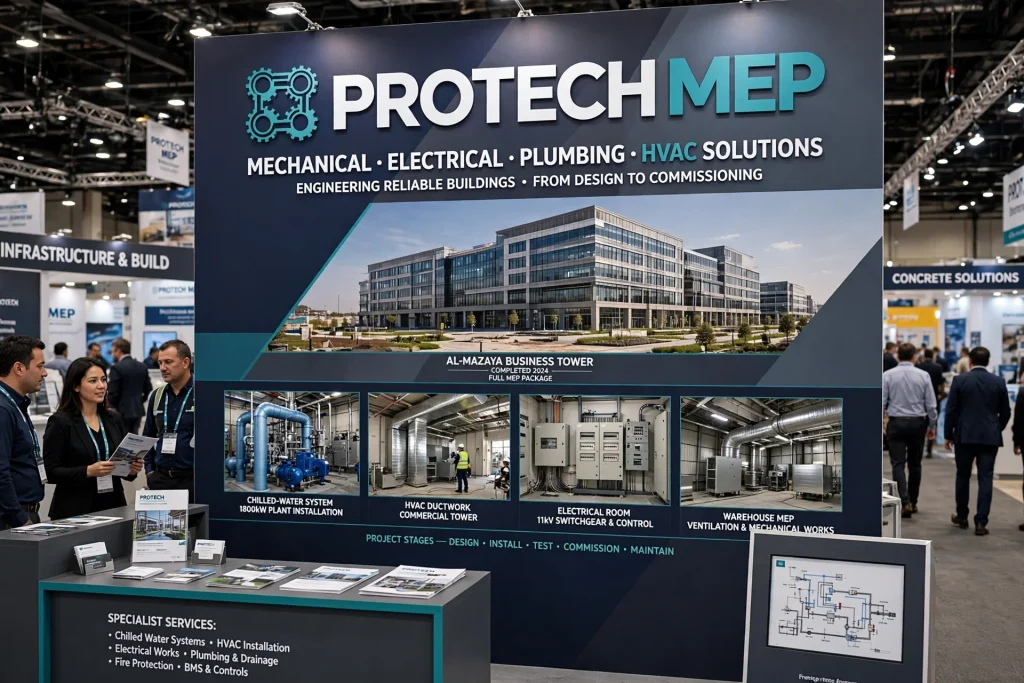
Large project images can be used as back-wall graphics, while smaller images can explain specific project stages or specialist services.
For example, an MEP contractor could display photographs of chilled-water systems, HVAC installations, electrical rooms, ductwork and completed mechanical installations.
Create a Strong Main Back Wall
The main back wall usually becomes one of the most visible branding elements of an exhibition stand.
Construction companies can use this space for their logo, primary message and one strong visual. The design should remain readable from a distance.
A common mistake is placing too much information on the back wall. Visitors walking through a busy exhibition hall generally need to recognise the company before they can decide whether to stop.
A large logo combined with a short service proposition and high-quality project image can often communicate more effectively than several paragraphs of text.
Use Construction Materials as Part of the Booth
Construction companies can make their booth more distinctive by incorporating real materials.
A building materials supplier might display stone, tiles, façade panels, insulation, glass, aluminium profiles or waterproofing systems.
A contractor can use material samples to demonstrate construction quality or specialist expertise.
Interactive material displays can be particularly useful for companies involved in architectural finishes, flooring, façades, roofing, waterproofing and interior fit-out.
Visitors can see and touch materials instead of only viewing photographs.
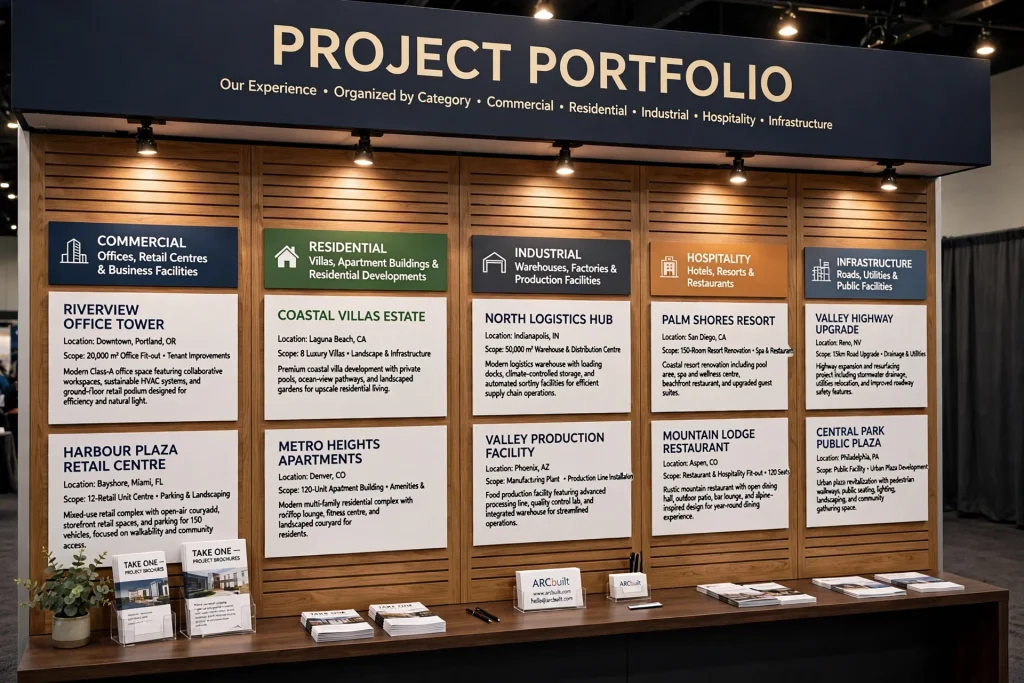
Add a Project Portfolio Wall
A project portfolio wall can transform an exhibition booth into a compact presentation of the company’s experience.
Projects can be organised by category rather than simply listed chronologically.
For example:
Commercial: Offices, retail centres and business facilities.
Residential: Villas, apartment buildings and residential developments.
Industrial: Warehouses, factories and production facilities.
Hospitality: Hotels, resorts and restaurants.
Infrastructure: Roads, utilities and public facilities.
Each project can include the project name, location, scope of work and a short description.
This creates useful context without overwhelming visitors.
Showcase Construction Technology
Construction exhibitions increasingly include technology companies, digital construction solutions and engineering innovations.
Companies can incorporate digital tools such as interactive screens, touch displays, project dashboards and digital presentations.
Building Information Modelling (BIM), 3D visualisation, digital project management, smart building systems and construction monitoring can all be presented through interactive displays where relevant.
For engineering companies, a touchscreen can allow visitors to explore different systems or project stages.
Technology should support the story rather than becoming a distraction. A large screen playing an unrelated promotional video may attract attention temporarily but provide little useful information.
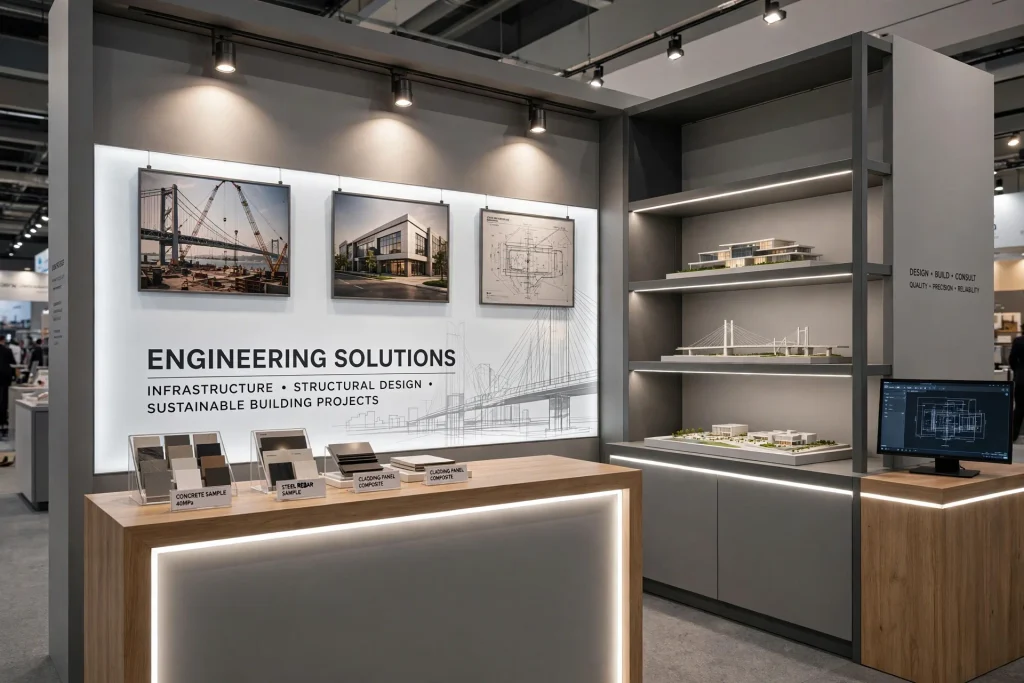
Use 3D Models and Architectural Visualisations
Three-dimensional models can be particularly effective for developers, contractors and engineering companies.
A physical scale model can show the overall structure of a development, while digital 3D models can explain complex engineering systems.
Architectural visualisations can also demonstrate the transformation from design concept to completed building.
For construction companies involved in large projects, 3D visualisation helps visitors understand scale and complexity more quickly than written descriptions.
Lighting as a Branding Element
Lighting should be considered part of the booth design rather than simply a functional requirement.
LED spotlights can highlight project photographs, product samples and architectural models. Linear LED lighting can define structural elements, counters and display shelves.
Backlit graphics can create strong visibility in a busy exhibition environment.
Lighting colour temperature should also complement the brand and materials. Neutral white lighting is commonly suitable for professional construction and engineering environments because it provides a clean visual appearance.
The lighting should not create strong glare on screens or make printed graphics difficult to read.
Make the Company Logo Highly Visible
The logo should be visible from multiple directions whenever the booth layout allows.
Construction exhibitions can become crowded, and visitors often navigate aisles from several angles. A logo positioned only on a low-level counter may disappear within the surrounding environment.
Raised lettering, illuminated logos, suspended signs and architectural branding elements can improve visibility.
However, brand visibility does not mean placing the logo on every available surface. Consistent repetition usually works better than excessive repetition.
Use Clear Service Categories
Construction companies often provide dozens of services, but exhibition visitors do not need every service listed in equal detail.
A booth can group services into clear categories.
For example:
Construction: General contracting, structural works and building construction.
Engineering: Civil, structural and MEP engineering.
MEP: HVAC, electrical, plumbing and fire protection.
Specialist Works: Waterproofing, façades, fit-out and finishing.
This structure makes the booth easier to scan.
Design a Visitor-Friendly Reception Counter
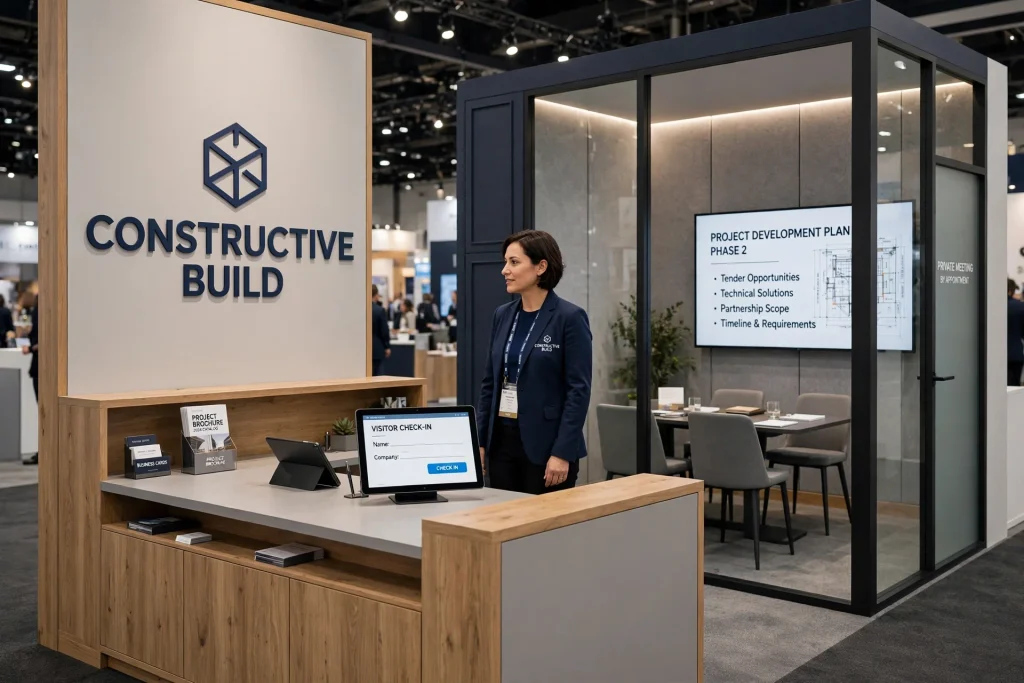
The reception counter is often the first point of interaction.
It should include the company logo while leaving enough open space for conversations. Staff should not have to stand behind a counter surrounded by excessive promotional materials.
A well-designed counter can include concealed storage for brochures, business cards, samples and personal belongings.
Digital tablets or screens can also be positioned nearby for visitor registration or project presentations.
Create a Private Meeting Area
Construction projects often involve commercial discussions that are not suitable for an open exhibition aisle.
If space permits, a small meeting area can be incorporated into the booth. It may include a table, chairs, acoustic separation and a display screen.
The meeting area can be used for discussions about project requirements, tender opportunities, development plans, partnerships and technical solutions.
For larger booths, a semi-private meeting room can provide a more professional environment for serious business discussions.
Use QR Codes Strategically
QR codes can connect physical booth visitors with digital information.
A QR code could lead to:
- Company website
- Project portfolio
- Service pages
- Company profile
- Technical brochures
- Product catalogues
- Case studies
- Contact forms
- LinkedIn company page
- Appointment booking
Instead of placing one QR code everywhere, companies can use different codes for specific content.
For example, a QR code beside a project wall could open a detailed case study, while a code at the reception counter could open the company contact page.
Create an Interactive Project Experience
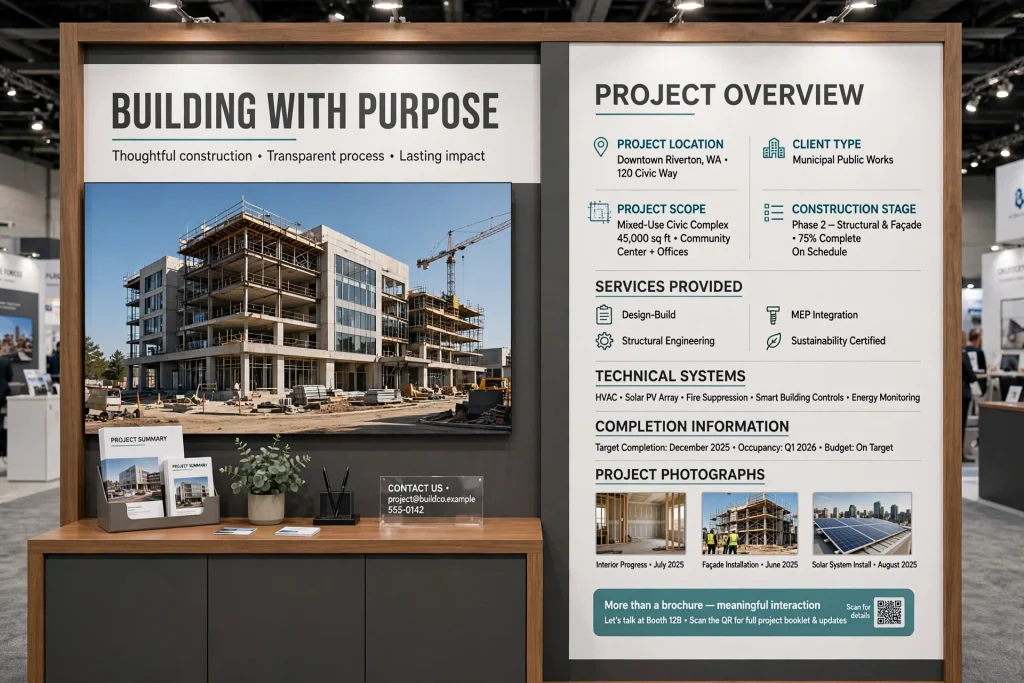
Construction companies can use interactive displays to let visitors explore completed projects.
A touchscreen could allow visitors to select a project and view:
- Project location
- Client type
- Project scope
- Construction stage
- Services provided
- Project photographs
- Technical systems
- Completion information
This can create a more meaningful interaction than simply handing visitors a brochure.
Use Large-Format Graphics Carefully
Large-format printing is useful for exhibition branding, but construction companies should avoid covering every surface with photographs and text.
Visual hierarchy is more important than graphic quantity.
A strong design might use one large hero image, a concise headline, several project images and clearly defined service categories.
Graphics should remain sharp at the viewing distance expected in the exhibition environment.
Consider a Pop-Up Booth Format
Not every construction company needs a large custom-built exhibition stand. Companies attending multiple smaller exhibitions may benefit from modular or portable systems.
A Pop up booth for exhibition can provide a practical branding solution where portability, quick installation and reusable graphics are priorities.
This format can work for contractors, construction suppliers, engineering firms and specialist service providers participating in smaller trade shows, networking events or regional exhibitions.
Incorporate Architectural Forms
Construction companies can use the booth structure itself as a branding element.
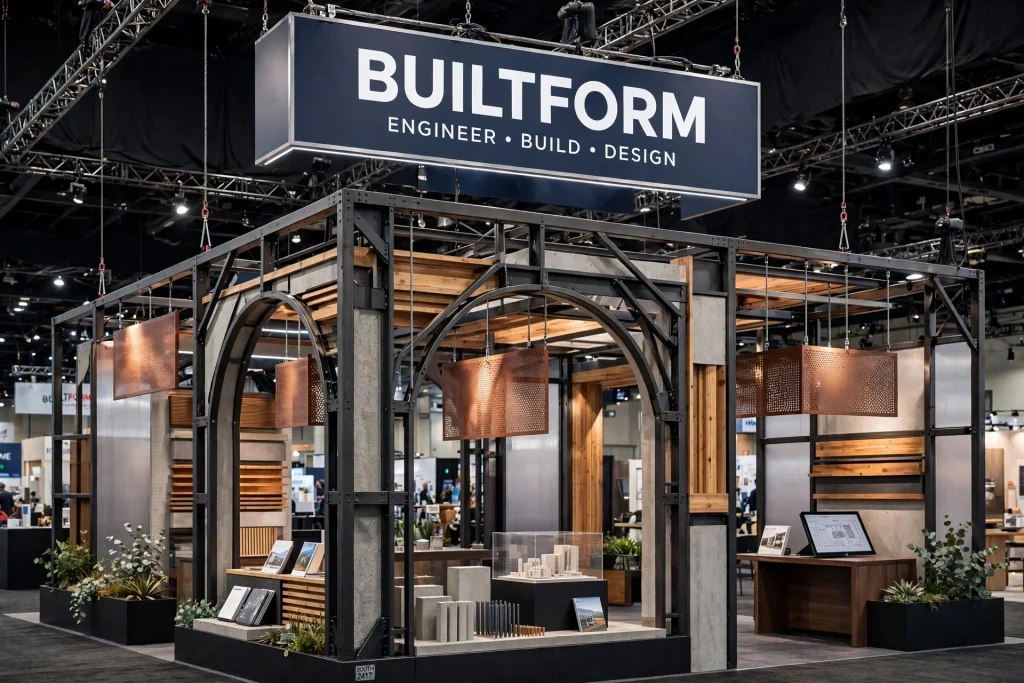
Geometric frames, architectural arches, exposed structural elements, layered panels and suspended features can reflect the company’s connection with the built environment.
For an engineering company, structural forms can become part of the visual identity.
For an architecture or design-build firm, the booth can resemble a miniature built environment with carefully considered materials, lighting and spatial planning.
Use Suspended Signs for Large Exhibition Halls
Large exhibition halls can make even substantial booths appear small.
Suspended overhead signs can improve visibility from a distance and help visitors locate the company.
The sign should be simple and readable. A logo and short brand message are generally more effective than a detailed service list.
Suspended signage should also comply with the exhibition organiser’s technical and safety requirements.
Branding for Construction Product Suppliers
Construction product suppliers have slightly different booth requirements from contractors.
Suppliers may need to showcase multiple products, brands, technical specifications and samples.
Wall-mounted product displays, sample racks, demonstration counters and product-specific lighting can help visitors compare materials.
For example, a supplier of waterproofing products could show membrane samples, installation layers and application diagrams.
A façade supplier could display aluminium, glass, cladding or architectural panel samples.
The booth should allow visitors to understand both the product and its practical construction application.
Construction Safety as a Branding Theme
Safety is a major part of construction operations and can be incorporated into booth communication.
Companies can display safety certifications, site safety procedures, training programmes, quality-control processes and project safety achievements where appropriate.
Visual communication should remain concise and factual.
Safety-related messaging can demonstrate that the company understands the operational realities of construction rather than focusing only on finished buildings.
Highlight Sustainability and Green Building
Sustainability has become an increasingly important topic in construction and real estate.
Construction companies can showcase environmentally responsible materials, energy-efficient systems, waste reduction, sustainable construction practices and green-building experience where these are genuinely part of their services.
Relevant concepts can include LEED, Estidama, energy-efficient HVAC systems, solar integration, sustainable materials and building performance.
In the UAE, sustainability messaging can be connected to the region’s broader focus on energy efficiency and responsible development.
Branding for MEP Contractors
MEP contractors should make invisible building systems visible.
Visitors may not immediately appreciate the complexity of HVAC, electrical, plumbing and fire-protection systems because these components are often hidden after construction.
Technical diagrams, installation photographs and simplified system illustrations can explain the company’s role.
An MEP booth could visually demonstrate chilled-water systems, air-handling units, ductwork, electrical distribution, building management systems and plumbing infrastructure.
This approach turns technical services into understandable visual stories.
Branding for Civil and Infrastructure Contractors
Civil engineering and infrastructure companies can use maps, aerial project photography, construction sequences and diagrams.
Infrastructure projects may include roads, bridges, drainage systems, utilities, tunnels, public facilities and large-scale developments.
A map-based project wall can show where the company has worked and the type of infrastructure it has delivered.
Drone photography can also provide strong visuals when permitted.
Localising Booth Branding for UAE Exhibitions
UAE construction companies can strengthen their exhibition presence by referencing relevant local markets and project environments.
Dubai-focused companies may highlight experience in Downtown Dubai, Business Bay, Dubai Marina, Jumeirah, Dubai South and other commercial or residential districts.
Abu Dhabi companies may reference areas such as Yas Island, Al Reem Island, Saadiyat Island and Mussafah where relevant to their project portfolio.
The objective is not to add locations simply for decoration. Local references should represent genuine project experience or service coverage.
Construction Exhibitions in Dubai
Dubai is an important hub for construction exhibitions, real estate events, engineering conferences and building-material trade shows.
Dubai World Trade Centre hosts major international events and attracts developers, contractors, consultants, architects and suppliers.
Dubai Exhibition Centre at Expo City Dubai also provides a major venue for conferences and exhibitions.
For companies exhibiting in Dubai, booth branding needs to work in a competitive environment where many businesses may offer similar construction services.
Strong visual differentiation, concise messaging and credible project evidence can help a booth stand apart.
Construction Exhibitions in Abu Dhabi
Abu Dhabi hosts major business, infrastructure, energy and construction-related events. Abu Dhabi National Exhibition Centre (ADNEC) is an important venue for exhibitions and conferences.
Companies targeting government projects, infrastructure development, commercial construction and engineering opportunities can use exhibition booths to present capabilities to professional audiences.
Project maps, technical portfolios, certifications and case studies can be particularly useful when the audience includes consultants, developers and procurement professionals.
Build a Brand Experience Instead of a Booth
The strongest construction exhibition stands should feel like a small version of the company’s brand.
Visitors should see the same logo, colours, typography, photography style and messaging across the booth, brochures, digital displays and staff clothing.
Consistency creates recognition.
The physical materials can also reflect the company’s positioning. A premium design-build company might use architectural finishes and refined lighting, while an industrial contractor may use technical materials, engineering diagrams and equipment imagery.
Give Visitors Something Useful
Promotional items can help visitors remember a company, but they should relate to the construction industry where possible.
Useful items might include technical notebooks, measuring tools, reusable bottles, project planners or branded USB alternatives where appropriate.
More importantly, the company should provide useful information such as project case studies, material guides, technical brochures or digital resources.
A visitor is more likely to remember a company that helped solve a problem than one that simply handed out merchandise.
Train Booth Staff
Even a beautifully designed exhibition stand can underperform if the staff are not prepared.
Staff should understand the company’s key services, major projects, target clients and most important differentiators.
They should also know how to qualify visitors.
Useful questions include:
“What type of project are you currently working on?”
“Are you looking for a contractor, consultant or supplier?”
“What stage is your project currently at?”
“Which construction service are you evaluating?”
These questions can turn a casual conversation into a useful business lead.
Measure Exhibition Booth Performance
Construction companies should measure more than visitor numbers.
Useful indicators can include qualified leads, meetings arranged, project enquiries, partnership discussions, QR-code scans, brochure downloads and follow-up opportunities.
A simple lead classification system can separate visitors into immediate opportunities, future prospects, partners, suppliers and general contacts.
After the exhibition, sales teams should follow up quickly while the conversation is still fresh.
Common Construction Booth Branding Mistakes
One common mistake is using too much text. Construction companies often have extensive service portfolios, but an exhibition booth is not a company website.
Another mistake is relying entirely on generic construction imagery. Real projects generally provide stronger evidence of experience.
Poor lighting can also reduce the impact of high-quality graphics.
A booth that looks impressive but has no comfortable space for conversations may also lose valuable business opportunities.
Finally, companies should avoid designing the booth without considering the exhibition hall, visitor flow, available space and organiser regulations.
How to Plan a Construction Exhibition Booth
Start by defining the target audience and primary business objective.
Next, identify the most important services, projects and proof points.
Develop the visual hierarchy before selecting materials and furniture. Determine where visitors will see the logo, main message, project images and service information.
Then plan lighting, digital displays, meeting areas, storage and visitor circulation.
Graphics should be designed according to the final viewing distance and printing specifications.
Before production, the complete booth should be reviewed against the exhibition organiser’s requirements for dimensions, height, electrical connections, rigging, fire safety and installation.
Frequently Asked Questions
What should a construction company display at a trade show?
A construction company can display completed projects, services, technical capabilities, certifications, materials, project case studies, digital presentations and relevant construction technologies.
How can a construction booth attract visitors?
Strong project photography, clear messaging, professional lighting, interactive displays, material samples and a well-organised layout can help attract and engage visitors.
Should construction companies use real project photos?
Yes, where permission is available. Real project photography can provide stronger evidence of experience than generic stock imagery.
What information should be on a construction exhibition booth?
The booth should usually communicate the company name, primary service proposition, key services, selected projects and a clear method for contacting or engaging with the company.
Are pop-up exhibition booths suitable for construction companies?
They can be suitable for companies attending smaller exhibitions or multiple events where portability, quick setup and reusable graphics are important.
Should a construction booth include a meeting area?
If space permits, a dedicated meeting area can be valuable for discussing projects, tenders, partnerships and technical requirements privately.
How important is lighting for an exhibition booth?
Lighting affects the visibility of logos, graphics, products and architectural features. Properly positioned LED lighting can improve both presentation and visitor comfort.
Conclusion
Trade show booth branding gives construction companies an opportunity to turn their project experience and technical capabilities into a physical brand experience. The most effective approach combines clear messaging, authentic project photography, architectural design, professional lighting, material samples, digital technology and comfortable visitor interaction.
For UAE construction companies exhibiting in Dubai and Abu Dhabi, localisation can make the booth even more relevant when it reflects genuine project experience and knowledge of the regional construction market.
Whether the company is a general contractor, civil engineering firm, MEP contractor, building-material supplier, specialist subcontractor or design-build company, the booth should answer three questions quickly: What do you do, where have you done it, and why should a potential client start a conversation with you?
When these elements are brought together through thoughtful branding and practical exhibition planning, a construction trade show booth becomes more than a display. It becomes a focused business-development environment designed to generate meaningful conversations and qualified opportunities.