

Blogs
Best LED Modules and Lighting Solutions for Sign Boards

Introduction
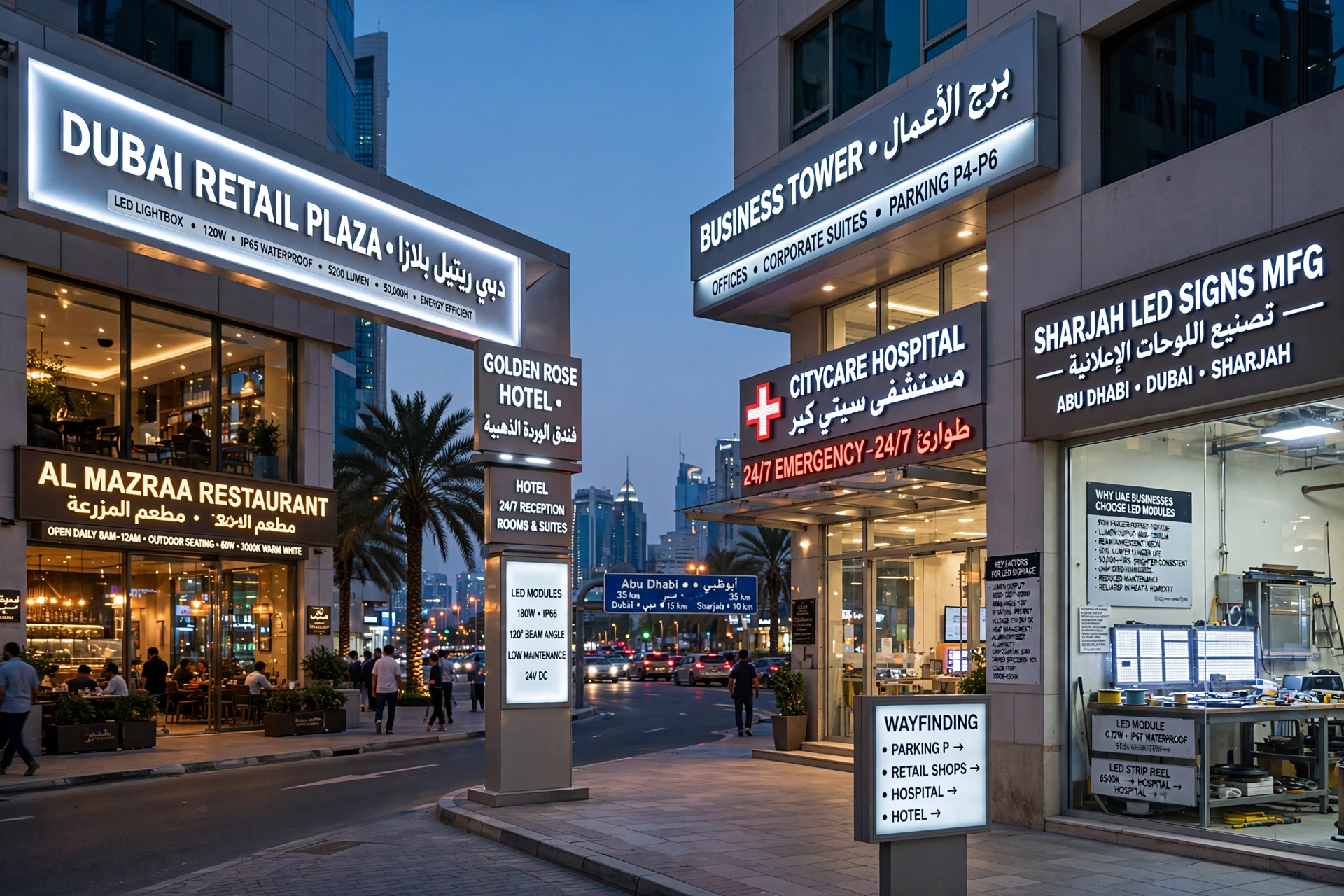
In today’s competitive business environment, illuminated signage plays a vital role in attracting customers and strengthening brand visibility. Whether installed on retail stores, shopping malls, restaurants, hotels, hospitals, office buildings, or commercial complexes, high-quality LED sign boards help businesses stand out both during the day and at night. Behind every bright and durable sign is a carefully selected LED lighting system designed to deliver consistent illumination, energy efficiency, and long-term reliability.
Across the UAE, businesses increasingly prefer LED modules over traditional fluorescent and neon lighting because they offer lower energy consumption, longer service life, brighter illumination, and reduced maintenance costs. Modern LED modules are available in various shapes, sizes, wattages, color temperatures, and waterproof ratings, making them suitable for different signage applications including channel letters, acrylic signs, light boxes, pylon signs, fascia signs, and wayfinding systems.
Choosing the right LED modules involves more than simply selecting a light source. Factors such as lumen output, beam angle, IP rating, voltage compatibility, heat management, LED chip quality, driver efficiency, and installation environment all influence the performance of illuminated signage.
For sign manufacturers, advertising companies, fabrication workshops, architects, contractors, and business owners throughout Dubai, Abu Dhabi, Sharjah, Ajman, Ras Al Khaimah, Fujairah, Al Ain, and Umm Al Quwain, investing in premium LED lighting solutions ensures brighter displays, improved durability, and lower operating costs over the lifetime of the sign.
Understanding LED Modules for Sign Boards
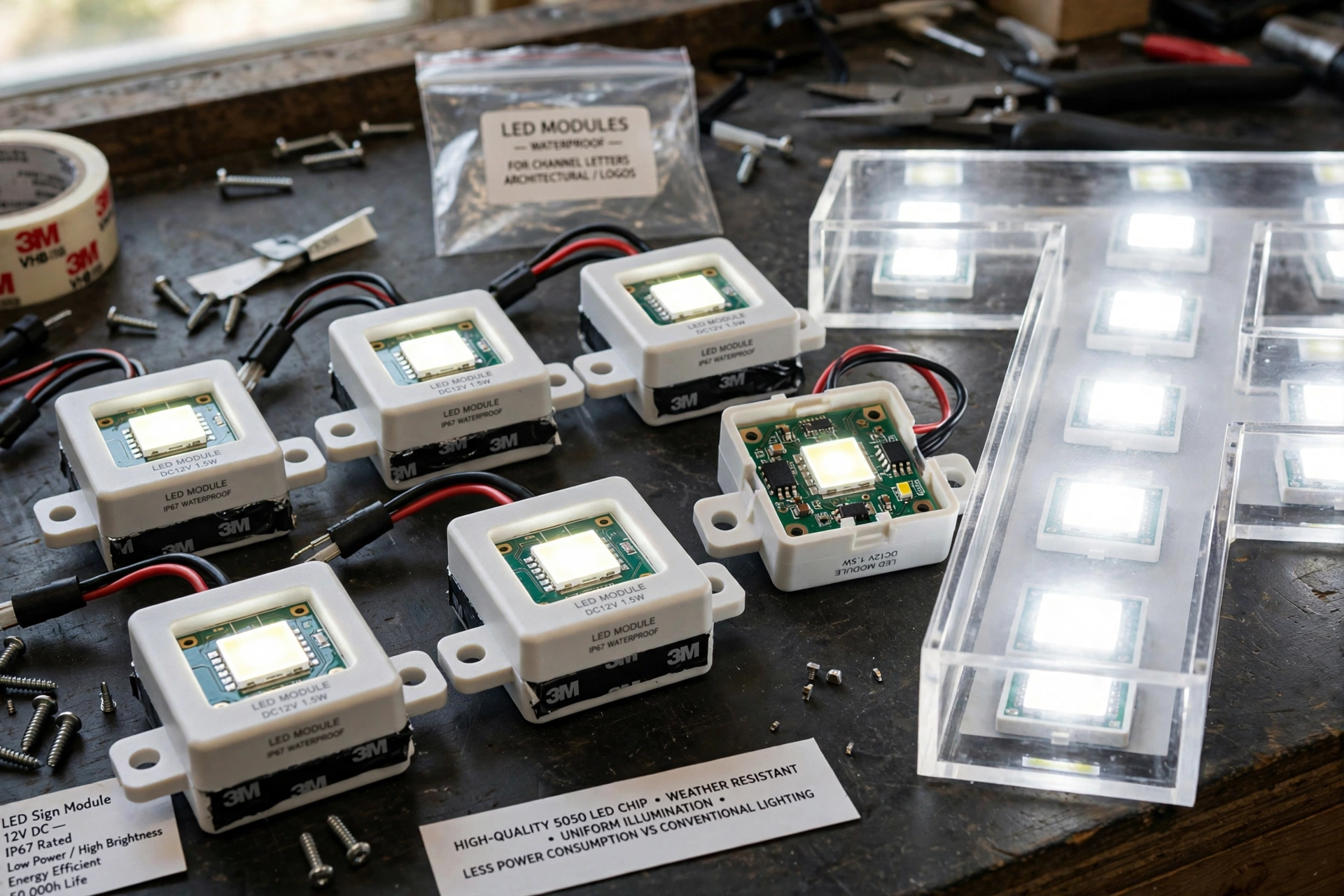
LED modules are compact lighting units that contain one or more Light Emitting Diodes (LEDs) mounted on a Printed Circuit Board (PCB). Unlike standard LED strips, LED modules are specifically engineered for signage applications where uniform illumination, weather resistance, and reliable performance are essential.
Each module generally includes:
- High-quality LED chips
- Injection-molded housing
- Waterproof encapsulation
- Lens for light distribution
- Pre-installed wiring
- Adhesive backing or mounting holes
These components work together to produce even lighting inside sign cabinets, acrylic channel letters, illuminated logos, and architectural displays.
Because LED modules are designed for commercial signage, they provide superior brightness while consuming significantly less electricity than conventional lighting technologies.
Why LED Modules Are the Preferred Choice for Modern Signage
Businesses across the UAE have largely replaced fluorescent tubes and neon lighting with LED modules because of the numerous advantages they provide.
One of the biggest benefits is energy efficiency. Modern LED technology converts more electrical energy into visible light while generating less heat. This helps businesses reduce electricity costs without sacrificing brightness.
Another major advantage is lifespan. Premium LED modules can operate for tens of thousands of hours when installed correctly with suitable power supplies and ventilation.
LED modules also provide:
- Uniform light distribution
- Faster installation
- Low maintenance requirements
- Minimal heat generation
- Better environmental performance
- Instant illumination
- High reliability
- Reduced replacement costs
These benefits make LED modules ideal for both indoor and outdoor commercial signage
Different Types of LED Modules Used in Sign Boards
Different sign designs require different lighting solutions. Selecting the correct LED module ensures even illumination and professional visual results.
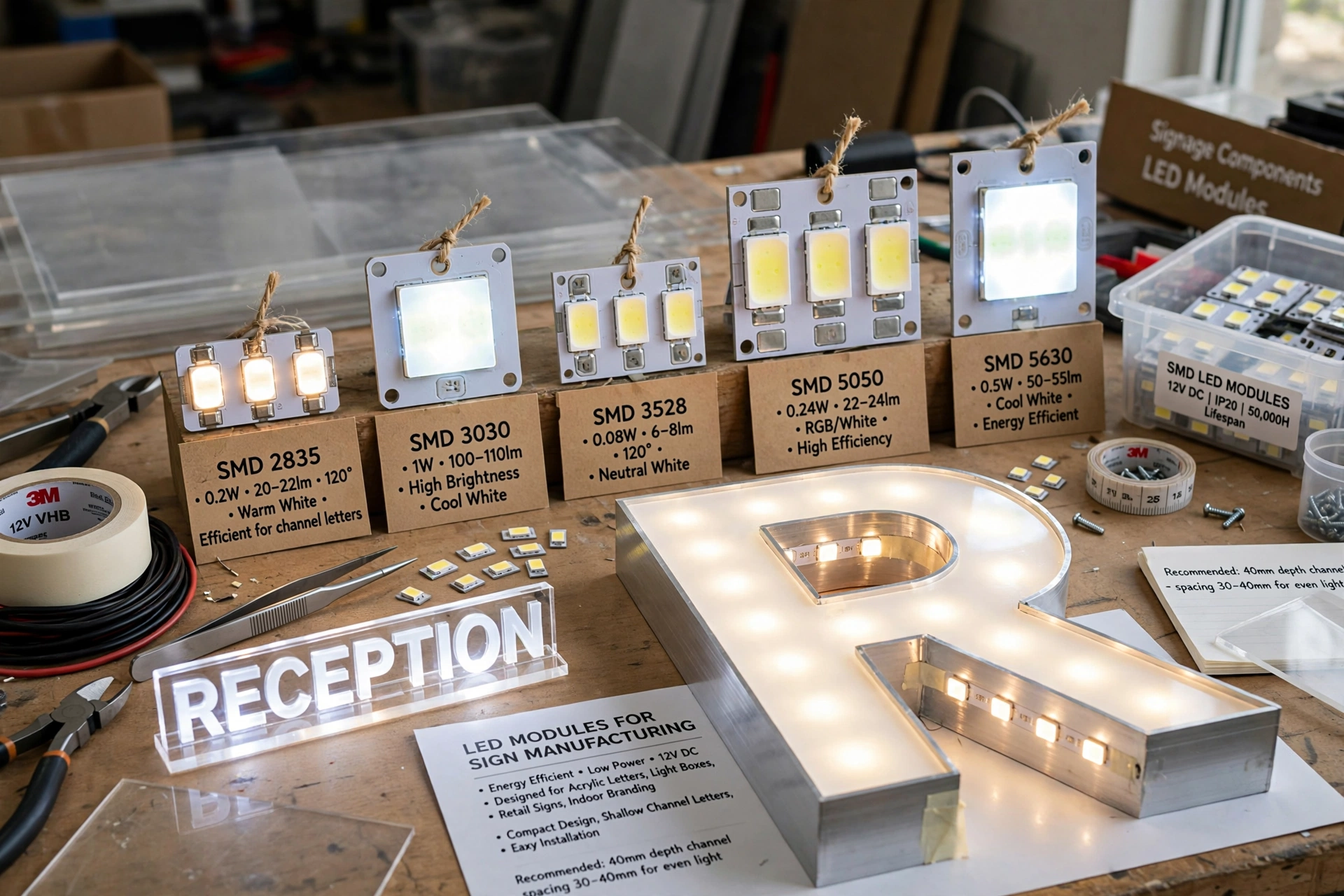
SMD LED Modules
Surface Mounted Device (SMD) LED modules are among the most commonly used options in sign manufacturing. They provide excellent brightness while maintaining energy efficiency.
Popular SMD chip sizes include:
- SMD 2835
- SMD 3030
- SMD 3528
- SMD 5050
- SMD 5630
These modules are suitable for:
- Acrylic letters
- Light boxes
- Retail signs
- Reception signage
- Indoor branding
Their compact design allows installation even in shallow channel letters.
COB LED Modules
Chip-on-Board (COB) LED modules feature multiple LED chips mounted closely together on a single substrate.
Advantages include:
- Higher lumen density
- Uniform illumination
- Better heat dissipation
- Reduced visible hotspots
- Professional appearance
COB technology is increasingly used for premium commercial signage requiring high brightness and smooth light output.
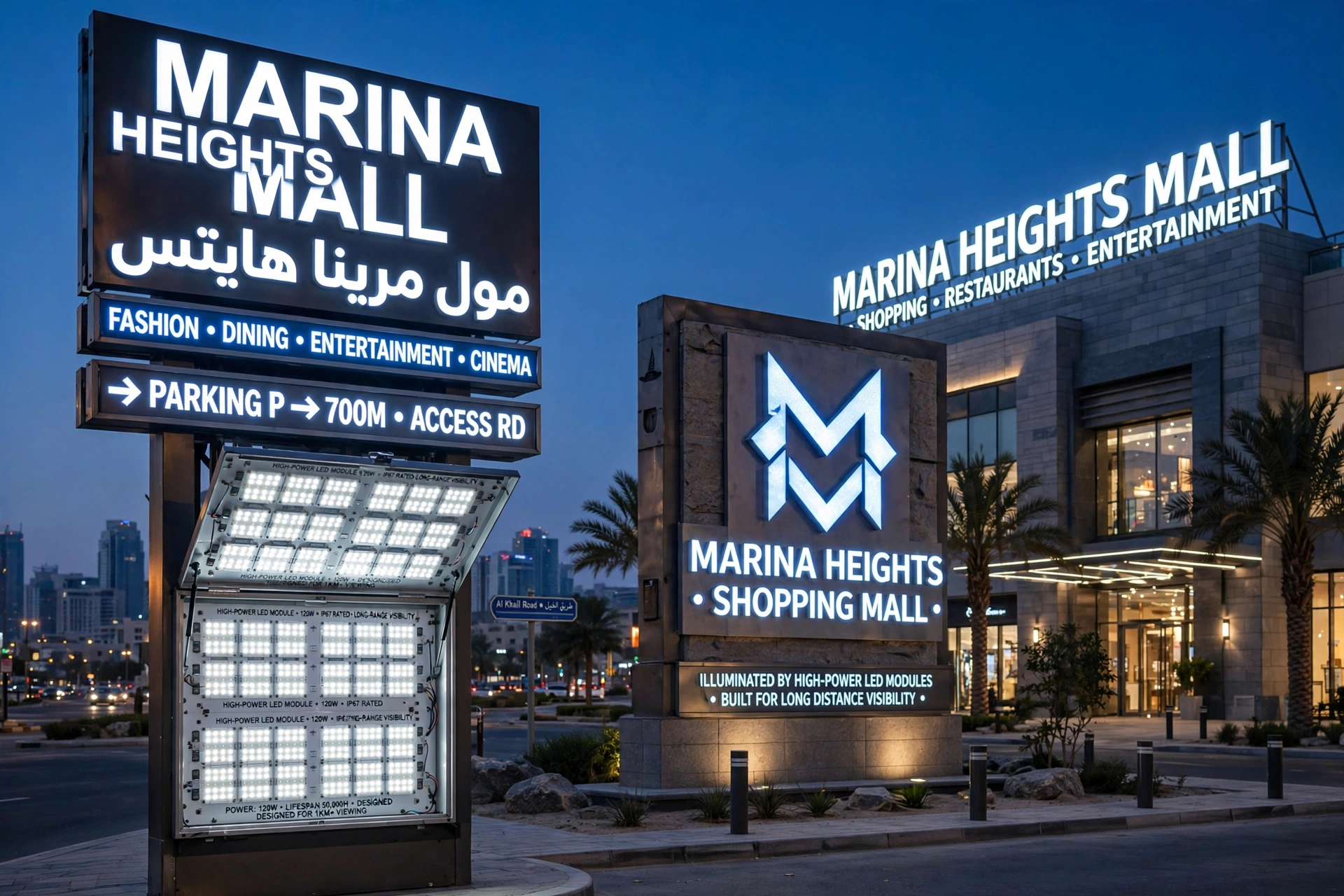
High-Power LED Modules
Large outdoor signs often require high-power modules capable of producing greater illumination.
These modules are commonly used for:
- Building signs
- Pylon signs
- Monument signs
- Large illuminated logos
- Shopping mall signage
High-power modules maintain visibility even from long viewing distances.
Common Applications of LED Modules
Modern LED modules support a wide variety of signage solutions across commercial and industrial sectors.
Some of the most common applications include:
Channel Letter Signs
Individual illuminated letters require compact LED modules capable of delivering uniform brightness throughout each letter.
Proper spacing prevents shadowing and uneven lighting.
Acrylic Sign Boards
Acrylic signage remains popular because of its premium appearance.
LED modules illuminate:
- Clear acrylic
- Frosted acrylic
- Colored acrylic
- Laser-cut acrylic
- Edge-lit acrylic panels
The result is bright, elegant branding suitable for offices, hotels, and retail stores.
Light Box Signage
Light boxes require evenly distributed illumination across printed graphics.
LED modules provide:
- Consistent brightness
- Low power consumption
- Minimal maintenance
- Long operating life
They are widely used in shopping malls, airports, hospitals, and commercial buildings.
Fabric Light Boxes
Fabric graphics continue to gain popularity because of their seamless appearance.
High-quality LED modules create smooth backlighting that enhances printed visuals while reducing shadows.
These systems are frequently installed in exhibition stands, retail environments, and corporate interiors.
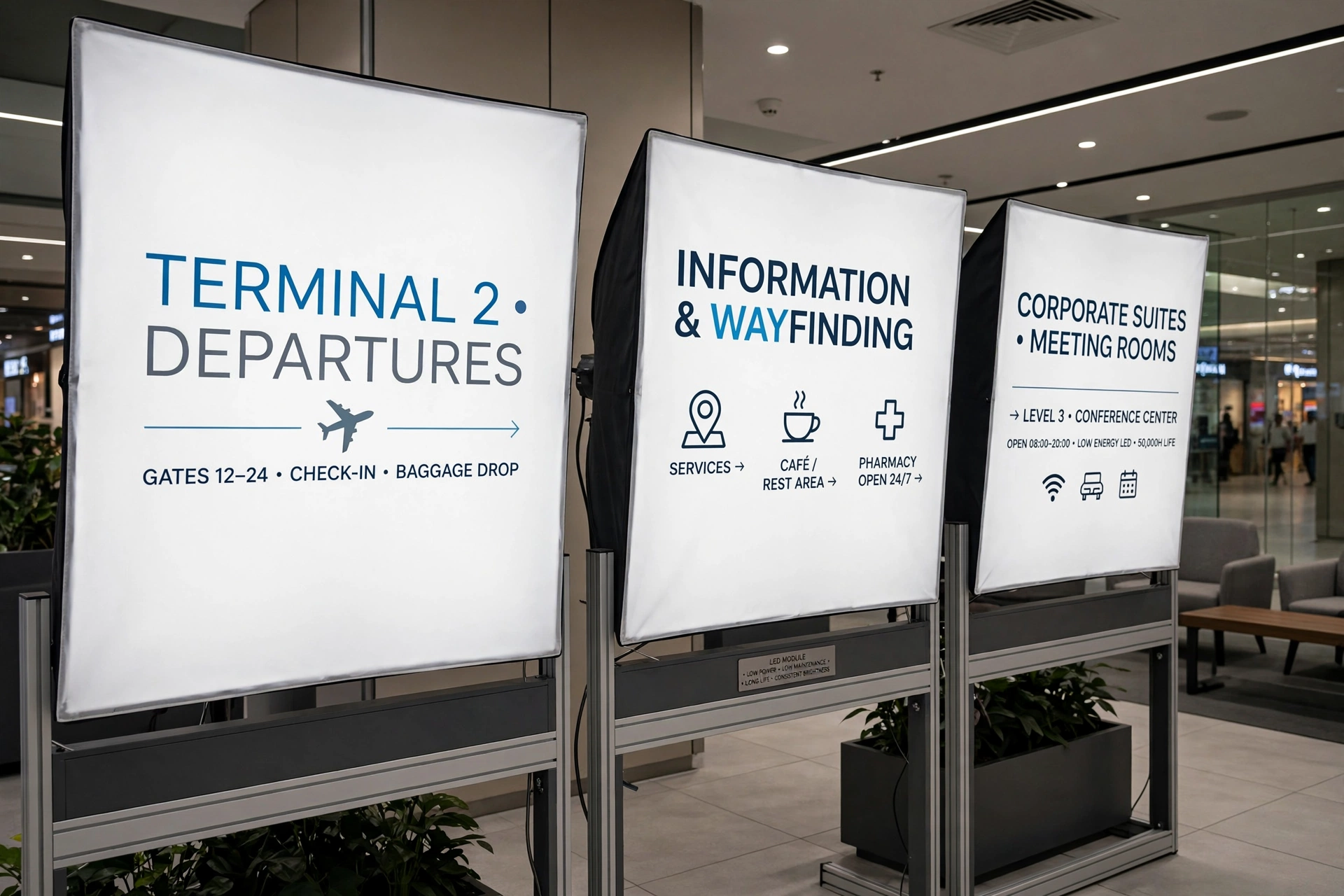
Wayfinding Systems
Hospitals, universities, airports, metro stations, shopping centres, and office complexes use illuminated directional signs.
LED modules improve visibility while maintaining low operational costs throughout continuous daily use.
Important Factors When Choosing LED Modules
Selecting LED modules requires careful consideration of technical specifications.
Brightness (Lumen Output)
Brightness determines how visible a sign appears.
Higher lumen output is generally recommended for:
- Outdoor advertising
- Highway signs
- Building facades
- Shopping mall entrances
Indoor applications often require lower brightness for comfortable viewing.
Manufacturers usually specify lumen ratings to help fabricators select the correct lighting configuration.
Color Temperature
Color temperature affects the appearance of illuminated signage.
Common options include:
- Warm White (3000K)
- Neutral White (4000K)
- Pure White (5000K)
- Cool White (6500K)
Businesses choose different temperatures depending on branding requirements.
Retail stores often prefer neutral white, while healthcare facilities commonly select cool white for a clean appearance.