

Blogs
Polymeric vs. Cast Vinyl: A Practical Guide for UAE Signage Companies

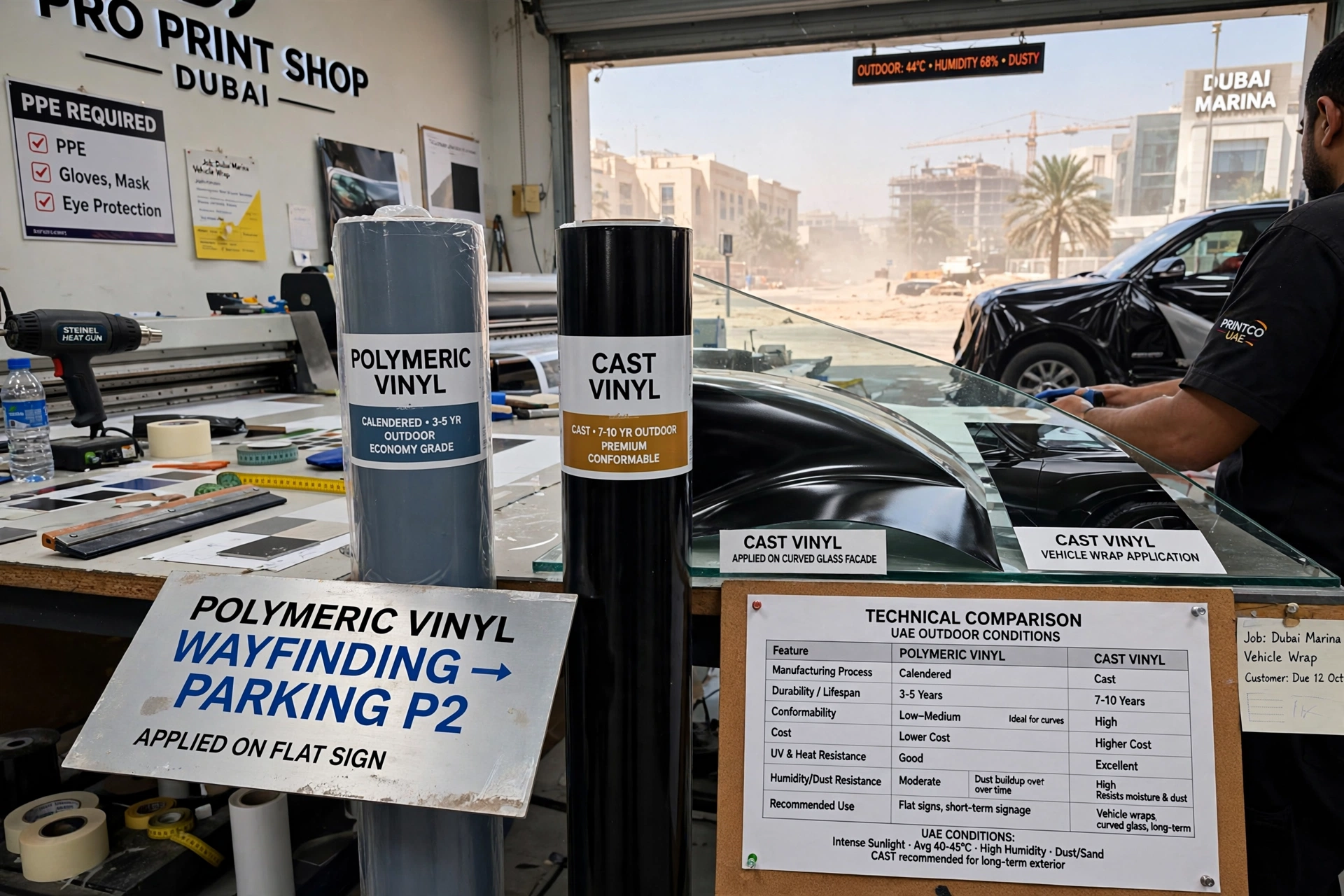
For signage companies in the UAE, material selection becomes even more important because Dubai, Abu Dhabi, Sharjah, and other Emirates experience intense sunlight, high temperatures, humidity, dust, and demanding outdoor conditions. A vinyl that performs well in a controlled indoor environment may not necessarily provide the same service life on an outdoor sign, vehicle, glass façade, or curved surface.
The right decision should therefore be based on the application, substrate, expected lifespan, surface shape, printing technology, installation conditions, and budget, rather than simply choosing the cheapest roll.
Choosing the correct vinyl is one of the most important decisions in professional signage production. Two of the most widely used categories are polymeric vinyl and cast vinyl. Although both are PVC-based self-adhesive films designed for printed graphics, they behave very differently during printing, application, conformability, outdoor exposure, and long-term use.
For professional sign makers, understanding polymeric and cast vinyl at a technical level can reduce material failures, improve installation quality, minimize rework, and produce more reliable results for customers.
What Is Polymeric Vinyl?
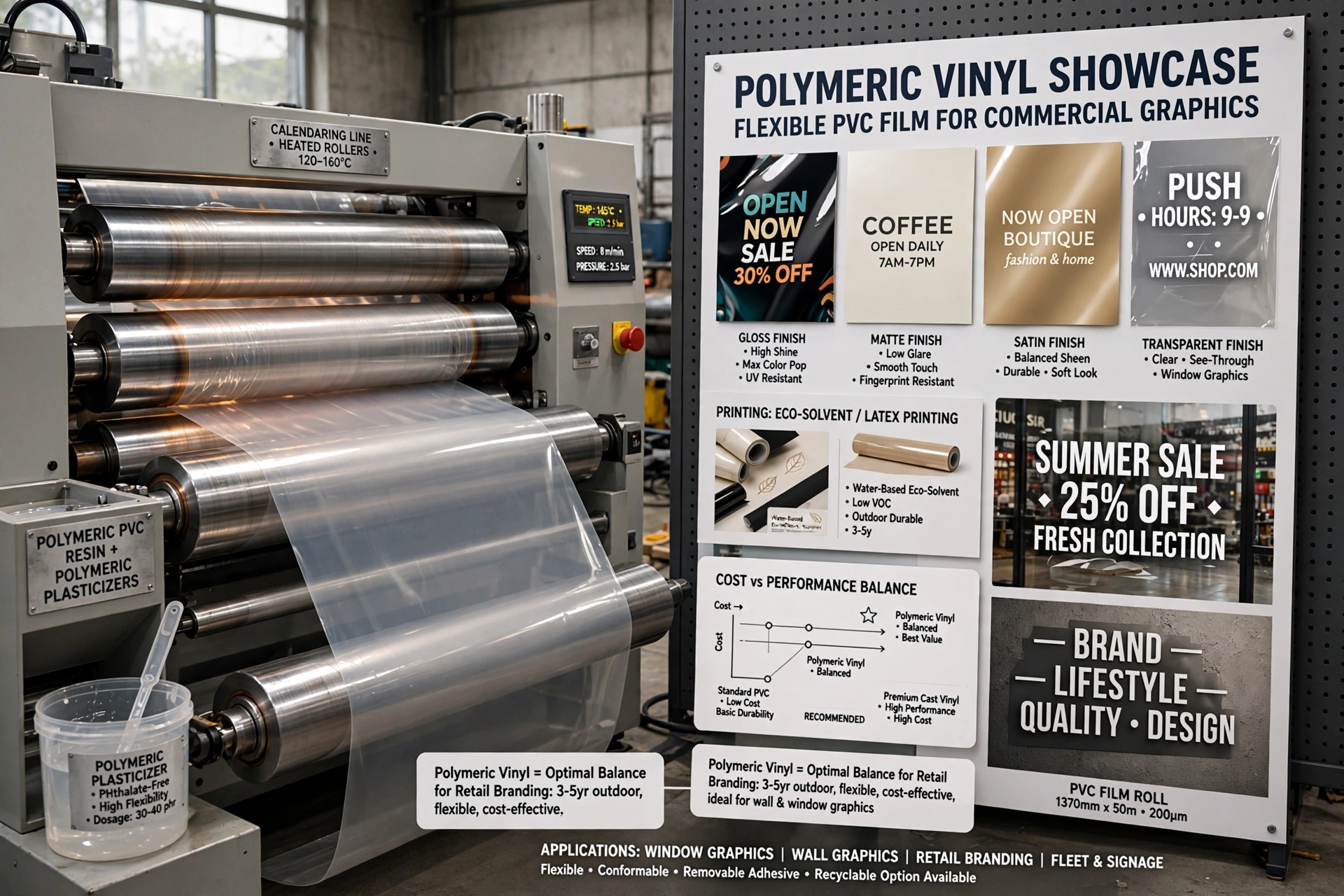
Polymeric vinyl is a flexible PVC film manufactured using polymeric plasticizers that provide greater flexibility and durability than basic monomeric calendared vinyl. It is generally produced through a calendaring process, where PVC material is heated and passed through rollers to achieve the required thickness.
Polymeric vinyl is widely used for commercial signage, window graphics, wall graphics, promotional displays, fleet graphics, retail branding, and other medium-term applications.
Its main advantage is the balance between performance and cost. It provides considerably better dimensional stability and outdoor durability than economy monomeric vinyl while remaining more affordable than premium cast films.
Polymeric films are available in gloss, matte, satin, transparent, white, colored, and specialty finishes. Printable versions are compatible with common wide-format technologies including eco-solvent, solvent, latex, and some UV printing systems, depending on the manufacturer’s specifications.
For many standard flat or gently curved signage applications, polymeric vinyl provides more than enough performance without the additional cost of cast film.
What Is Cast Vinyl?
Cast vinyl is considered a premium category of flexible PVC film. Instead of being mechanically stretched through rollers in the same way as calendared films, cast vinyl is manufactured by spreading a liquid PVC formulation into a thin film and curing it.
This manufacturing process produces a thinner and more dimensionally stable material with excellent conformability.
The major advantage becomes apparent when the vinyl must follow complex curves, recesses, contours, rivets, channels, or compound surfaces. Cast vinyl can stretch and conform to these shapes without developing the same level of memory or shrinkage associated with lower-grade films.
This is why cast vinyl is widely specified for vehicle wraps, automotive graphics, complex surfaces, premium fleet branding, architectural curves, and high-performance outdoor applications.
For a professional signage company, cast vinyl should not automatically be considered “better” in every situation. It is better suited to specific applications where its technical characteristics justify the additional cost.
Polymeric vs. Cast Vinyl: The Fundamental Difference
The most important distinction is how the material behaves after installation.
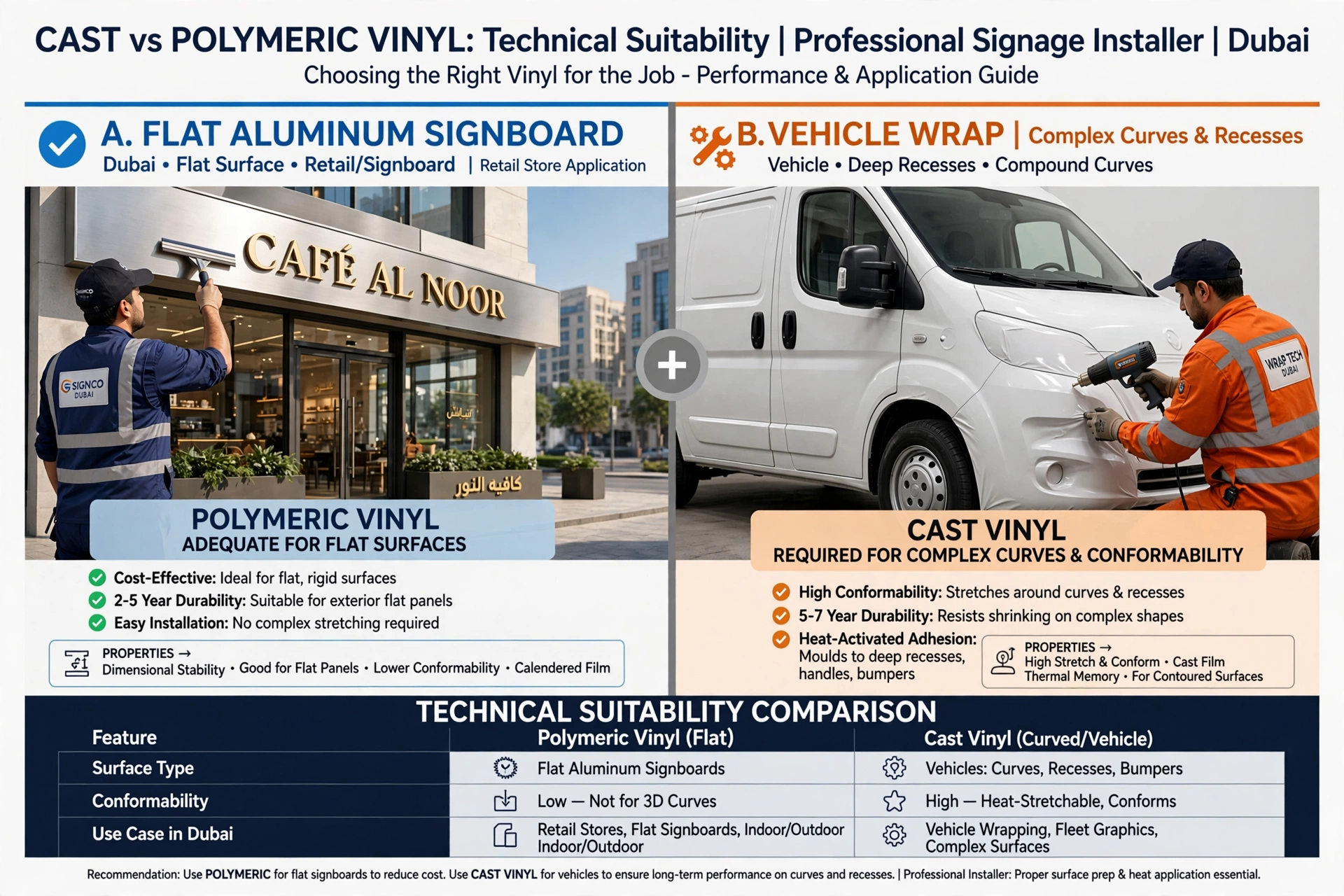
Polymeric vinyl is an excellent choice for relatively flat surfaces and moderate curves. Cast vinyl is engineered for demanding surfaces where the film must conform significantly without excessive tension or shrinkage.
Consider a flat aluminum signboard installed outside a retail store in Dubai. There is little reason to use an expensive cast film if a quality polymeric film provides the required outdoor durability and print performance.
Now consider a vehicle with deep recesses, door handles, compound curves, bumpers, and body contours. In this situation, cast vinyl is usually the technically superior choice because its conformability allows installers to manipulate the film around complex geometry.
The correct question is therefore not “Which vinyl is better?” but “Which vinyl is technically appropriate for this application?”
That distinction is critical for professional signage companies.
Dimensional Stability Matters in the UAE Climate
Dimensional stability refers to a vinyl film’s ability to maintain its original dimensions after installation despite changes in temperature and environmental conditions.
This characteristic is extremely important in the UAE. Outdoor graphics can experience intense solar radiation during the day followed by cooler nighttime temperatures. The repeated expansion and contraction of materials can place stress on vinyl graphics and adhesives.
Lower-quality films may shrink over time, exposing edges or creating visible gaps between panels. On vehicle graphics, excessive shrinkage can become particularly noticeable around contours and seams.
High-quality polymeric and cast films are formulated to minimize dimensional changes. Cast vinyl generally provides superior dimensional stability, particularly for demanding long-term applications.
Professional installers should also consider substrate preparation, application temperature, edge sealing, lamination, and installation technique because even premium vinyl can fail if installed incorrectly.
Which Vinyl Is Better for Flat Signage?
For conventional flat signage, polymeric vinyl is often the most practical option.
Typical applications include aluminum composite panels, PVC boards, Forex sheets, acrylic panels, glass, smooth painted surfaces, retail signboards, indoor branding panels, and commercial information signs.
If the substrate is relatively flat and the expected lifespan is moderate, polymeric vinyl can provide an excellent combination of print quality, durability, and cost efficiency.
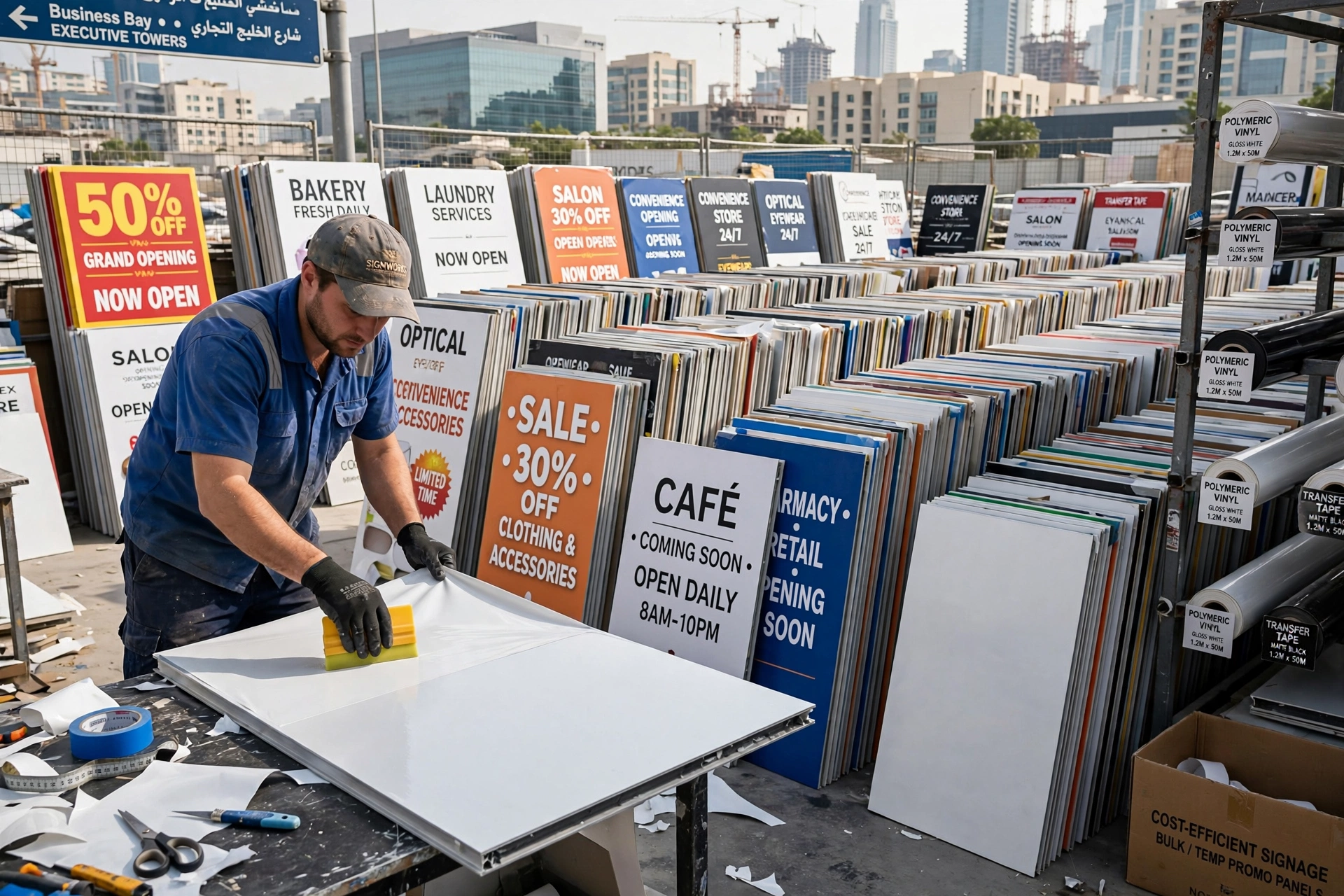
For example, a retail campaign in Business Bay may require hundreds of temporary promotional panels. Using premium cast film for every panel could unnecessarily increase project costs without providing meaningful performance benefits.
A properly selected polymeric film can provide excellent results when applied to a correctly prepared flat substrate.
When Should Signage Companies Choose Cast Vinyl?
Cast vinyl becomes more appropriate when the project involves complex geometry, long-term outdoor exposure, or high-value applications where failure would be particularly expensive.
Vehicle wrapping is the classic example. Automotive body panels contain compound curves, recessed areas, bumpers, mirrors, door handles, and channels. Vinyl must stretch and conform to these shapes while maintaining visual consistency.
Cast film is also useful for premium fleet graphics, high-end vehicle branding, architectural surfaces with curves, and specialized outdoor graphics.
When material replacement is expensive or difficult, investing in a higher-performance film can make economic sense even if its initial price is higher.
The correct material selection should always consider the total project cost, not just the price per square meter.
Printing Quality Depends on More Than the Vinyl Type
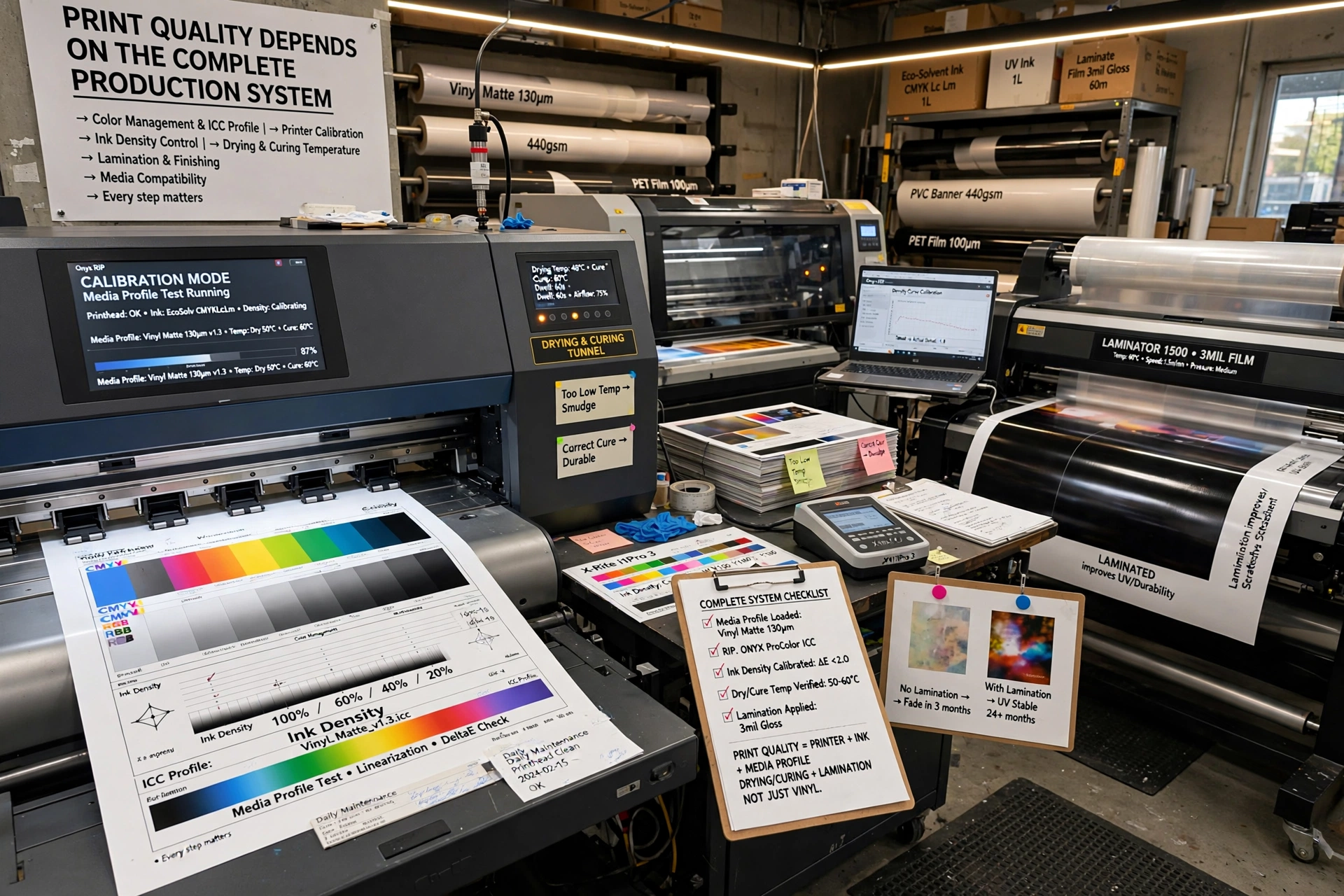
A common mistake is to assume that choosing cast or polymeric vinyl automatically guarantees excellent print quality. In reality, print performance depends on the complete production system.
Printer calibration, ink technology, media profile, resolution, drying temperature, curing, color management, lamination, and storage conditions all influence the final result.
Wide-format printers using eco-solvent, solvent, latex, or UV technologies require media profiles appropriate for the specific vinyl. Incorrect ink density can cause slow drying, excessive ink pooling, color inconsistency, or poor adhesion.
Professional print operators should test unfamiliar vinyl before beginning a large production run. A small media test can identify compatibility issues before hundreds of square meters of material are wasted.
Adhesive Performance Is Equally Important
The vinyl film itself is only one part of the finished graphic. The adhesive determines how effectively the material bonds to the substrate and how reliably it remains attached over time.
Different applications require different adhesive characteristics. Permanent adhesives are appropriate for long-term graphics where removal is not expected, while removable adhesives are useful for temporary campaigns, wall graphics, promotional displays, and changing retail branding.
Surface preparation is critical. Dust, grease, silicone residue, wax, moisture, oxidation, and poorly cured paint can prevent proper adhesion.
In Dubai’s dusty environment, even a small amount of contamination can create application defects. Professional installers should clean and degrease surfaces carefully before application and follow the manufacturer’s recommended installation temperature.
Polymeric Vinyl Is Often the Better Value
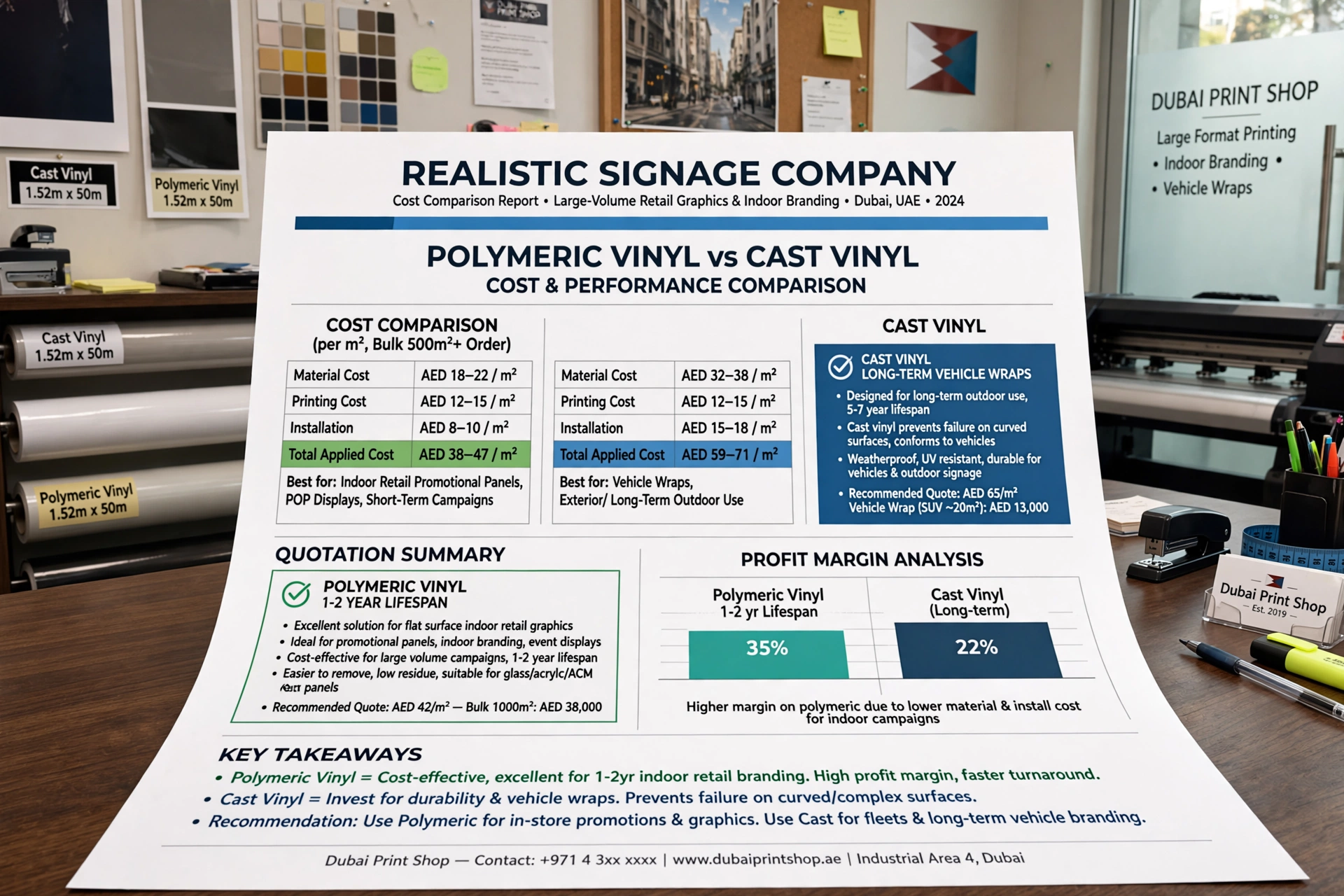
Cost efficiency is one of the strongest arguments for polymeric vinyl.
A signage company producing large volumes of retail graphics, promotional panels, indoor branding, and standard outdoor signs may achieve better margins by using high-quality polymeric vinyl where its performance is sufficient.
Using premium cast film for every project increases material costs without necessarily improving the finished product.
A professional quotation should therefore consider the customer’s actual requirements. If the graphic is expected to last one or two years on a relatively flat surface, polymeric vinyl may provide an excellent solution.
For long-term vehicle wraps or highly complex surfaces, however, the additional investment in cast vinyl can prevent premature failure and expensive reinstallation.
Vehicle Graphics Require Careful Material Selection
Vehicle graphics represent one of the clearest applications where the difference between polymeric and cast vinyl becomes important.
Fleet vehicles operate under constant vibration, washing, UV exposure, temperature fluctuations, road dust, and mechanical stress. Graphics installed around deep contours must remain securely bonded while accommodating movement.
For simple flat-sided vans, polymeric vinyl may sometimes be appropriate depending on the intended lifespan and manufacturer’s specifications. However, complex vehicle wraps generally require cast film because of its superior conformability and dimensional stability.
Installers must also account for vehicle paint condition, previous repairs, waxes, ceramic coatings, surface contamination, rivets, seams, and recessed areas before application.
Material selection and installation technique work together to determine the final lifespan.
Outdoor Signage in Dubai Requires UV and Weather Resistance
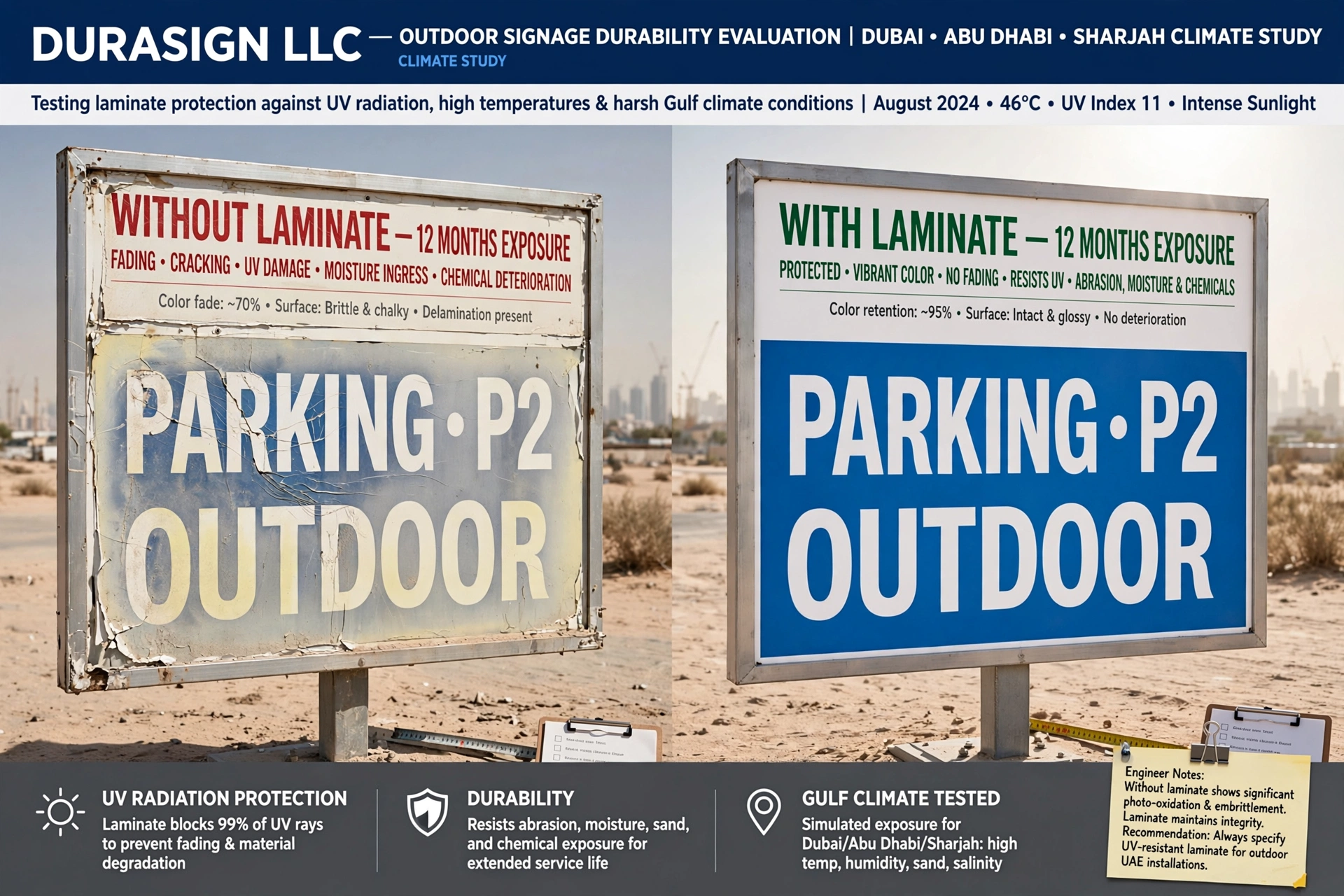
The UAE’s climate places considerable demands on outdoor signage materials. Direct sunlight exposes printed graphics to ultraviolet radiation that can gradually cause fading, while high temperatures can influence adhesive behavior and film stability.
For outdoor signage in Dubai, Abu Dhabi, Sharjah, and other Emirates, signage companies should evaluate the manufacturer’s stated outdoor durability, ink compatibility, laminate requirements, and expected environmental exposure.
Lamination can provide additional protection against UV radiation, abrasion, moisture, cleaning chemicals, and physical wear. The correct laminate should be compatible with the vinyl and intended application.
For high-value outdoor graphics, skipping an appropriate protective laminate simply to reduce initial production costs can shorten the useful life of the finished sign.
Why Lamination Should Be Considered
Lamination is a transparent protective layer applied over printed vinyl. It can be glossy, matte, satin, textured, anti-slip, or specialized for particular applications.
For outdoor graphics, laminate helps protect printed inks against UV exposure and physical abrasion. For vehicle graphics, it can provide additional resistance against road contaminants, washing, and environmental exposure.
Interior graphics may use matte laminates to reduce glare in brightly illuminated offices, shopping malls, exhibitions, and retail environments.
The laminate must be compatible with the base vinyl. Differences in flexibility, shrinkage, and thermal behavior can create problems if incompatible materials are combined.
How UAE Signage Companies Should Choose Between Them
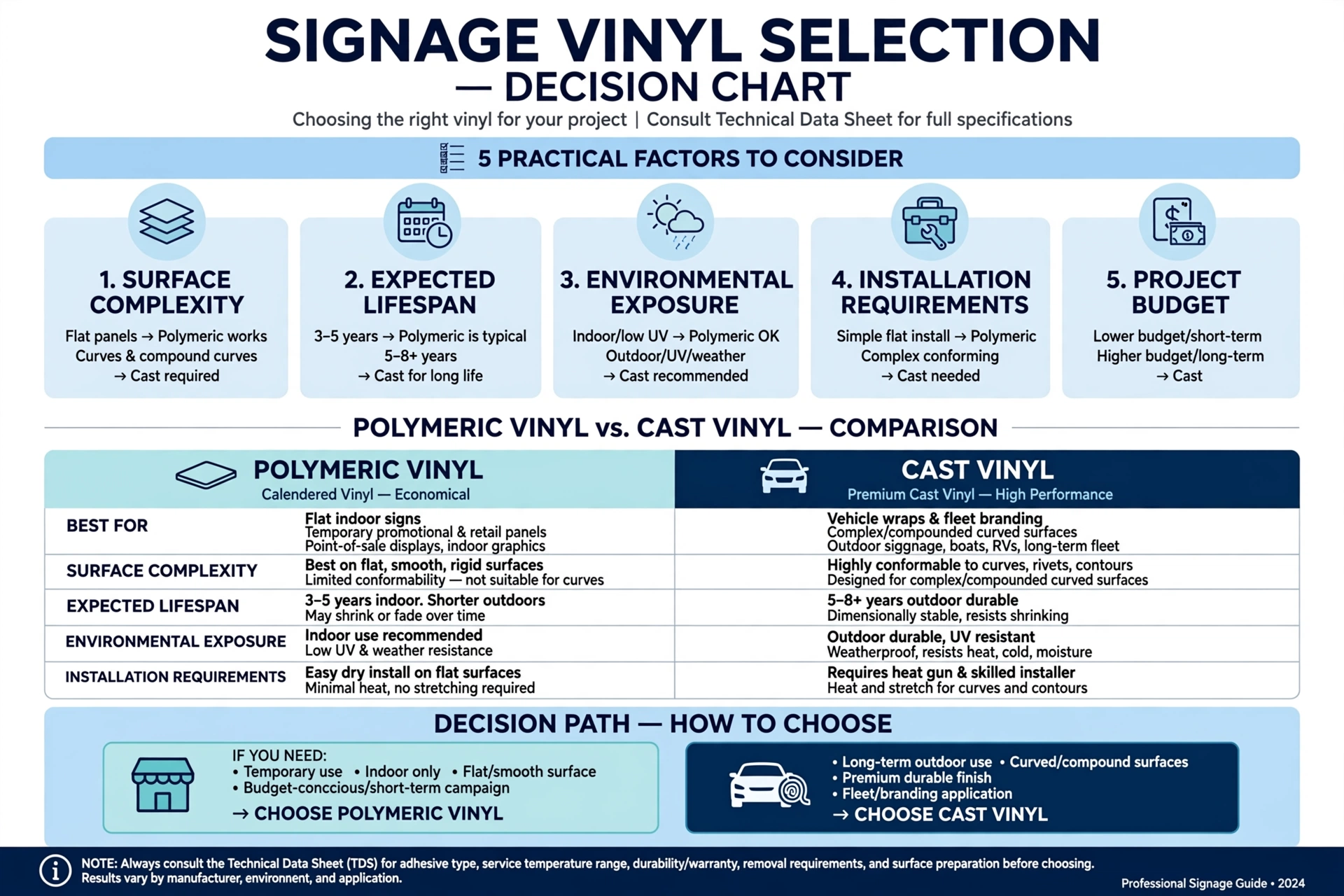
The best approach is to evaluate five practical factors: surface complexity, expected lifespan, environmental exposure, installation requirements, and project budget.
For flat indoor signs, temporary promotional graphics, retail panels, and standard commercial branding, polymeric vinyl will often provide the best balance of performance and cost.
For complex vehicle wraps, compound curves, premium fleet branding, and demanding long-term outdoor applications, cast vinyl generally provides better technical performance.
For projects where the substrate is unusual or the application conditions are demanding, signage companies should consult the vinyl manufacturer’s technical data sheet rather than relying solely on general assumptions.
A professional polymeric vinyl supplier can also help determine whether polymeric, cast, monomeric, transparent, frosted, greyback, or specialty vinyl is appropriate for the specific project.
Common Mistakes That Cause Vinyl Failure
Many vinyl failures are blamed on the material when the actual cause is poor installation or incorrect application.
Applying vinyl to contaminated surfaces, installing below the recommended temperature, stretching the film excessively, failing to post-heat appropriate cast films, using incompatible laminates, applying graphics to poorly cured paint, or selecting the wrong adhesive can all reduce service life.
Another common mistake is using a material outside its intended application. A film designed for flat signage should not automatically be stretched around deep vehicle recesses.
Professional signage production requires the material, printer, ink, laminate, adhesive, substrate, and installation method to work together as one system.
Polymeric vs. Cast Vinyl Comparison
| Feature | Polymeric Vinyl | Cast Vinyl |
|---|---|---|
| Manufacturing | Calendared | Cast |
| Cost | Generally lower | Generally higher |
| Flat surfaces | Excellent | Excellent |
| Moderate curves | Good | Excellent |
| Complex curves | Limited | Excellent |
| Vehicle wrapping | Suitable for selected applications | Preferred for demanding wraps |
| Dimensional stability | Very good | Excellent |
| Conformability | Good | Excellent |
| Long-term demanding applications | Good | Excellent |
| Typical signage | Excellent | Often unnecessary |
| Premium graphics | Good | Excellent |
| Cost efficiency | High | Higher initial investment |
The table demonstrates why there is no universal winner. Each material occupies a different position in professional signage production.
Final Recommendation for UAE Signage Professionals
For most standard signage applications, quality polymeric vinyl is the practical choice because it provides strong print performance, good durability, dimensional stability, and cost efficiency. It is particularly effective for flat and moderately curved surfaces used in retail, corporate, promotional, and commercial signage.
Cast vinyl becomes the better technical choice when maximum conformability, dimensional stability, and long-term performance are required, particularly for complex vehicle wraps, premium fleet graphics, compound curves, and demanding outdoor applications.
For UAE signage companies, the climate should always be considered during material selection. Strong UV exposure, heat, dust, humidity, and frequent cleaning can accelerate material deterioration when unsuitable products are used.
The most experienced signage professionals do not select vinyl based solely on price. They evaluate the substrate, application method, expected lifespan, environmental exposure, printer and ink combination, adhesive requirements, lamination system, and installation conditions. That approach produces more reliable graphics, reduces material waste, prevents premature failures, and ultimately delivers better value to the customer.
Understanding the difference between polymeric and cast vinyl therefore gives signage companies a significant practical advantage: use polymeric where its performance is sufficient, and invest in cast vinyl where the application genuinely demands it.