

Blogs
Digital Signage for Shopping Malls and Retail Stores in the UAE

Digital signage has become an important part of modern retail environments across the United Arab Emirates. Shopping malls, department stores, fashion outlets, supermarkets, electronics retailers, beauty stores, restaurants, banks, and entertainment venues increasingly use digital displays to communicate with customers in real time.
Unlike static posters and printed banners, digital signage allows businesses to change promotional messages, product information, advertisements, prices, schedules, directions, and branded content without physically replacing printed materials. This flexibility makes digital displays particularly valuable in high-traffic commercial environments.
The UAE provides a strong environment for digital signage because of its highly developed retail sector, tourism industry, premium shopping destinations, and technology-focused commercial infrastructure. Locations such as Dubai Mall, Mall of the Emirates, Dubai Festival City Mall, City Centre Mirdif, Yas Mall, Abu Dhabi Mall, Al Maryah Island, and Sharjah City Centre attract large numbers of shoppers and visitors, creating substantial opportunities for visual communication.
For retailers, however, successful digital signage is not simply about installing a large screen. Screen placement, brightness, resolution, viewing distance, content design, connectivity, maintenance, accessibility, and integration with the wider customer journey all influence performance.
Why Digital Signage Matters in UAE Retail
Retail environments are highly visual.
Customers encounter storefronts, product displays, promotional graphics, architectural features, advertisements, price information, wayfinding signs, and branded experiences throughout their shopping journey.
Digital signage adds another communication layer to this environment.
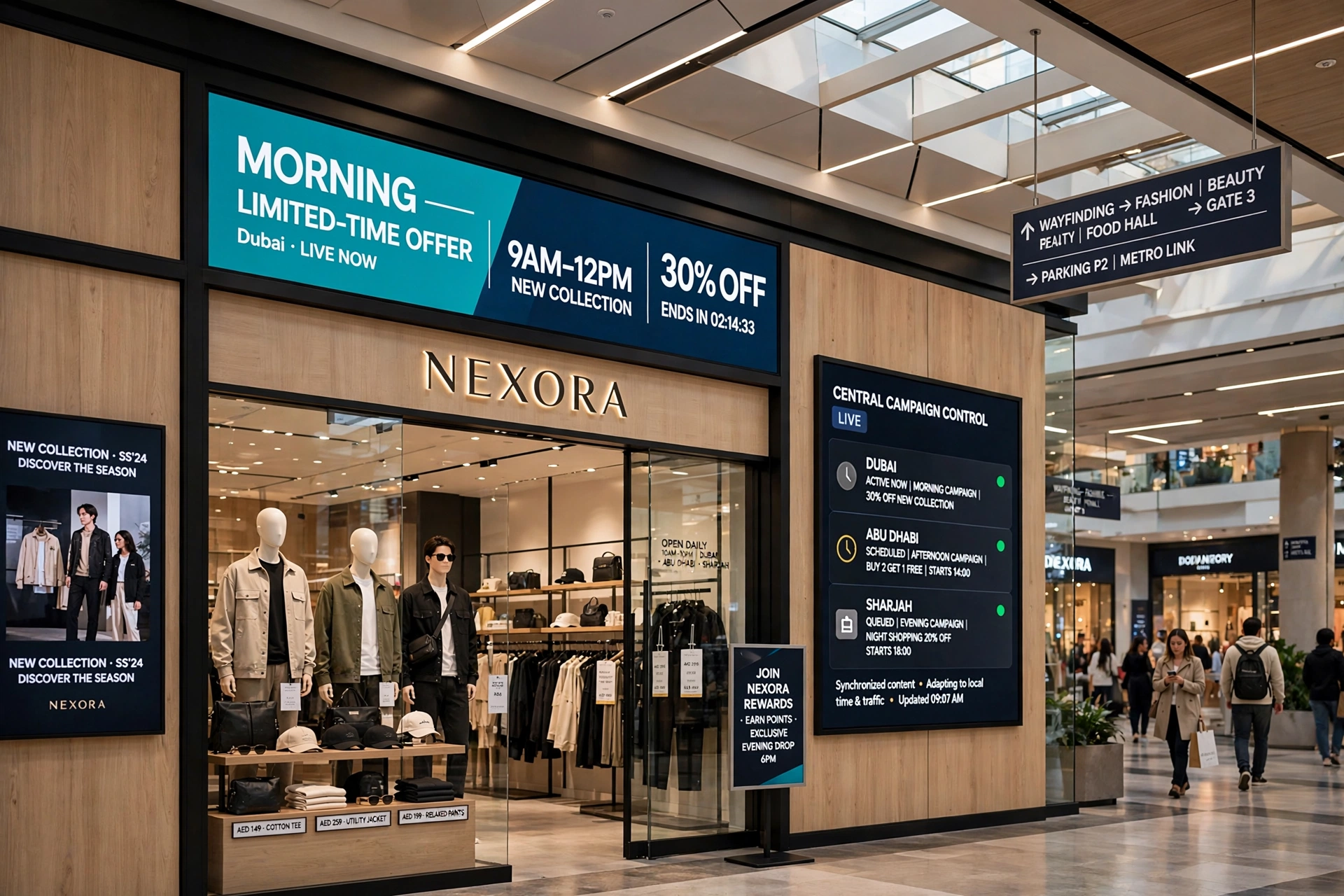
A retailer can use a display to promote a new collection in the morning, advertise a limited-time offer in the afternoon, and promote an evening campaign later in the day.
This flexibility is particularly useful for businesses operating in shopping malls where customer traffic can vary throughout the day.
Digital displays can also support a consistent brand identity across multiple branches.
A retail company with stores in Dubai, Abu Dhabi, and Sharjah can manage content centrally while adapting campaigns to individual locations.
Digital Signage in Shopping Malls
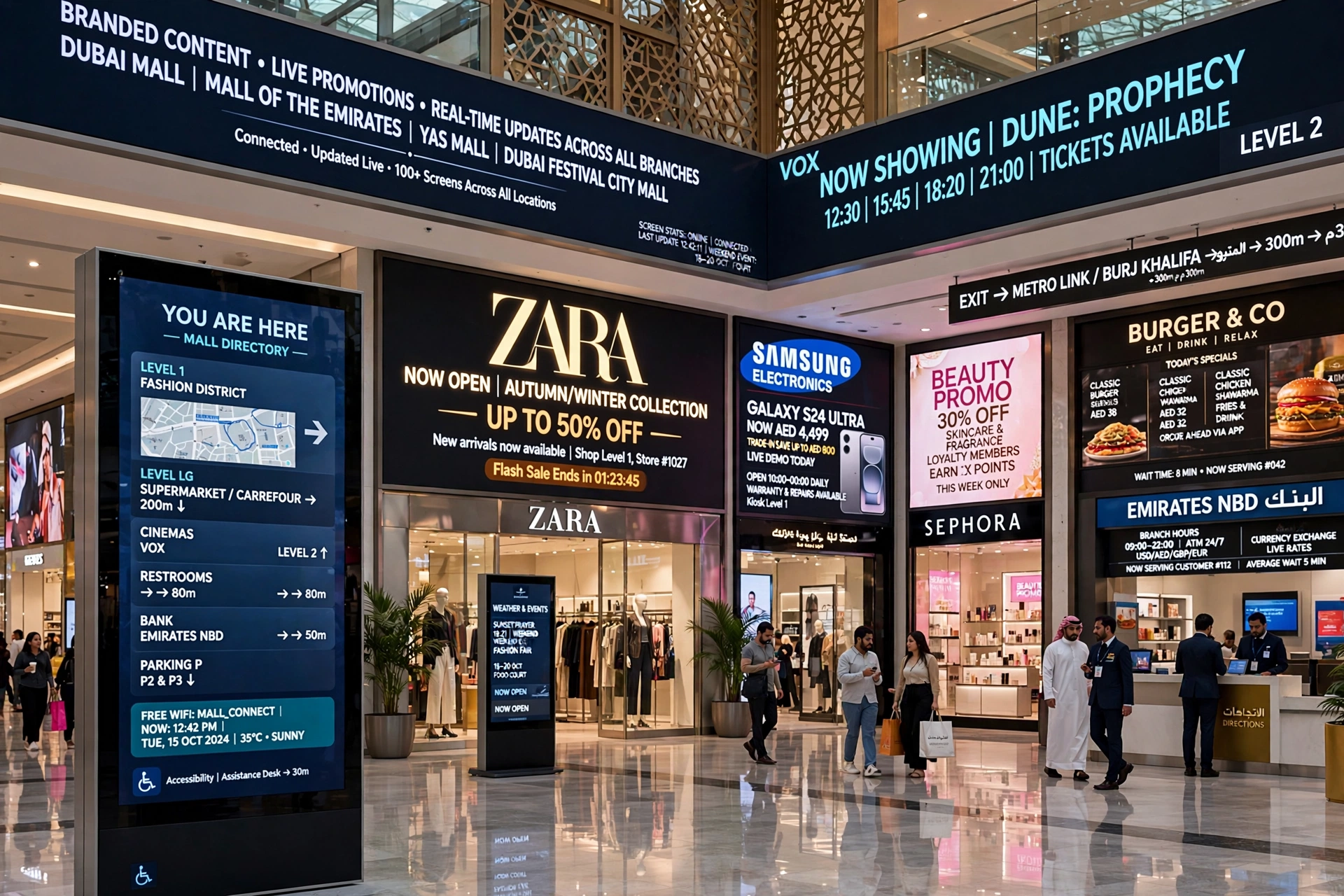
Shopping malls are among the most suitable environments for digital signage because they contain multiple brands, customer journeys, common areas, food and beverage outlets, entertainment facilities, and high-traffic corridors.
Digital displays can serve several purposes within the same mall.
They can provide wayfinding, advertising, event promotion, tenant communication, public information, promotional campaigns, directory services, and branded content.
Large digital displays can be positioned in atriums or entrances to create visual impact, while smaller screens can provide information near elevators, escalators, corridors, parking areas, and individual stores.
The objective should always be linked to the location of the display.
A screen near a mall entrance may focus on awareness and promotions, while a screen near a specific retail zone may provide directions or highlight nearby offers.
Digital Signage for Retail Stores
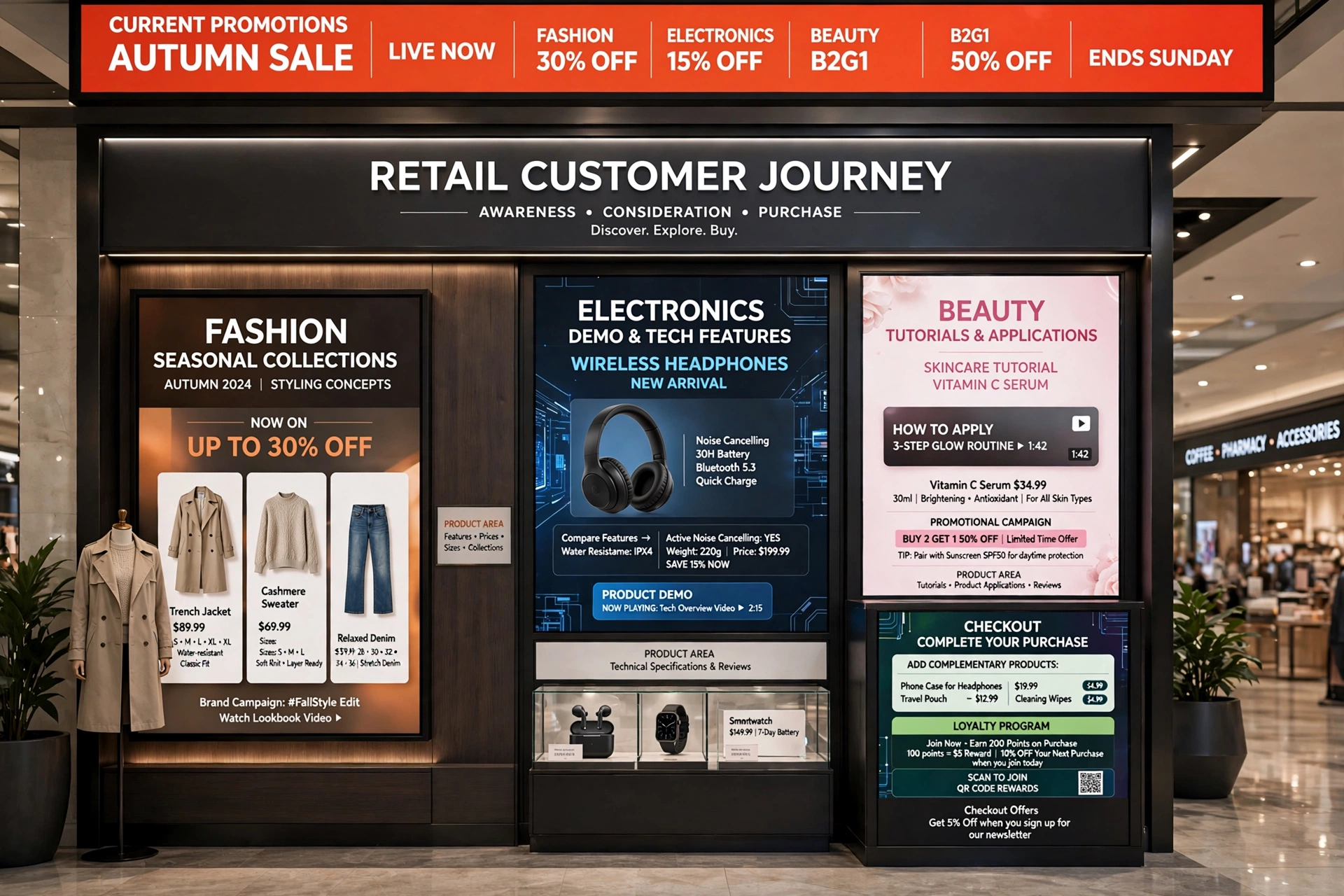
Retail stores can use digital signage throughout the customer journey.
A storefront display can attract attention from people walking through the mall.
An entrance screen can introduce current promotions.
Product-area displays can provide information about features, prices, sizes, or product collections.
Checkout-area screens can promote complementary products or loyalty programs.
Digital signage can therefore support customers from initial awareness through product consideration and purchase.
For fashion retailers, for example, digital screens can display seasonal collections, styling concepts, brand campaigns, and product videos.
Electronics stores can use displays to demonstrate products and explain technical features.
Beauty retailers can showcase tutorials, product applications, and promotional campaigns.
Digital Signage and Customer Experience
One of the strongest advantages of digital signage is its ability to improve the customer experience when content is useful and appropriately positioned.
Customers visiting a large shopping mall may need information about stores, restaurants, facilities, parking, entrances, elevators, or entertainment areas.
Digital displays can help reduce confusion by providing visual guidance.
Interactive displays can take this further by allowing users to search for a store, select a category, find a particular brand, or identify the shortest route to a destination.
This can be especially useful in large shopping environments where customers may not immediately know where a particular store or facility is located.
Digital Wayfinding for Shopping Malls
Wayfinding is one of the most practical applications of digital signage.
A modern digital wayfinding system can display:
Store directories: Customers can search for individual retailers.
Floor information: Displays can show different shopping levels.
Directions: Visual maps can guide customers toward a destination.
Facilities: Restrooms, prayer rooms, customer service desks, parking zones, and elevators can be identified.
Promotions: Relevant retail offers can be displayed alongside directions.
The system should use clear typography, recognizable icons, appropriate contrast, and simple navigation.
The objective is to reduce cognitive effort rather than overwhelm visitors with information.
Digital Advertising Screens for Mall Advertising
Shopping malls provide valuable advertising opportunities because customers are already in a commercial environment.
Digital advertising screens can be used by mall tenants, brands, event organizers, property developers, financial institutions, automotive companies, hospitality businesses, and other advertisers.
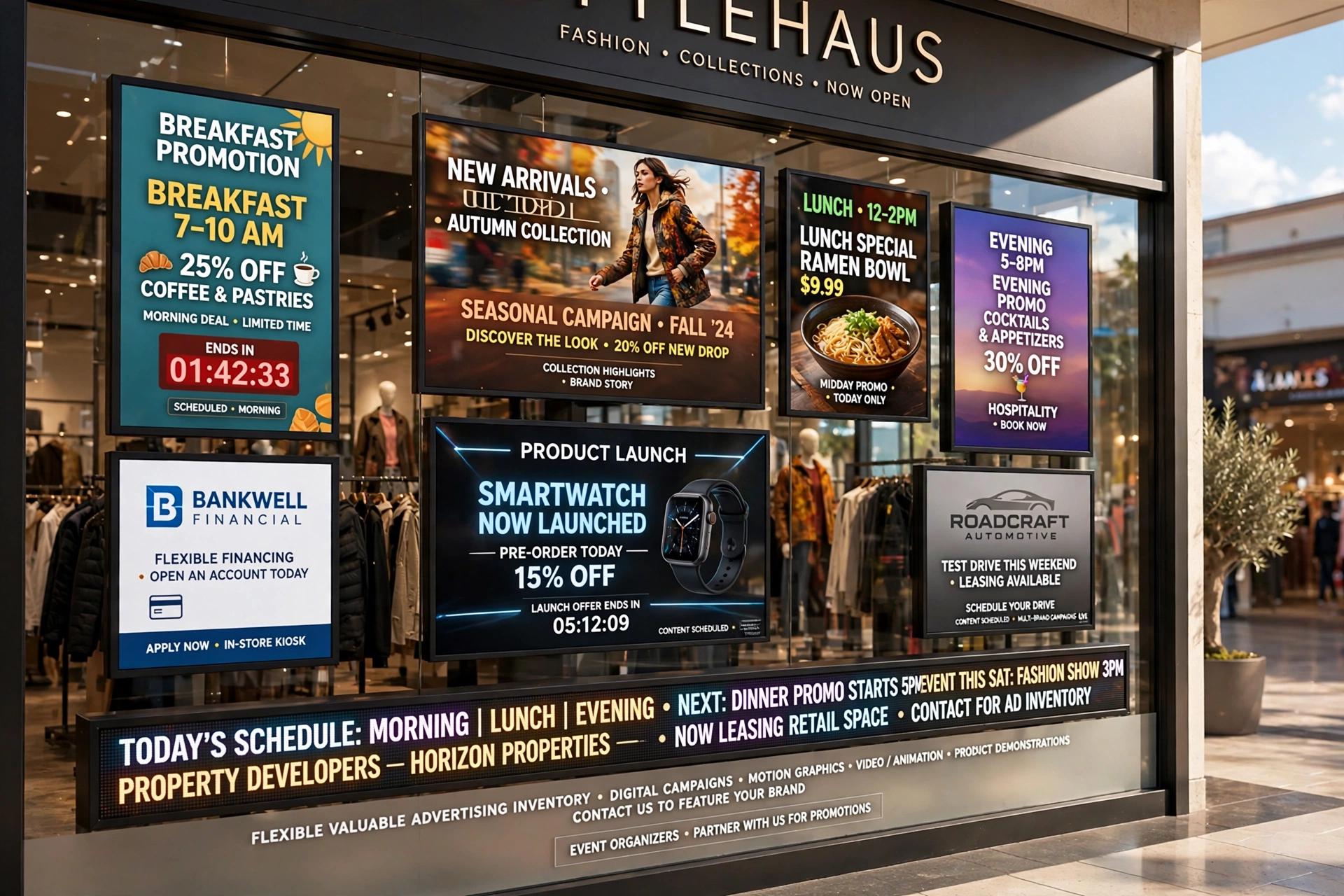
Unlike static advertising, digital campaigns can include motion graphics, video, animation, product demonstrations, countdowns, and time-sensitive promotions.
Content can also be scheduled.
A breakfast promotion can run in the morning, lunch offers during midday, and evening promotions later.
This allows advertising inventory to become more flexible and potentially more valuable.
Retail Window Digital Signage
Retail windows are one of the first points of contact between a store and potential customers.
Digital window displays can communicate promotional messages even before a customer enters.
For fashion stores, window screens can display:
- New arrivals
- Seasonal campaigns
- Fashion videos
- Product launches
- Discount campaigns
- Brand stories
- Collection highlights
Brightness needs to be carefully considered because window displays can experience strong ambient light.
A screen that looks excellent indoors may appear insufficiently bright when positioned behind glass exposed to direct sunlight.
Indoor Digital Signage Displays
Indoor displays typically operate in controlled lighting conditions.
They can be installed on walls, columns, kiosks, retail counters, entrances, or suspended structures.
The appropriate screen size depends on viewing distance and available space.
A small screen positioned close to customers may be more effective than a large screen viewed from too far away.
Retailers should therefore determine the expected viewing distance before selecting the display.
Outdoor Digital Signage in the UAE
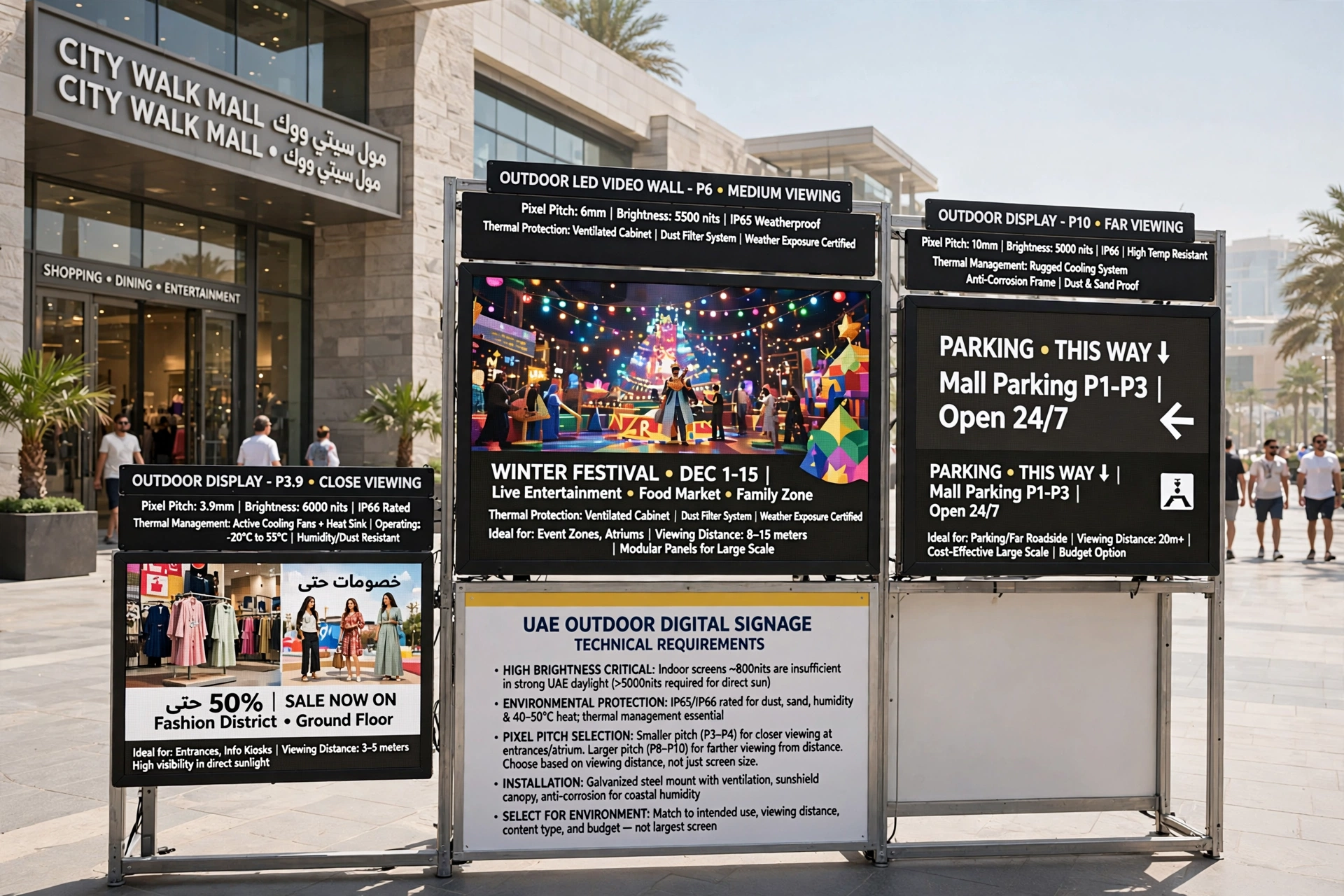
Outdoor digital signage has different technical requirements.
Displays installed outside shopping malls or retail properties may experience:
- Direct sunlight
- High temperatures
- Dust
- Humidity
- Weather exposure
- Temperature fluctuations
Outdoor displays therefore require suitable brightness, protection, thermal management, and installation methods.
Brightness is particularly important.
A screen designed for indoor use may not provide sufficient visibility under strong UAE daylight conditions.
Outdoor digital signage should be selected according to its intended environment rather than simply choosing the largest available screen.
LED Video Walls for Shopping Malls
Large LED video walls can create high-impact visual experiences in mall atriums, entrances, event areas, and entertainment zones.
LED technology allows manufacturers and integrators to create large-format displays using modular panels.
Pixel pitch is an important specification.
A smaller pixel pitch is generally suitable for closer viewing distances, while larger pixel pitches may be appropriate for displays viewed from farther away.
The correct pixel pitch should therefore be selected based on screen size, viewing distance, content type, and budget.
LCD Commercial Displays
LCD commercial displays remain useful for many retail applications.
They can provide high-resolution content in stores, corridors, meeting areas, reception zones, directories, and promotional locations.
Commercial-grade displays are designed for more demanding operating schedules than many consumer televisions.
Retailers should consider operating hours, expected screen uptime, ventilation, mounting requirements, connectivity, warranty, and service support when selecting commercial displays.
The objective is to choose equipment suitable for continuous commercial use.
Digital Menu Boards for Food Courts and Restaurants
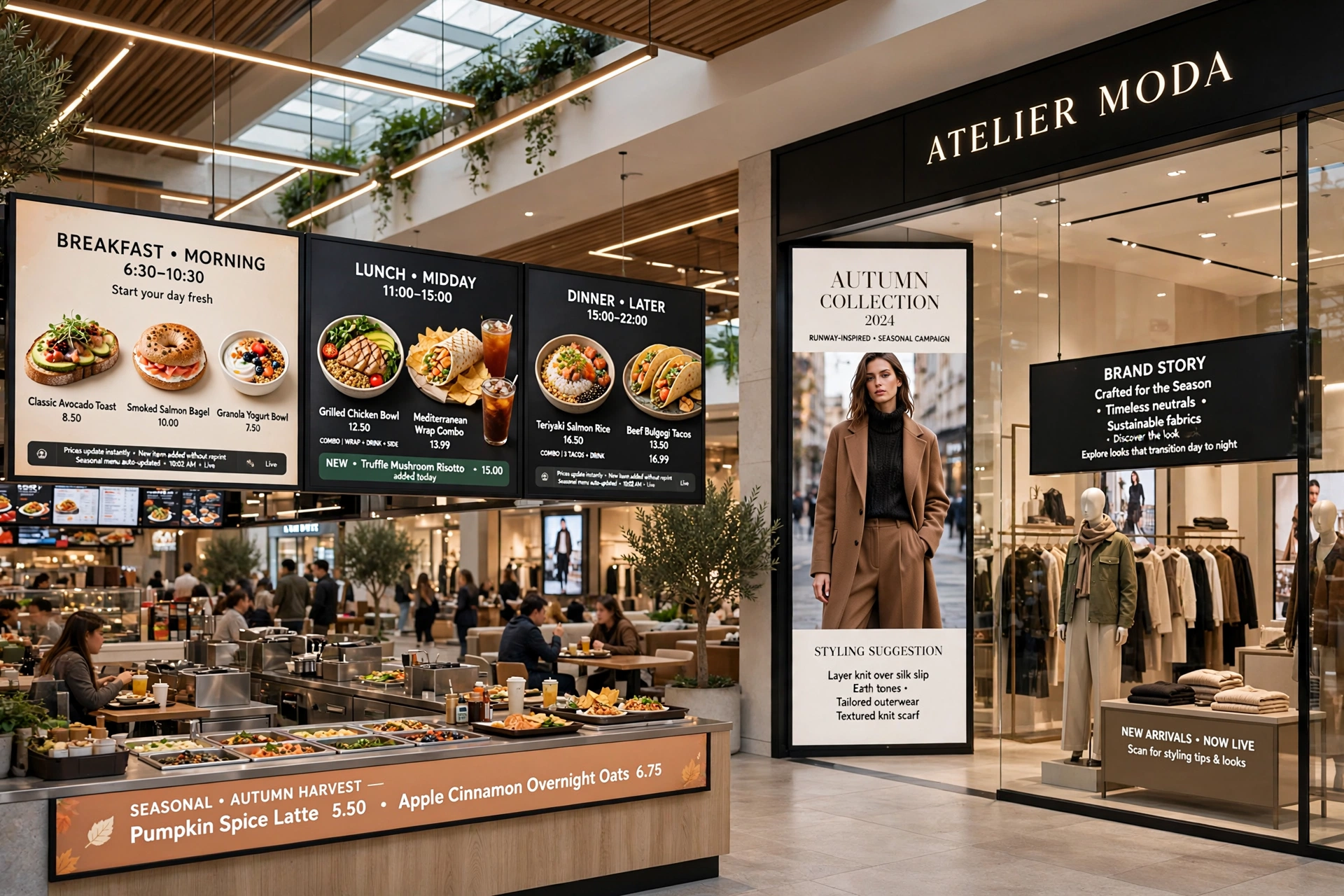
Food courts and restaurants within shopping malls can use digital menu boards to display food images, prices, meal combinations, promotions, and seasonal items.
Digital menus make it easier to update pricing or introduce new products without redesigning and printing physical boards.
Content can also be organized according to meal periods.
For example, breakfast content can be displayed in the morning, lunch combinations during midday, and dinner promotions later in the day.
Food imagery should be optimized for screen viewing.
Poor-quality images or excessive text can reduce the effectiveness of the display.
Digital Signage for Fashion Retail
Fashion is a particularly visual retail category.
Digital displays can be used to create lifestyle-oriented experiences rather than simply presenting product information.
Retailers can show models wearing new collections, seasonal campaigns, styling suggestions, runway-inspired content, or brand stories.
Screens positioned near product displays can connect digital content with physical merchandise.
For premium fashion brands, the design of the digital content should also reflect the brand’s visual identity.
Typography, motion, photography, color palette, and transitions should feel consistent with the brand.
Digital Signage for Electronics Stores
Electronics retailers can use digital displays to demonstrate product features.
A screen positioned next to a television, laptop, smartphone, camera, or home appliance can explain key specifications.
Video demonstrations can show products in operation.
This can help customers understand technical features without relying entirely on sales staff.
Interactive displays can also provide comparison tools where appropriate.
This makes digital signage a potential sales-support tool rather than simply an advertising medium.
Digital Signage for Supermarkets
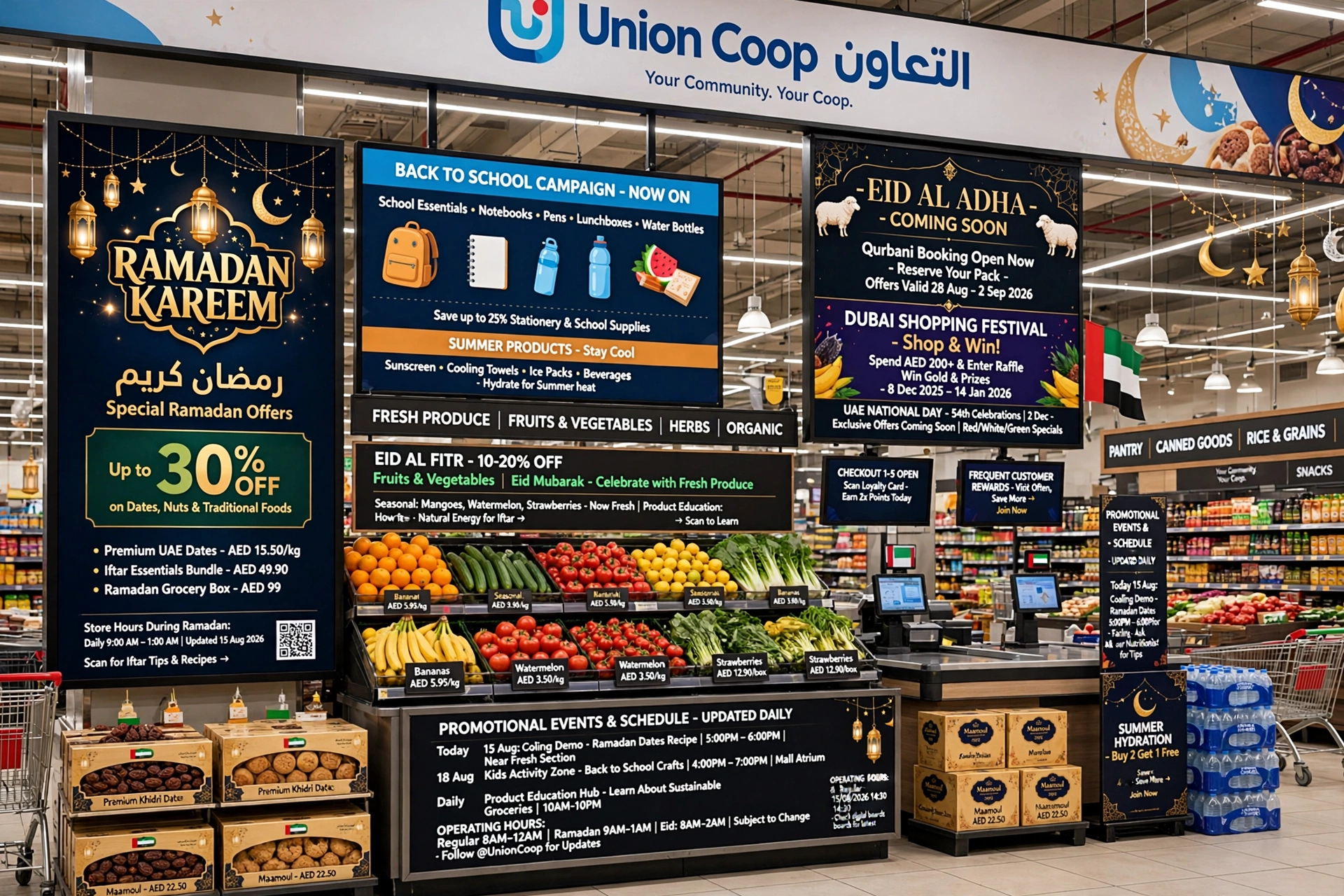
Supermarkets can use digital displays for promotions, product education, seasonal campaigns, category navigation, and brand advertising.
Displays can be positioned near entrances, aisles, checkout areas, fresh-food sections, or promotional zones.
Content can be updated according to inventory and campaign schedules.
For example, seasonal content can promote Ramadan products, Eid offers, back-to-school campaigns, summer products, or special grocery promotions.
Because supermarkets often experience frequent customer visits, dynamic content can help maintain visual interest.
Digital Signage During Ramadan and UAE Events
The UAE retail calendar includes important seasonal periods such as Ramadan, Eid Al Fitr, Eid Al Adha, UAE National Day, Dubai Shopping Festival, and major promotional events.
Digital signage allows retailers and malls to adapt content quickly for these periods.
A mall can update displays with event schedules, seasonal greetings, promotions, entertainment information, and special operating hours.
This flexibility is particularly valuable during campaigns where information changes frequently.
Content should remain culturally appropriate and consistent with the brand and venue.
Content Management Systems for Digital Signage
A digital signage system typically includes more than the screen.
A complete setup may involve a commercial display, media player, content management system, network connection, mounting structure, software, and monitoring system.
The content management system allows authorized users to upload, schedule, organize, and update content.
For a retailer with multiple branches, centralized management can simplify campaign deployment.
For example, a new promotional video can be uploaded once and distributed to multiple stores.
Individual locations can then receive localized content when required.
Scheduling Digital Signage Content
Scheduling makes digital signage more useful than static advertising.
A business can determine when specific content appears.
This can be based on:
- Time of day
- Day of week
- Promotional period
- Store location
- Customer segment
- Seasonal event
- Product campaign
A restaurant can schedule breakfast content in the morning.
A shopping mall can display event information during specific hours.
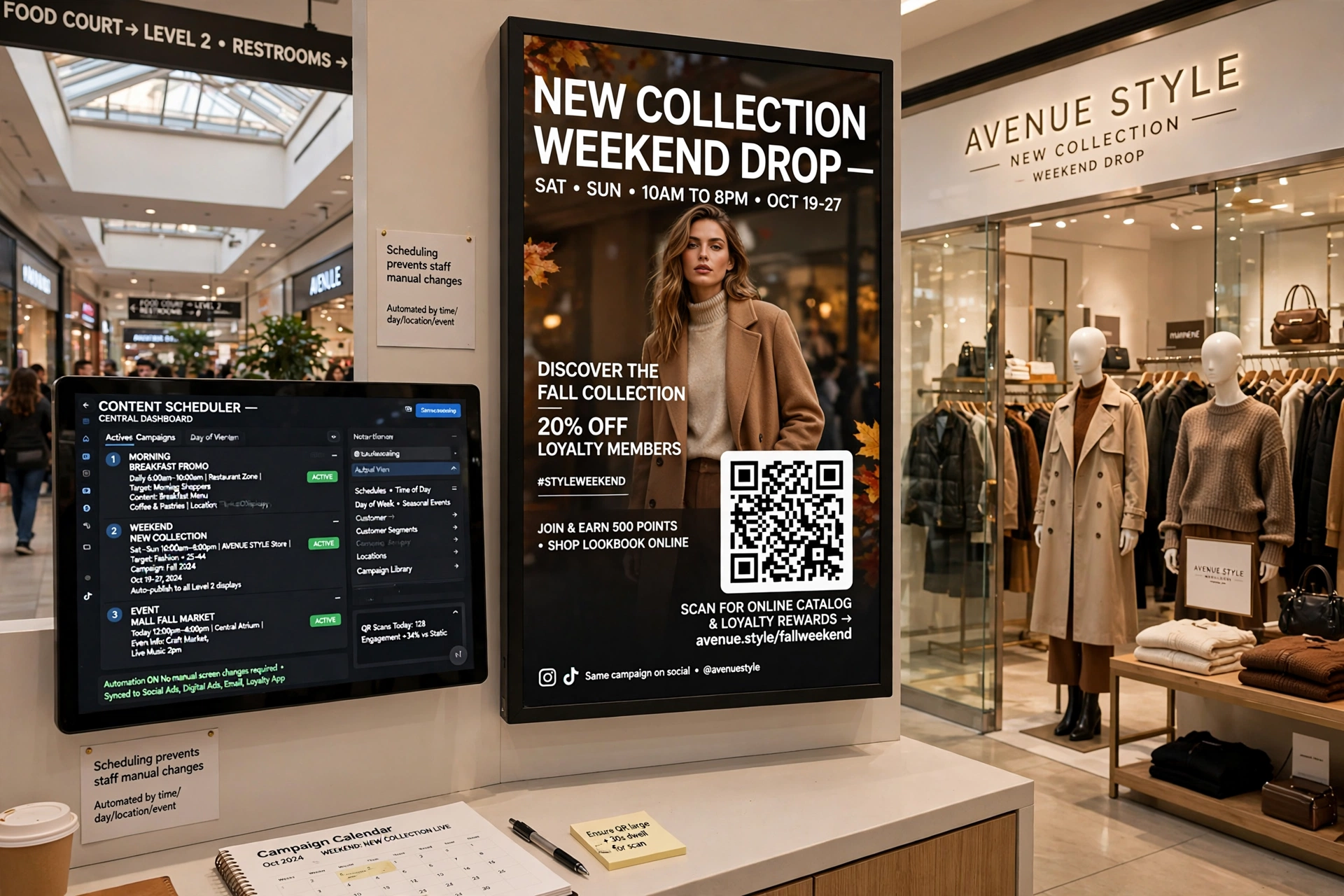
A fashion retailer can promote a new collection throughout the weekend.
Scheduling also helps prevent staff from manually changing screens.
Connecting Digital Signage With Retail Marketing
Digital signage should be integrated with the broader marketing strategy.
A campaign may begin on social media, continue through digital advertising, and appear inside the physical retail environment.
Consistent campaign imagery can help customers recognize the same promotion across different channels.
Retailers can also use QR codes on digital displays to connect physical audiences with digital experiences.
For example, a screen could promote a product and provide a QR code leading to product information, an online catalog, loyalty program, or promotional landing page.
The QR code should be large enough and displayed long enough to be realistically scanned.
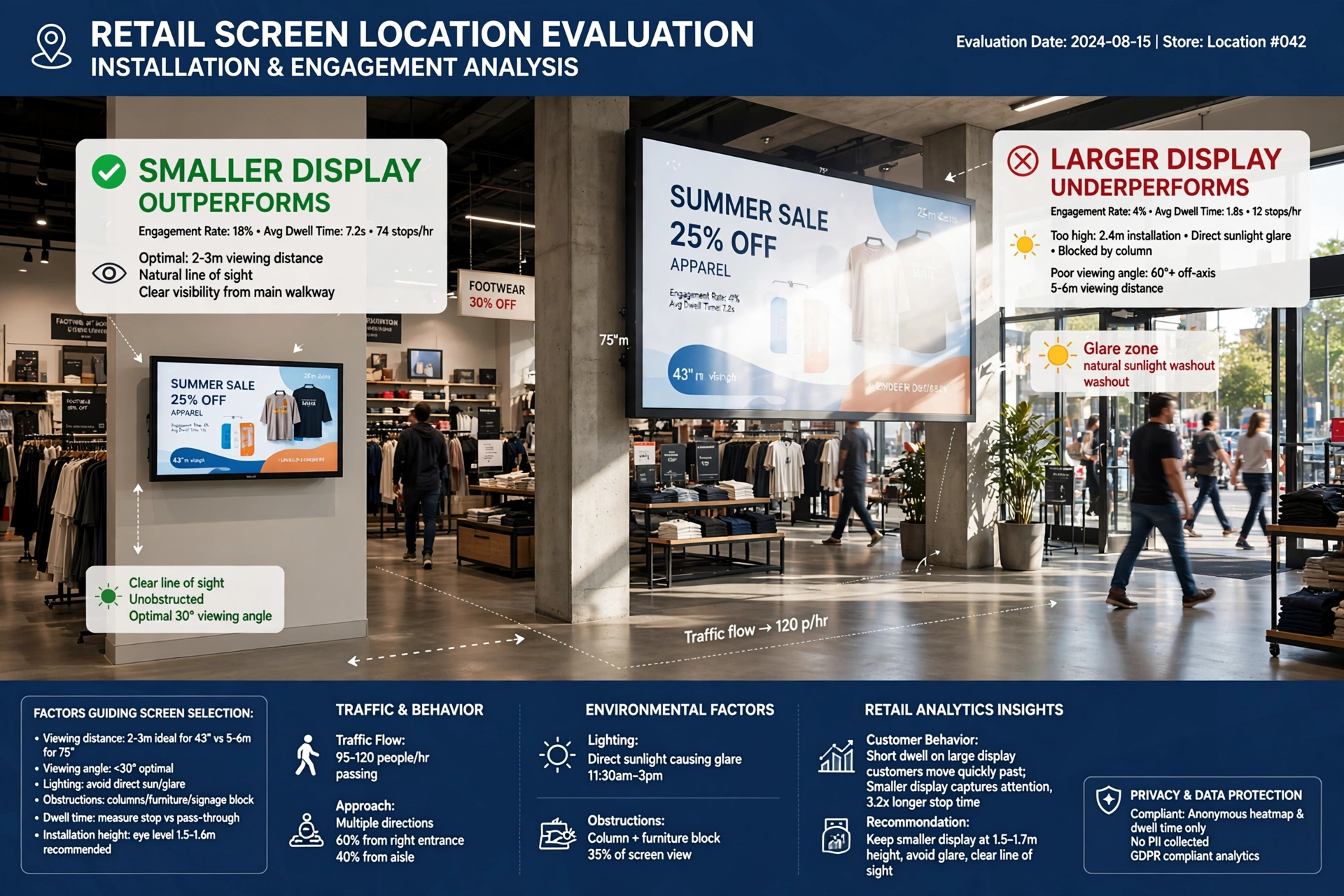
Screen Placement Is More Important Than Screen Size
One of the biggest mistakes in digital signage is assuming that a larger screen automatically produces better results.
Visibility depends on placement.
A smaller display positioned directly within a customer’s natural line of sight can outperform a much larger display placed in an unsuitable location.
Before installation, businesses should evaluate:
Viewing distance: How far away will customers normally stand?
Viewing angle: Will people approach from different directions?
Lighting: Is there direct sunlight or glare?
Traffic flow: How many people pass the location?
Obstructions: Could columns, displays, furniture, or signage block the screen?
Dwell time: Do customers stop in this area or move quickly?
These factors should guide screen selection and installation height.
Digital Signage and Retail Analytics
Advanced digital signage environments can integrate with analytics technologies depending on the system.
Retailers may use analytics to understand traffic patterns, campaign performance, screen engagement, or customer behavior.
However, any system involving cameras, customer data, or personal information should be designed and operated according to applicable privacy and data-protection requirements.
Analytics should support business decisions without compromising customer trust.
Maintenance of Digital Signage Systems
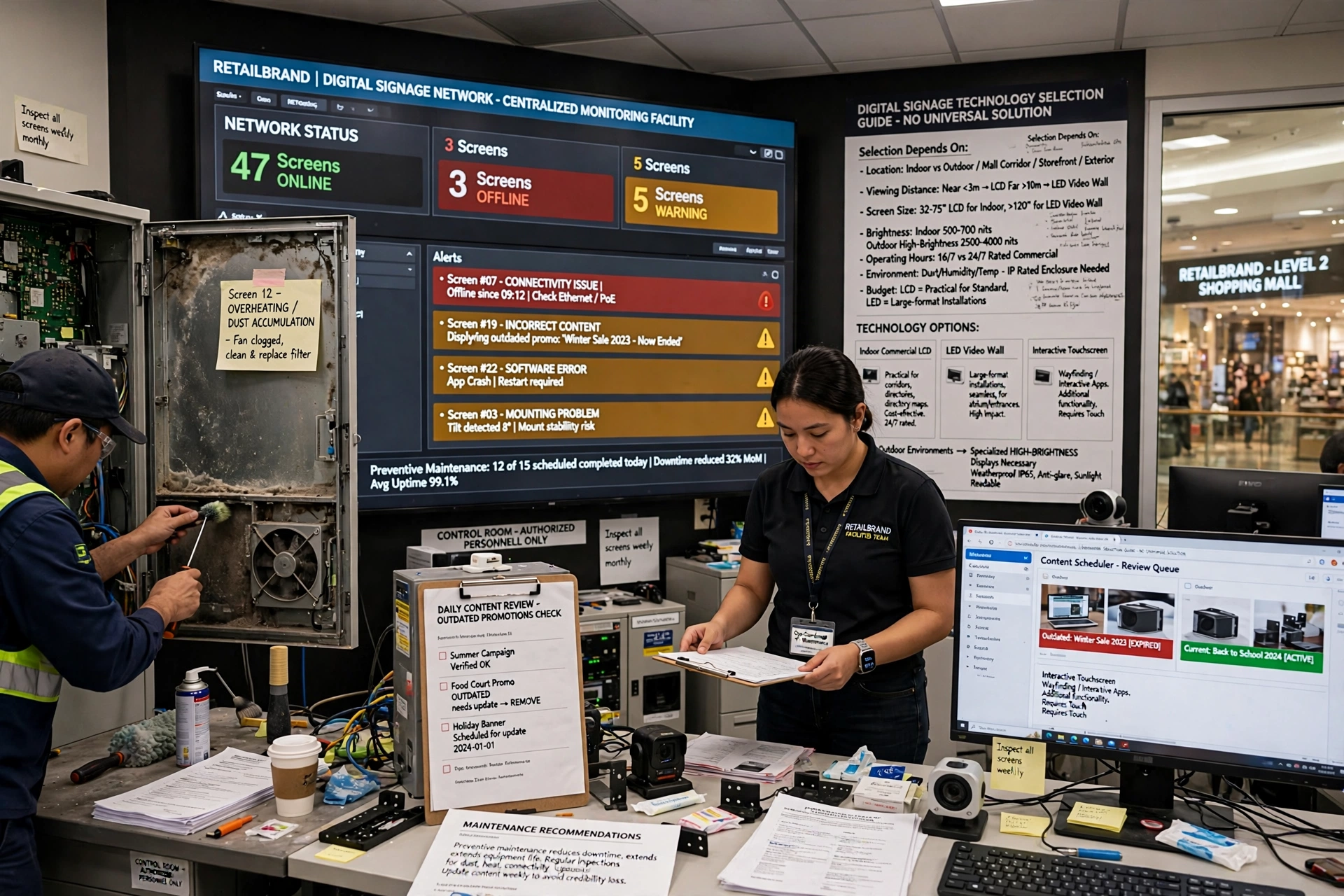
A digital signage network needs ongoing maintenance.
Screens should be inspected for display faults, connectivity issues, overheating, dust accumulation, mounting problems, and software errors.
Content should also be reviewed regularly.
Outdated promotions can damage the credibility of a retail brand.
For shopping malls, centralized monitoring can help facility teams identify screens that are offline or displaying incorrect content.
Preventive maintenance can reduce downtime and extend equipment life.
Choosing the Right Digital Signage Technology
There is no universal display technology for every retail application.
The selection depends on location, viewing distance, screen size, content, brightness, operating hours, budget, and environmental conditions.
For some indoor applications, commercial LCD displays may be practical.
For large-format installations, LED video walls may be more appropriate.
For interactive applications, touchscreen displays may provide additional functionality.
For outdoor environments, specialized high-brightness displays may be necessary.
The technology should therefore follow the application.
Digital Signage Installation Considerations
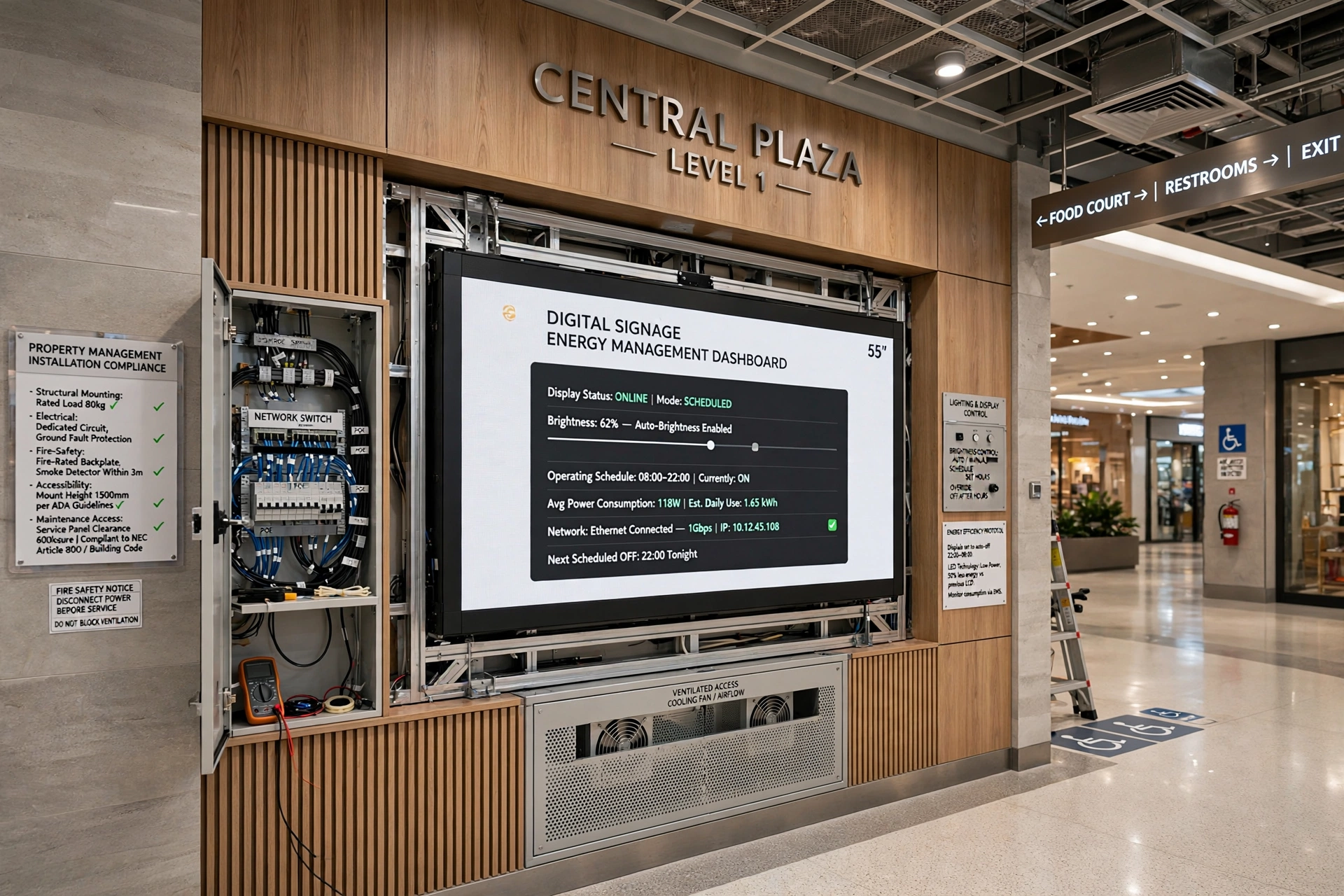
Professional installation should account for structural mounting, electrical requirements, ventilation, cable management, network connectivity, accessibility for maintenance, and overall visual integration.
A display should not appear as an isolated piece of technology.
The mounting structure, surrounding wall, lighting, branding, and architectural elements should create a cohesive installation.
For shopping malls, installation also needs to coordinate with property management and relevant building requirements.
Electrical and fire-safety considerations should be addressed before installation.
Digital Signage and Energy Efficiency
Large digital signage networks can consume significant energy, particularly when displays operate for extended periods.
Businesses can improve efficiency by selecting appropriate commercial displays, scheduling operating hours, using brightness controls, and turning displays off when they are not needed where operationally appropriate.
LED technology can also provide energy-efficient illumination compared with older display technologies, although actual consumption depends on screen size, brightness, content, and operating hours.
Energy management should therefore be considered during system design.
Digital Signage in Dubai, Abu Dhabi and Sharjah
The demand for digital retail communication extends across the UAE.
Dubai has major shopping destinations and a strong tourism-driven retail environment.
Abu Dhabi combines large shopping malls, luxury retail, government-related commercial activity, hospitality, and residential developments.
Sharjah has growing retail, family entertainment, residential, and commercial environments.
Other areas such as Ajman, Ras Al Khaimah, and Fujairah also provide opportunities for digital signage across retail, hospitality, education, healthcare, and commercial properties.
The local environment should influence the design.
A high-end mall installation may require a very different system from a neighborhood retail store.
Digital Signage for Premium Retail Environments
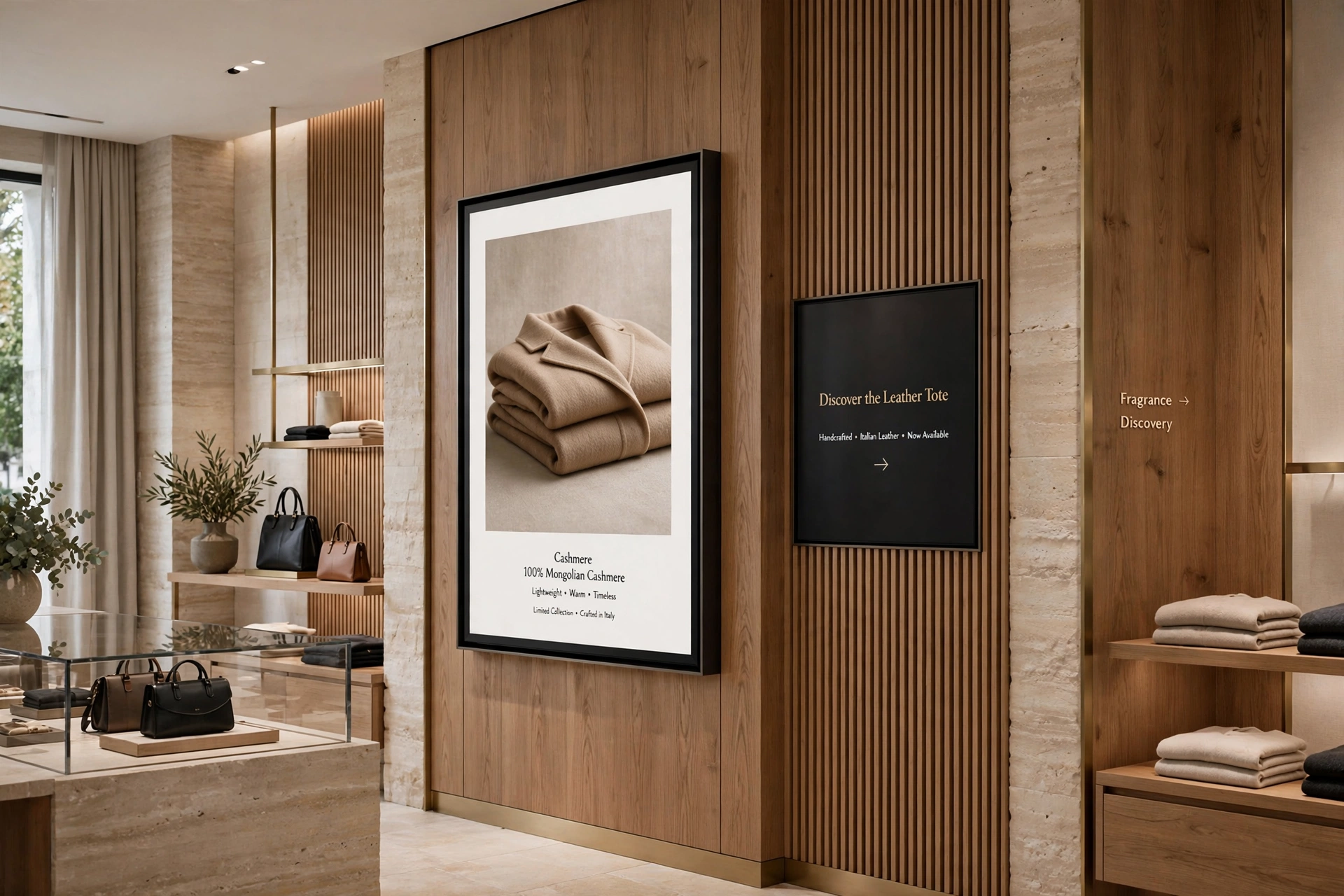
Luxury retail requires careful attention to visual quality.
Screens should not make the store feel overly commercial if the brand relies on exclusivity.
High-quality content, accurate color reproduction, clean installation, concealed cabling, appropriate brightness, and premium mounting solutions can help digital displays integrate into luxury environments.
For premium brands, the display itself becomes part of the interior architecture.
The technology should support the brand rather than dominate it.
How Digital Signage Can Support Retail Sales
Digital signage does not guarantee sales, but it can support several stages of the purchasing journey.
It can attract attention, introduce products, explain features, communicate promotions, reinforce branding, and direct customers toward specific areas.
The effectiveness depends on content quality and relevance.
A screen filled with too much text may be ignored.
Short, visually clear messages are often easier to process in a moving retail environment.
Content should be designed around the amount of time customers realistically have to view it.
Designing Effective Digital Signage Content
Effective content is usually clear, visually strong, and easy to understand quickly.
Important information should have strong visual hierarchy.
The headline should be readable.
Images should be high quality.
Animations should support the message rather than distract from it.
Branding should be visible but not overwhelming.
Calls to action should be simple.
The content should also be tested from the actual viewing distance.
A design that looks excellent on a computer monitor may become difficult to read when displayed several meters away.
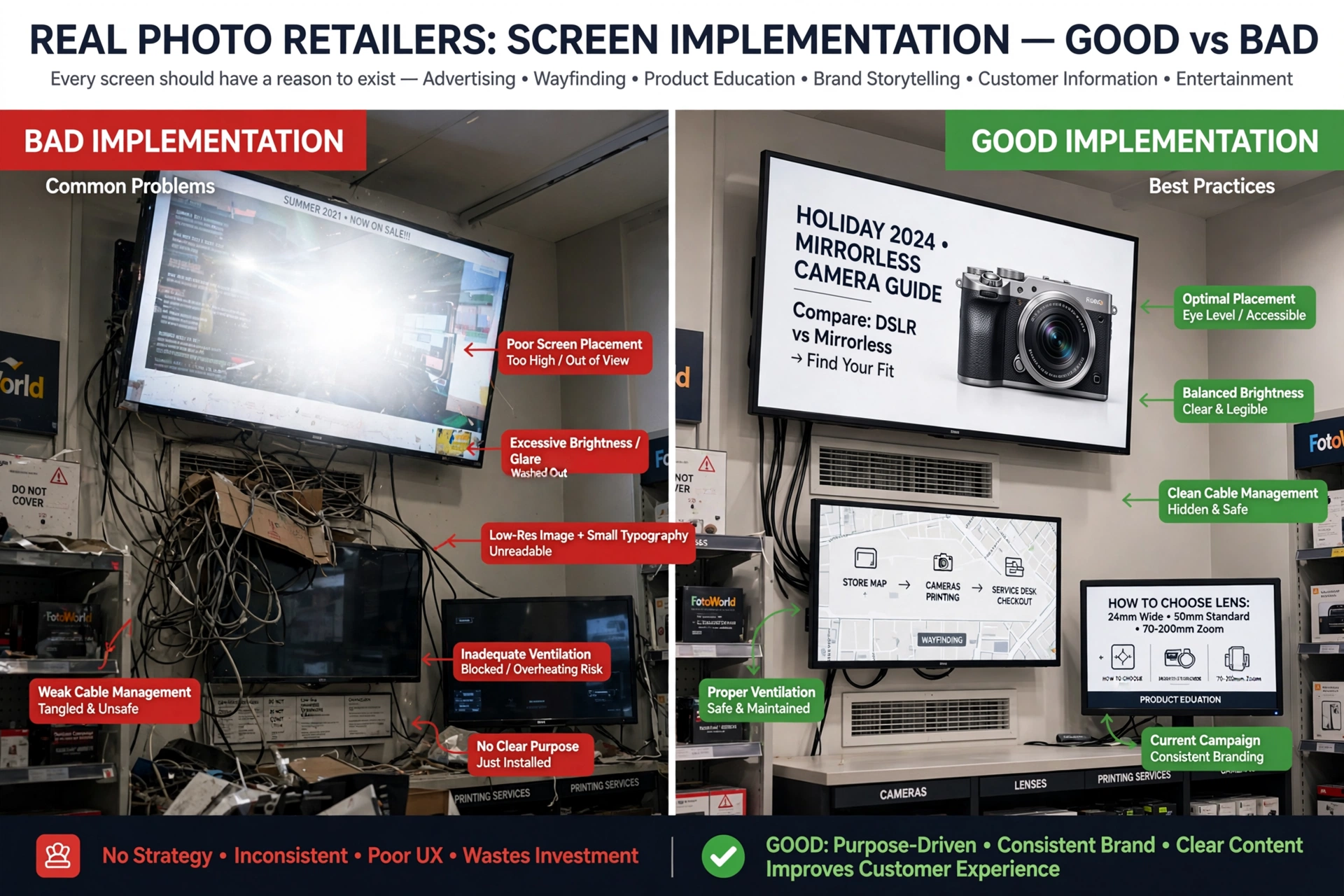
Common Digital Signage Mistakes in Retail
Retailers sometimes focus heavily on hardware while neglecting content.
Other common problems include poor screen placement, excessive brightness, insufficient brightness, outdated campaigns, low-resolution images, small typography, weak cable management, inadequate ventilation, and inconsistent branding.
Another mistake is installing screens without defining their purpose.
Every screen should have a reason to exist.
Is it advertising?
Wayfinding?
Product education?
Brand storytelling?
Customer information?
Entertainment?
The answer should influence the screen’s size, location, content, and technology.
Building a Scalable Digital Signage Network
Businesses planning multiple stores should think beyond a single screen.
A scalable system can allow new displays and locations to be added without replacing the entire infrastructure.
Centralized content management, standardized hardware specifications, remote monitoring, network connectivity, and consistent content templates can simplify expansion.
This is particularly useful for retailers operating across multiple emirates.
A well-planned digital signage network can become part of the company’s long-term retail infrastructure.
Conclusion
Digital signage has become an increasingly valuable communication tool for shopping malls and retail stores across the UAE.
From large LED video walls and digital advertising screens to indoor commercial displays, interactive kiosks, digital directories, window displays, and menu boards, the technology can support multiple stages of the customer journey.
The greatest value comes when digital signage is integrated with retail design, customer experience, advertising, wayfinding, branding, content management, analytics, and operational planning.
For shopping malls, digital displays can help visitors navigate large spaces, discover stores, learn about events, and engage with promotions.
For retailers, screens can showcase products, communicate offers, demonstrate features, strengthen brand identity, and create more dynamic in-store experiences.
However, successful implementation requires more than purchasing screens. Businesses need to consider brightness, resolution, pixel pitch, viewing distance, screen size, placement, commercial-grade hardware, connectivity, CMS software, installation, maintenance, energy consumption, and content strategy.
Dubai, Abu Dhabi, Sharjah, and other UAE markets provide strong opportunities for retailers and mall operators to use digital communication as part of modern customer experience strategies.
When technology, content, architecture, and retail objectives are planned together, Digital Signage for Shopping Malls can become more than an advertising tool. It can become an integrated part of the shopping environment that helps customers discover, navigate, engage, and interact with retail spaces more effectively.