

Blogs
Acrylic Sheets: Complete Guide for Signage, Displays and Fabrication

Acrylic sheets are among the most widely used transparent and colored plastic sheet materials in modern signage, retail displays, exhibition systems, interior design, architectural fabrication, and visual communication. Known chemically as polymethyl methacrylate (PMMA), acrylic is valued for its optical clarity, relatively low weight, weather resistance, surface appearance, and ability to be cut and fabricated into customized shapes.
For signage manufacturers, advertising companies, retail fit-out contractors, exhibition specialists, interior designers, and fabricators in the UAE, acrylic provides a practical alternative to traditional materials such as glass and, for certain applications, polycarbonate or PVC.
However, choosing acrylic correctly requires more than selecting a color or thickness. Acrylic type, sheet thickness, surface finish, light transmission, fabrication method, environmental exposure, mounting system, and intended application all affect the final result.
This guide explains how acrylic sheets work, where they are used, how they are fabricated, and what buyers should consider before selecting material for a signage, display, or fabrication project.
What Are Acrylic Sheets?
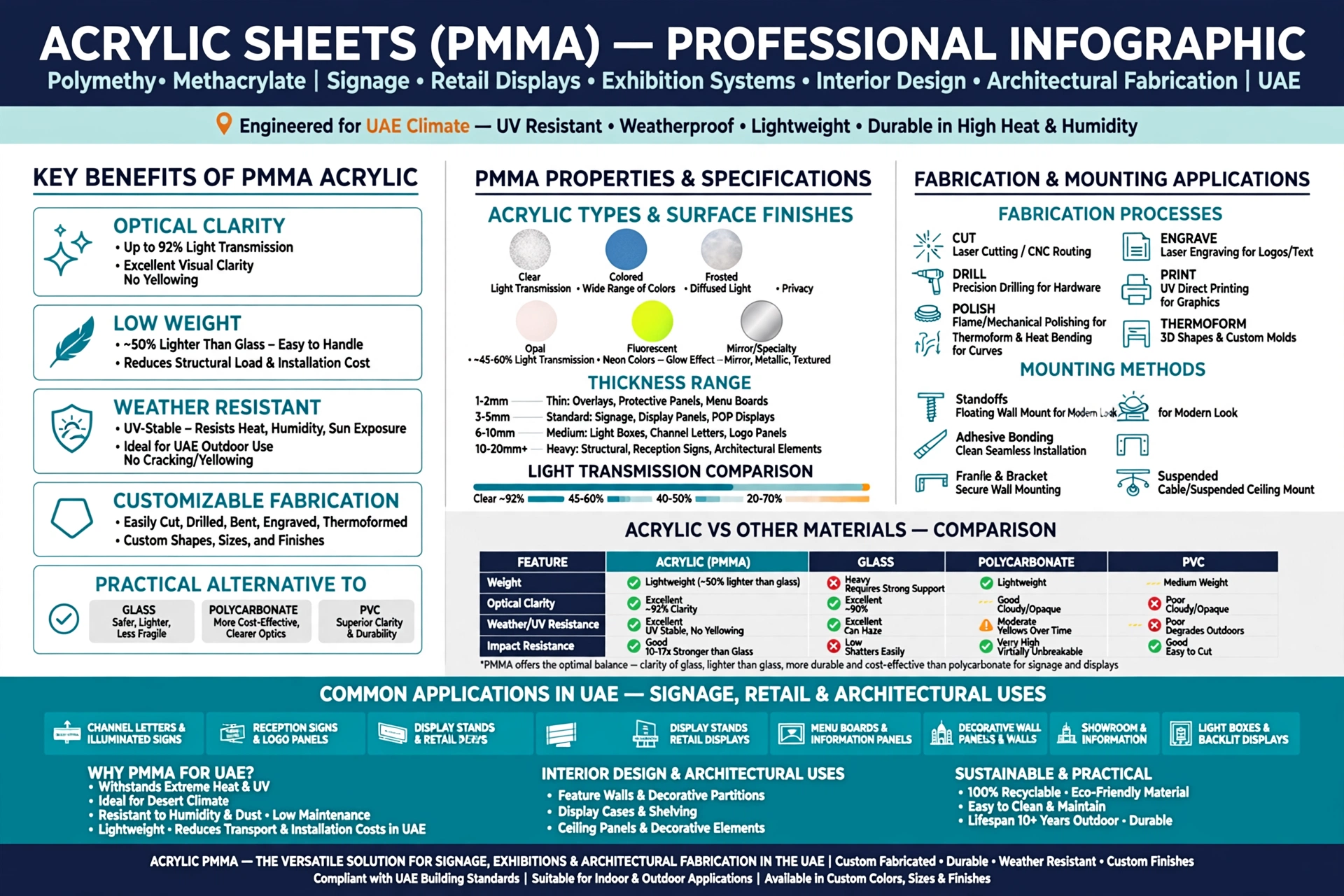
Acrylic sheets are rigid thermoplastic panels manufactured from polymethyl methacrylate. The material is commonly recognized for its glass-like optical appearance combined with lower weight and easier fabrication.
Clear acrylic can provide excellent transparency, while colored, frosted, opal, fluorescent, mirror, and specialty finishes can create different visual effects.
In the signage industry, acrylic is frequently used for channel letters, illuminated signs, reception signs, logo panels, display stands, menu boards, light boxes, directional signs, retail displays, and decorative panels.
Its popularity comes from the combination of appearance and workability. Fabricators can cut, drill, polish, bend, engrave, print, and thermoform acrylic depending on the grade and application.
Why Acrylic Is Popular for Signage
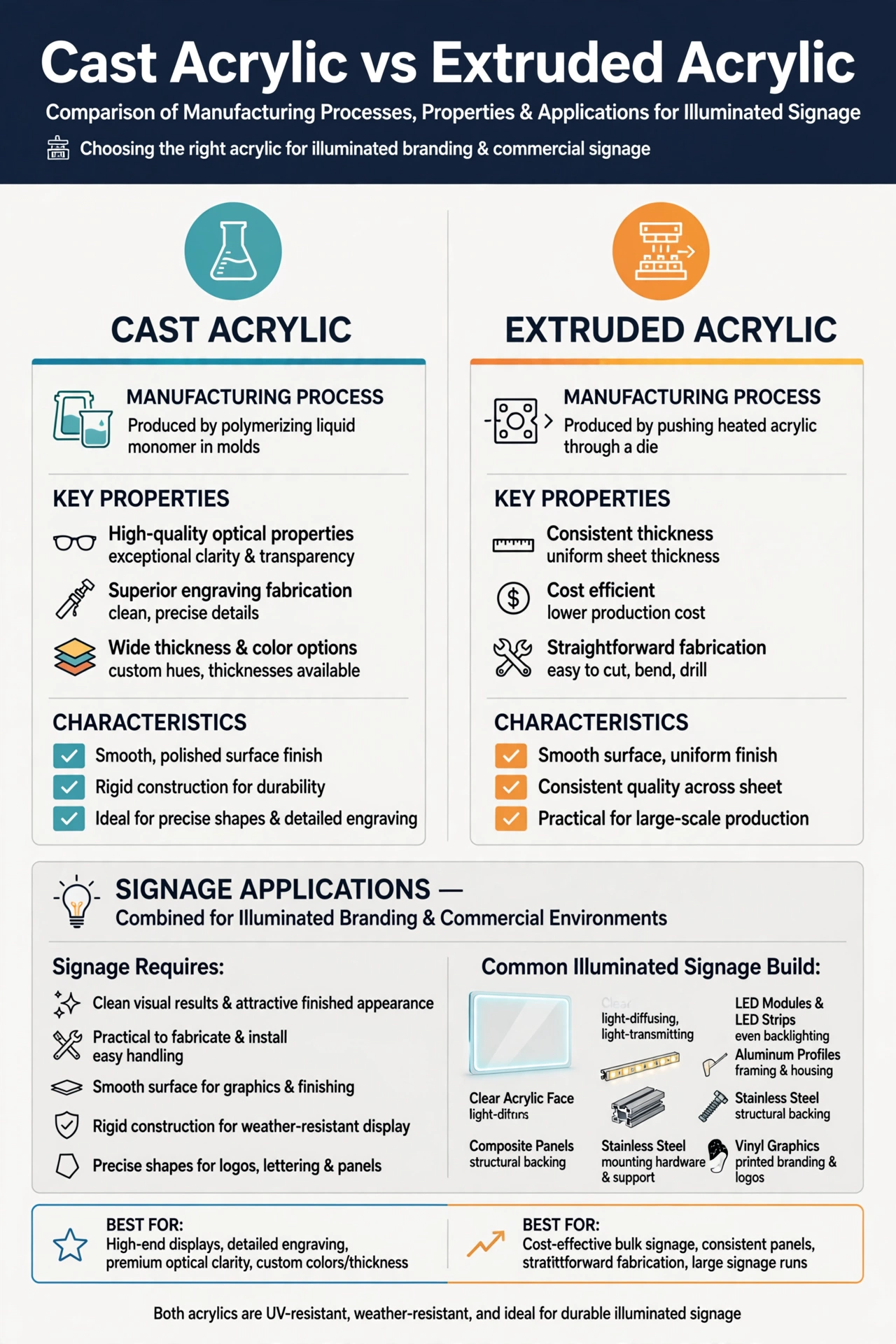
Signage requires materials that can produce clean visual results while remaining practical to fabricate and install.
Acrylic performs well in this environment because its smooth surface provides an attractive finished appearance and its rigid construction allows manufacturers to create precise shapes.
Clear acrylic can be combined with LED modules, LED strips, aluminum profiles, aluminum composite panels, stainless steel, vinyl graphics, and other signage materials.
For illuminated signage, acrylic can also act as a light-diffusing or light-transmitting face depending on its formulation and finish.
This makes it useful for businesses requiring illuminated branding in commercial environments.
Cast Acrylic vs Extruded Acrylic
One of the most important distinctions when purchasing acrylic sheets is the manufacturing process.
The two major categories are cast acrylic and extruded acrylic.
Cast acrylic is produced by polymerizing the acrylic material in molds. It is commonly selected for applications requiring high-quality optical properties, engraving, fabrication, or specific thickness and color options.
Extruded acrylic is produced by pushing the material through a die. It can provide consistent thickness and is often used where cost efficiency and straightforward fabrication are important.
The correct choice depends on the project.
A signage fabricator may prefer cast acrylic for certain detailed engraving or premium display applications, while extruded acrylic may be suitable for projects where consistent sheet dimensions and cost control are priorities.
Choosing the Correct Acrylic Sheet Thickness
Acrylic is available in different thicknesses, and thickness selection should be based on the application’s structural and visual requirements.
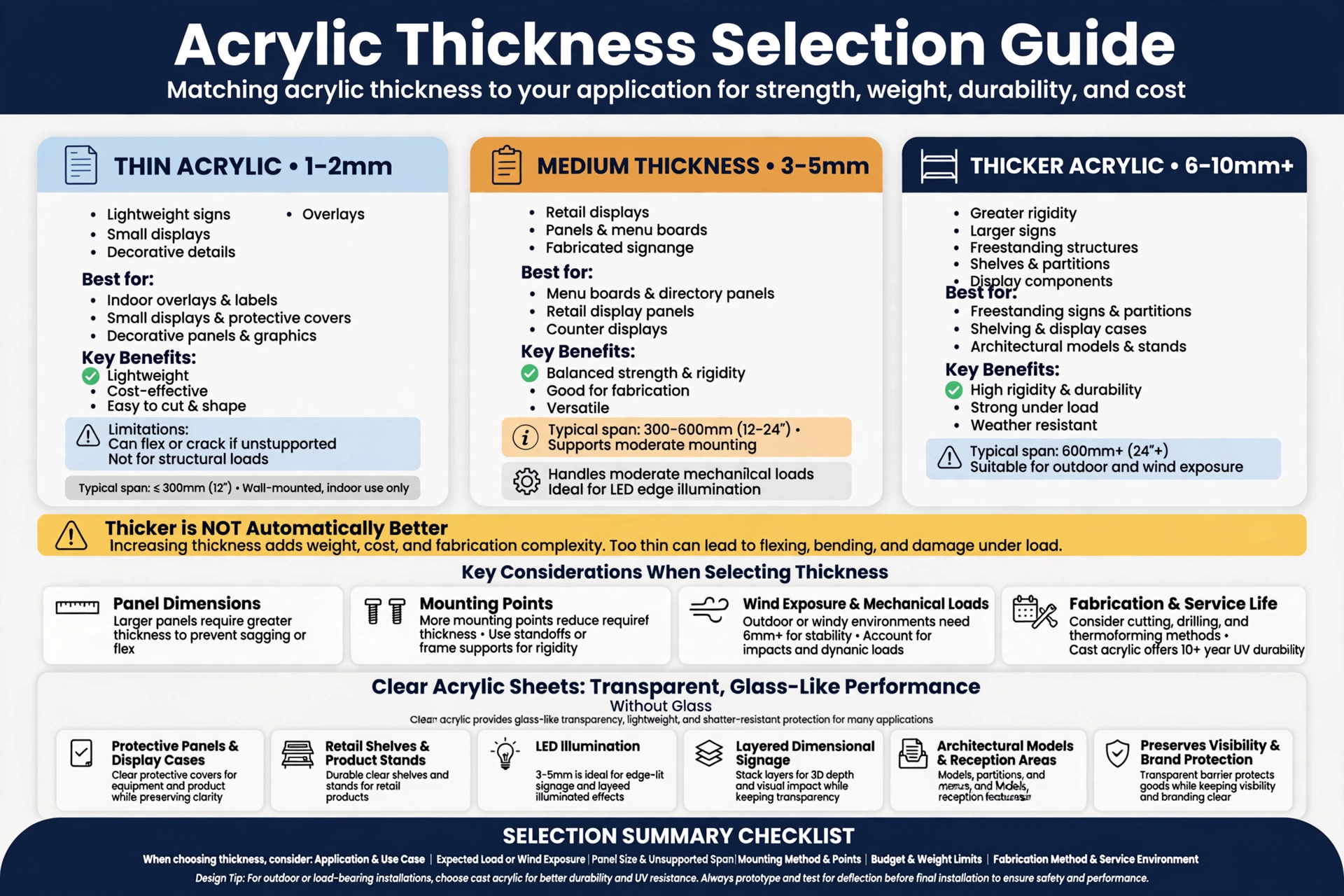
Thin acrylic can be suitable for lightweight signs, overlays, small display components, and certain decorative applications.
Medium-thickness sheets may be appropriate for retail displays, panels, menu boards, and fabricated signage.
Thicker acrylic can provide greater rigidity for larger signs, freestanding structures, shelves, partitions, and substantial display components.
However, thicker does not automatically mean better.
Using unnecessarily thick material increases weight and material cost. Using material that is too thin can result in excessive flexing or damage during fabrication and installation.
Professional fabricators therefore consider panel dimensions, mounting points, unsupported spans, wind exposure, mechanical loads, fabrication method, and intended service life before selecting thickness.
Clear Acrylic Sheets for Visual Communication
Clear acrylic is one of the most recognizable acrylic products.
It can be used when a project requires a transparent or glass-like appearance without using actual glass.
Applications include protective panels, display cases, retail shelves, brochure holders, menu displays, architectural models, product stands, reception areas, and decorative structures.
Clear acrylic can also be combined with printed graphics, vinyl lettering, LED illumination, or layered construction to create dimensional signage.
Its transparency makes it particularly useful where designers want to preserve visibility while adding branding or protection.
Colored Acrylic Sheets
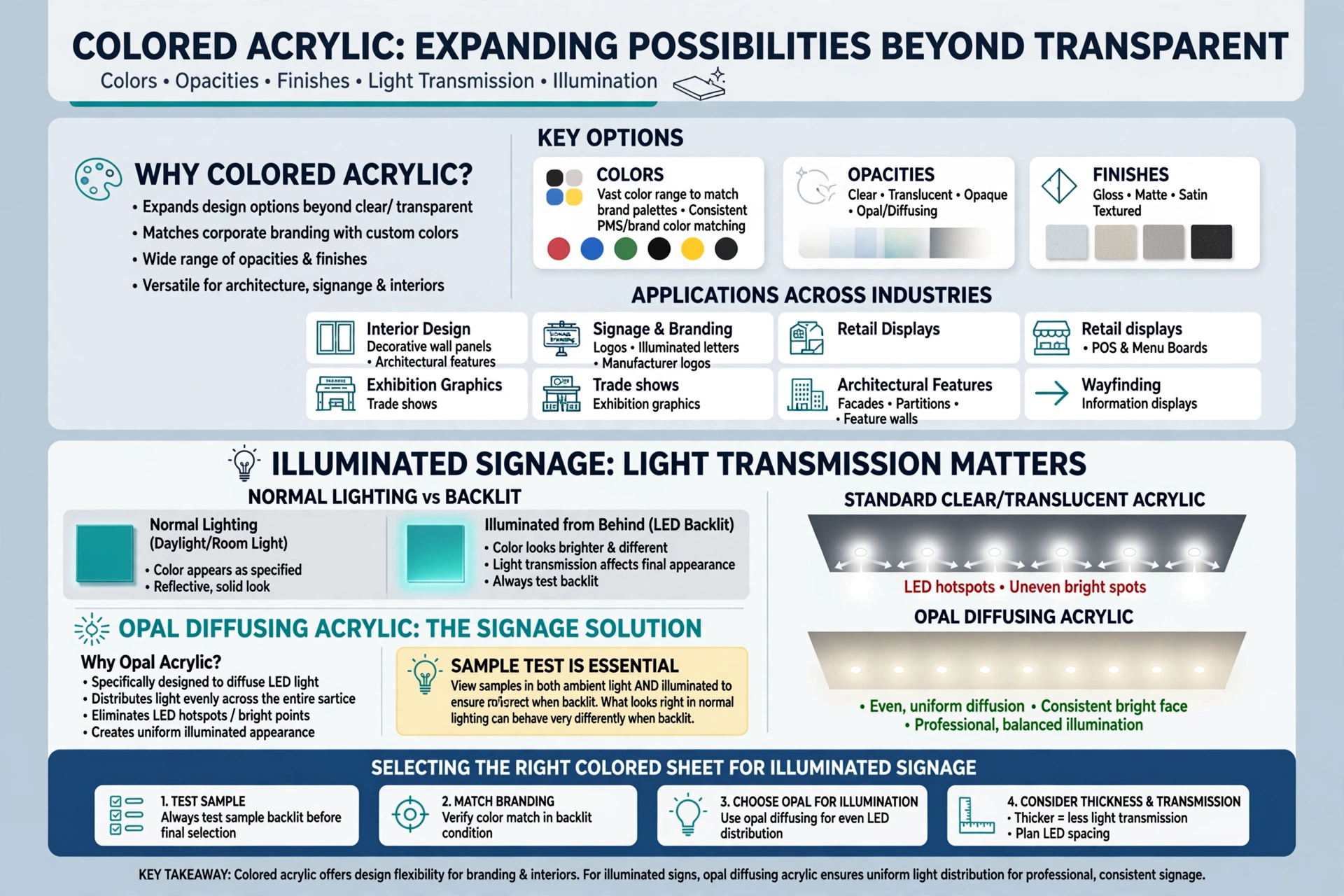
Colored acrylic expands the material’s possibilities beyond transparent applications.
Sheets can be available in different colors, opacities, and finishes, allowing signage manufacturers to match corporate branding or interior design schemes.
Colored acrylic can be used for logos, letters, decorative wall panels, retail displays, point-of-sale structures, menu boards, exhibition graphics, and architectural features.
When selecting a colored sheet for illuminated signage, it is important to understand how much light the material transmits.
A color that looks correct under normal lighting may behave differently when illuminated from behind.
Therefore, a sample test is often useful for illuminated applications.
Opal Acrylic for Illuminated Signs
Opal or diffusing acrylic is particularly relevant to the signage industry.
Illuminated signs require light to be distributed across the visible face rather than appearing as concentrated points.
An appropriately selected opal acrylic can help diffuse LED illumination and create a more uniform appearance.
This is particularly useful for light boxes, channel letters, illuminated logos, menu boards, retail signage, and indoor displays.
However, the acrylic should be selected together with the LED system.
LED module spacing, brightness, optical distribution, cabinet depth, acrylic transmission, and diffuser characteristics all influence the final result.
Simply choosing a white acrylic sheet does not guarantee uniform illumination.
Frosted Acrylic Sheets for Privacy and Design
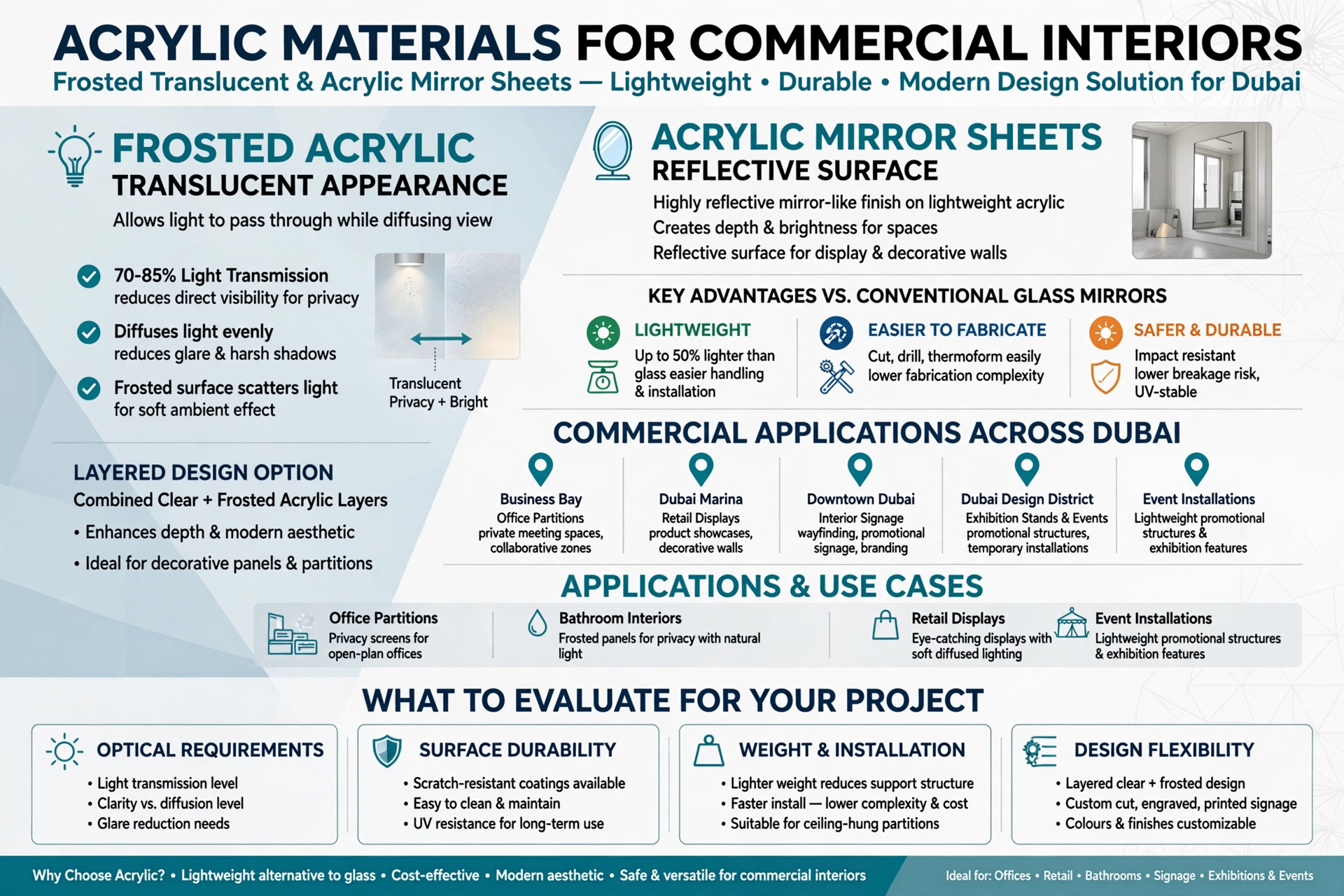
Frosted acrylic provides a translucent appearance that allows light through while reducing direct visibility.
This makes it useful for privacy screens, office partitions, decorative panels, retail displays, bathroom applications, and interior signage.
In commercial interiors, frosted acrylic can create a modern appearance while maintaining some light transmission.
It can also be combined with clear acrylic or graphics to create layered designs.
For offices and retail environments in Business Bay, Dubai Marina, Downtown Dubai, and Dubai Design District, this type of material can support both branding and interior aesthetics.
Acrylic Mirror Sheets
Mirror acrylic uses a reflective surface to create a lightweight alternative to conventional glass mirrors for selected decorative and display applications.
It can be used in retail displays, decorative walls, exhibition stands, event installations, interior features, and promotional structures.
Because mirror acrylic is lighter and easier to fabricate than glass, it can be useful where weight and installation complexity are important considerations.
However, it does not behave exactly like conventional glass mirror products, so buyers should evaluate optical requirements and surface durability before specifying it for demanding applications.
Acrylic Sheets for LED Signage
Acrylic and LED technology are highly compatible in signage applications.
Acrylic can be used as the face of illuminated channel letters, light boxes, logo signs, directional signs, and retail displays.
The lighting system must be designed around the acrylic’s optical properties.
The sign depth, LED module spacing, light output, diffuser properties, and face material all affect illumination uniformity.
If LEDs are installed too close to the face, hotspots may appear.
If the sign is too shallow for the selected LED configuration, uniformity may be difficult to achieve.
A professional signage manufacturer therefore treats acrylic and LED selection as one integrated design problem.
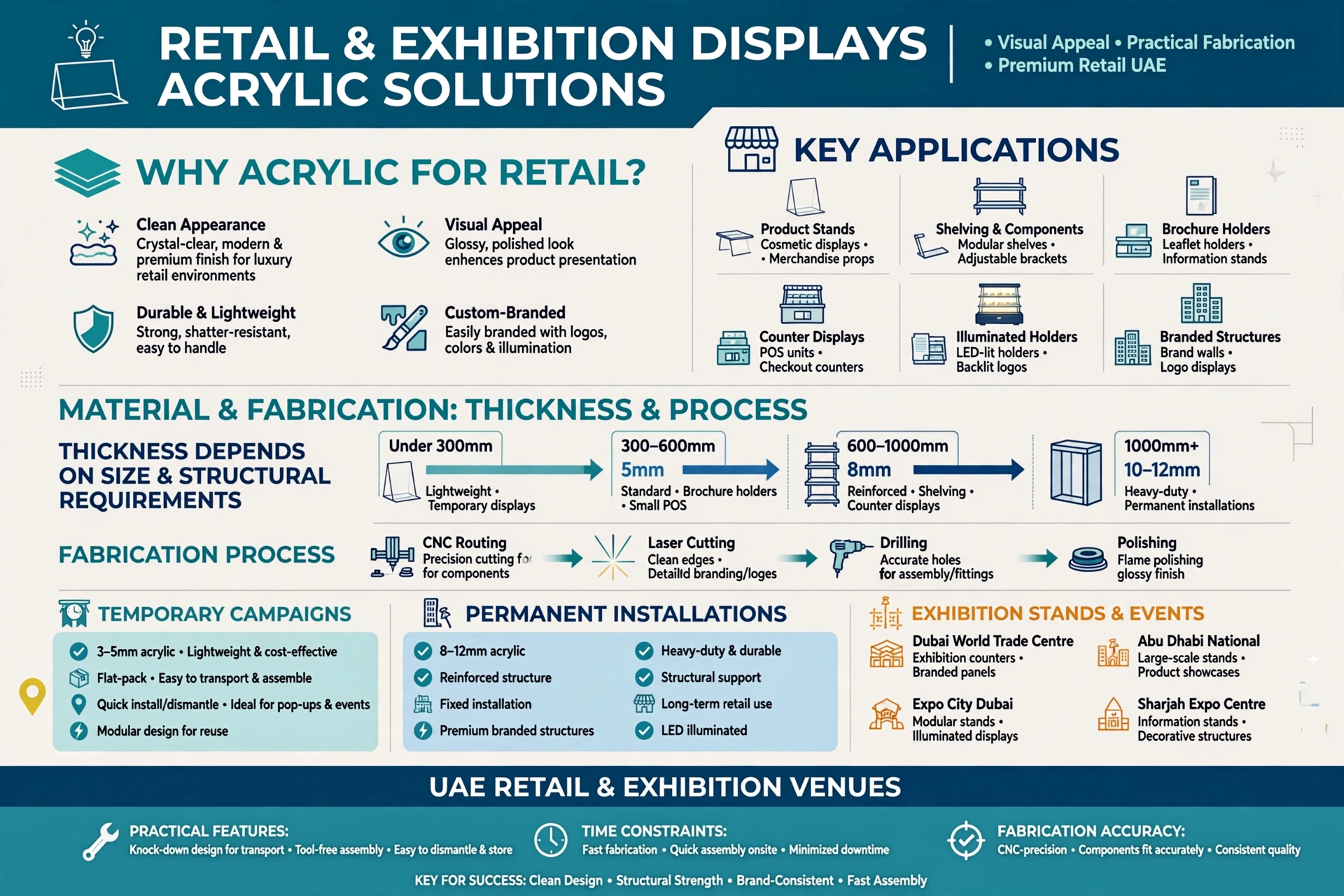
Acrylic Sheets for Retail Displays
Retail environments demand materials that combine visual appeal with practical fabrication.
Acrylic can be used to create product stands, shelving components, brochure holders, counter displays, POS units, cosmetic displays, illuminated product holders, and branded structures.
Its clean appearance works particularly well with premium retail environments.
In shopping destinations such as Dubai Mall, Mall of the Emirates, Yas Mall, and major retail centers across Abu Dhabi and Sharjah, acrylic displays can be incorporated into temporary campaigns or permanent retail installations.
The correct sheet thickness depends on the size and structural requirements of the display.
Acrylic Sheets for Exhibition Stands
Exhibitions require materials that are visually attractive but also practical to transport, fabricate, assemble, and dismantle.
Acrylic can be incorporated into exhibition counters, branded panels, illuminated logos, product displays, shelves, information stands, and decorative structures.
The Dubai World Trade Centre, Expo City Dubai, Abu Dhabi National Exhibition Centre, and Sharjah Expo Centre host exhibitions where companies frequently require customized display systems.
Because exhibition structures are often assembled under time constraints, fabrication accuracy becomes important.
CNC routing, laser cutting, drilling, polishing, and other fabrication methods can help manufacturers produce components that fit together accurately.
Acrylic Fabrication Techniques
Acrylic can be processed using several fabrication methods.
Laser cutting is commonly used for detailed shapes, lettering, decorative components, and precision-cut parts. The process can produce clean edges when appropriate settings and material grades are used.
CNC routing is useful for larger sheets, thicker acrylic, dimensional signage components, and applications requiring specific cutting paths.
Saw cutting can also be used for straightforward straight-line cuts.
After cutting, edges can be polished mechanically or through other suitable finishing methods depending on the required appearance.
The fabrication method should be selected according to sheet thickness, design complexity, required edge quality, production volume, and project budget.
Thermoforming Acrylic Sheets
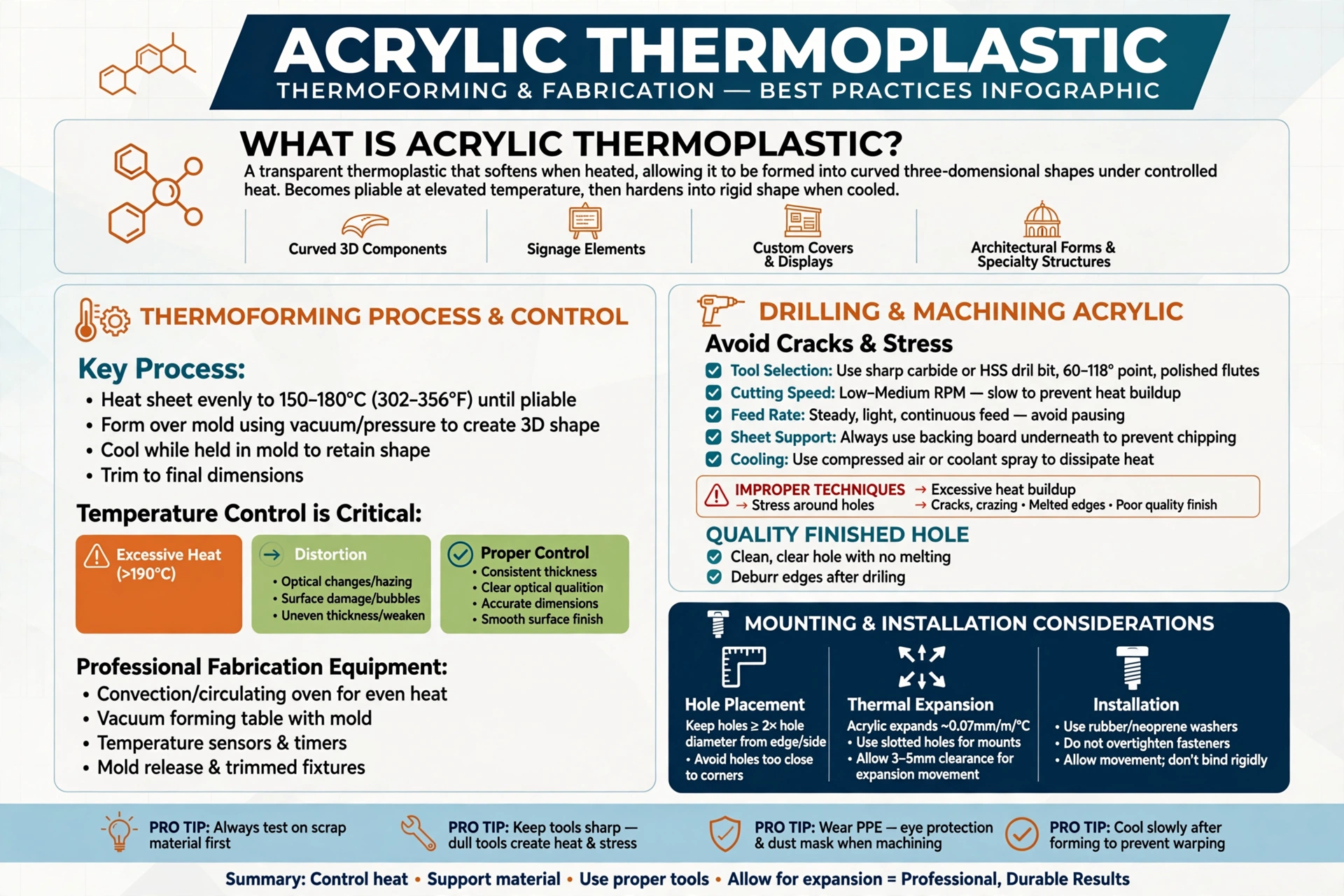
Acrylic is a thermoplastic material, meaning it can soften when heated and can be shaped under controlled conditions.
Thermoforming can be used to create curved or three-dimensional components.
This expands the possibilities beyond flat panels.
Fabricators can produce customized covers, display components, architectural forms, signage elements, and specialty structures.
Temperature control is important during thermoforming. Excessive heat or incorrect forming conditions can cause distortion, optical changes, surface damage, or uneven thickness.
Professional fabrication therefore requires appropriate equipment and process control.
Drilling and Machining Acrylic
Acrylic can be drilled and machined, but it should be handled carefully.
Improper drilling techniques can create excessive heat or stress around holes, potentially causing cracks.
The tool selection, cutting speed, feed rate, sheet support, and cooling approach can influence the quality of the finished hole.
This becomes particularly important when acrylic panels are being mechanically mounted.
Holes should not be positioned too close to edges, and suitable allowances should be considered where thermal expansion or movement could affect the installation.
Acrylic Edge Finishing
The edge of an acrylic sheet can significantly influence its final appearance.
A rough cut edge may be acceptable for hidden components but unsuitable for exposed premium displays.
Fabricators can use different polishing techniques to create a smoother and more transparent edge.
Polished acrylic edges can be particularly attractive when illuminated because the edge can interact with light and create a distinctive visual effect.
This technique is sometimes used in LED edge-lit signs and decorative acrylic panels.
Acrylic Sheets for Interior Design
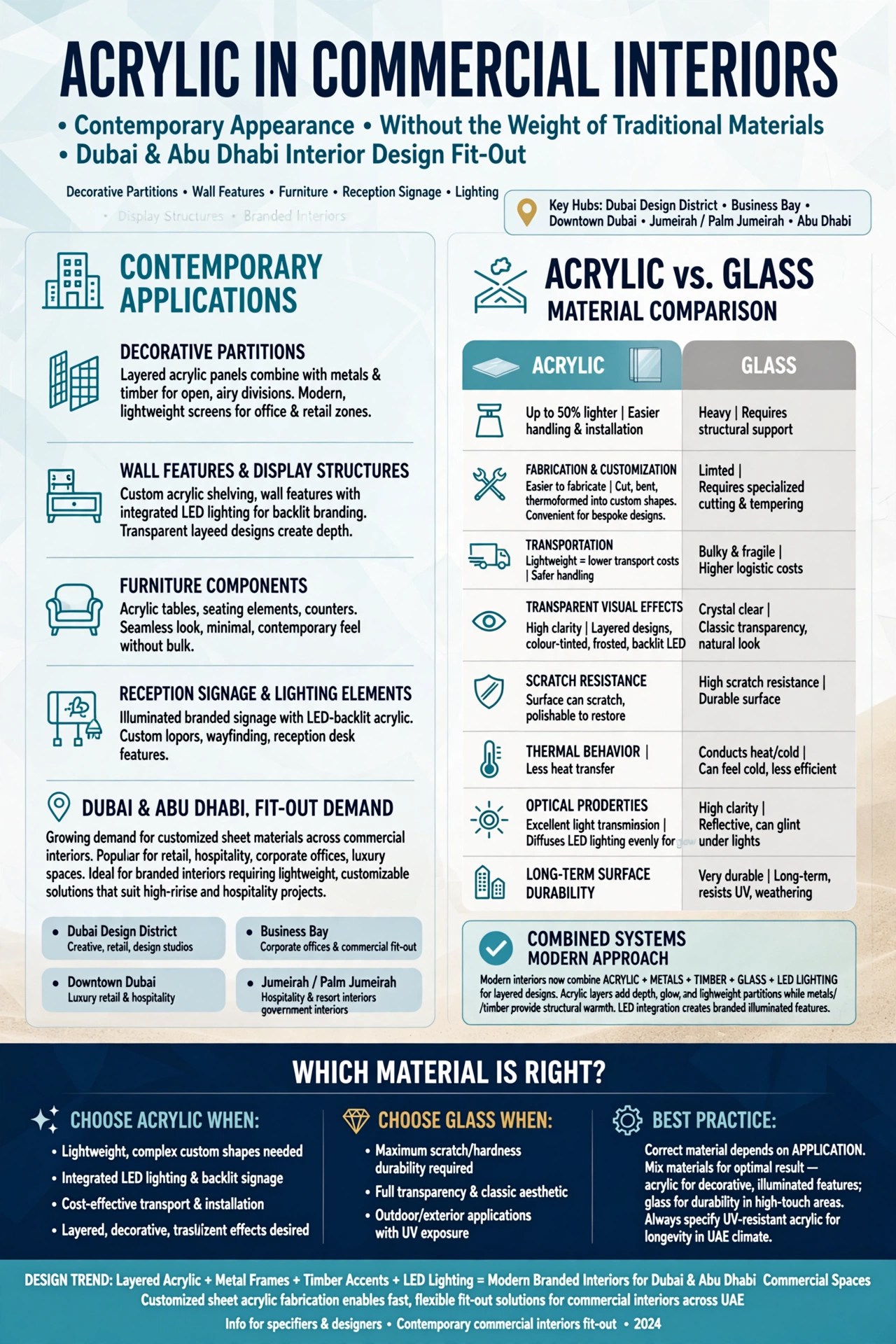
Acrylic is increasingly used in commercial interiors because it can provide a contemporary appearance without the weight associated with some traditional materials.
Applications include decorative partitions, wall features, furniture components, reception signage, lighting elements, display structures, and branded interiors.
Dubai’s active interior-design and fit-out sector creates substantial demand for customized sheet materials.
Projects in Dubai Design District, Business Bay, Downtown Dubai, Jumeirah, Palm Jumeirah, and Abu Dhabi may use acrylic as part of larger interior systems.
The material can be combined with metals, timber, glass, LED lighting, and other surfaces to create layered designs.
Acrylic Compared With Glass
Acrylic is often compared with glass because both can provide transparent visual effects.
Acrylic is generally lighter and easier to fabricate than glass, which can make transportation and customized fabrication more convenient.
Glass, however, has different characteristics relating to scratch resistance, thermal behavior, optical properties, and long-term surface durability.
The correct material therefore depends on the application.
Acrylic is often attractive where light weight, fabrication flexibility, impact resistance relative to standard glass, and customization are priorities.
Glass may be preferred where specific architectural, optical, fire, or surface-performance requirements dictate its use.
Acrylic Compared With Polycarbonate
Polycarbonate is another engineering thermoplastic commonly compared with acrylic.
Polycarbonate is generally recognized for its high impact resistance, while acrylic is widely valued for optical clarity, surface appearance, and ease of fabrication.
For signage, retail displays, decorative panels, and applications where visual appearance is a major consideration, acrylic can be an excellent choice.
For applications where exceptional impact resistance is the primary requirement, polycarbonate may be more appropriate.
The decision should therefore be based on the actual operating conditions rather than assuming one plastic sheet is universally better.
Can Acrylic Be Used Outdoors?
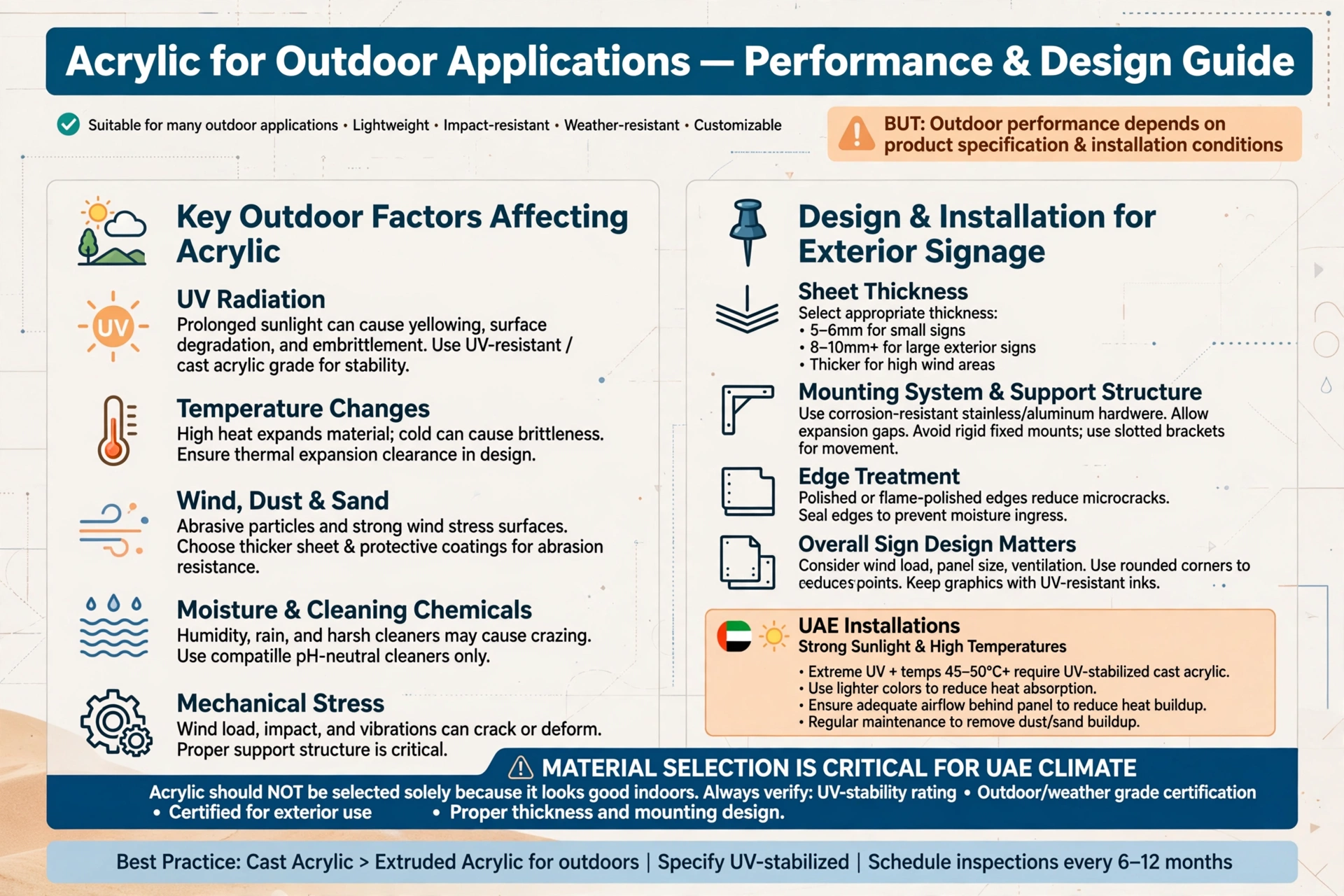
Acrylic can be suitable for many outdoor applications, but outdoor performance depends on the product specification and installation conditions.
Outdoor signage is exposed to UV radiation, temperature changes, wind, dust, moisture, cleaning chemicals, and mechanical stress.
Acrylic selected for exterior signage should therefore be appropriate for outdoor exposure.
The sheet thickness, mounting system, support structure, edge treatment, and overall sign design also matter.
For UAE installations, the combination of strong sunlight and high temperatures makes material selection particularly important.
Acrylic should not be selected solely because it looks good indoors.
Acrylic Sheets and the UAE Climate
The UAE presents a demanding environment for signage and display materials.
In locations such as Dubai, Abu Dhabi, Sharjah, Ajman, Ras Al Khaimah, and Al Ain, outdoor materials can experience high temperatures and strong solar exposure.
Coastal areas such as Dubai Marina and Palm Jumeirah may also present additional environmental considerations because of humidity and salt-laden air.
Acrylic signage installed outdoors should therefore be designed with the complete environment in mind.
The substrate, fasteners, adhesives, aluminum frame, LED system, and mounting structure should all be compatible with the expected conditions.
How to Clean and Maintain Acrylic Sheets
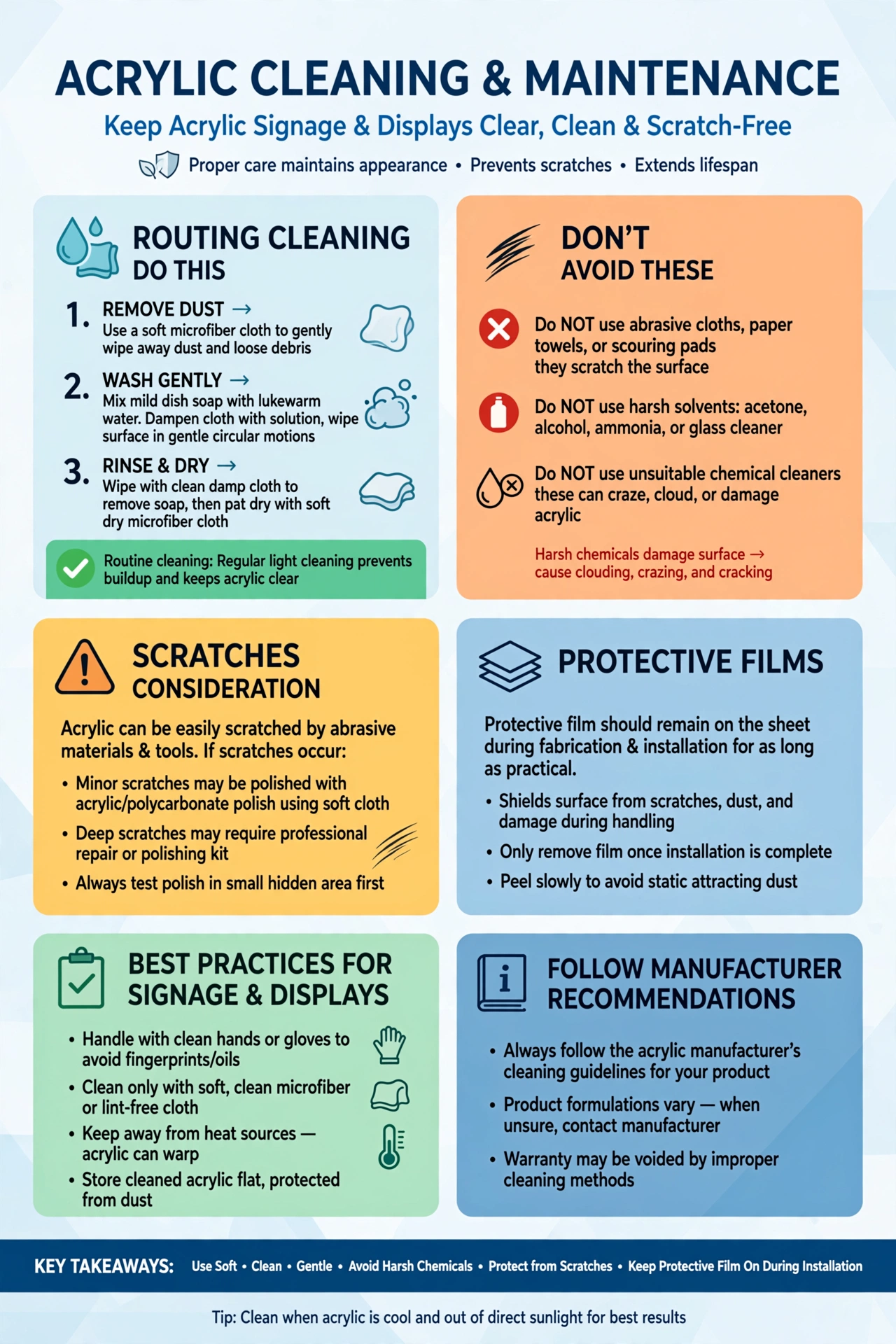
Acrylic requires appropriate cleaning methods to maintain its appearance.
Dust should be removed using a soft, clean material rather than an abrasive cloth.
Harsh solvents or unsuitable chemical cleaners can damage the acrylic surface.
For signage and displays, routine cleaning should follow the manufacturer’s recommendations.
Scratches are another consideration. Acrylic can be scratched by abrasive materials, tools, and improper cleaning practices.
This is why protective films should remain on the sheet during fabrication and installation for as long as practical.
Choosing the Right Acrylic Sheet for a Project
Selecting acrylic should begin with the application rather than the product catalog.
A buyer should consider whether the sheet will be used indoors or outdoors, whether it will be illuminated, what thickness is required, whether it will be cut or thermoformed, how it will be mounted, and what visual appearance is required.
The desired finish may be clear, colored, frosted, opal, mirror, fluorescent, textured, or another specialty surface.
The fabrication process should also be considered before purchasing.
For example, if the project requires detailed laser cutting, the fabricator should confirm that the selected material is appropriate for that process.
Working With an Acrylic Sheet Supplier
The quality of the final project depends partly on the consistency of the sheet material.
Professional buyers should evaluate thickness tolerance, surface quality, color consistency, optical appearance, protective packaging, available dimensions, technical documentation, and product availability.
For commercial projects, consistent material supply is particularly important because replacing one batch with another can create differences in color or surface appearance.
A reliable supplier should also be able to help buyers identify the appropriate material for signage, display, fabrication, and architectural applications.
Businesses operating in Abu Dhabi and surrounding areas can work with an Acrylic Sheets Supplier in Abu Dhabi when they need material selection support, sheet availability, and suitable acrylic products for local signage and fabrication projects.
Acrylic Sheet Applications Across Dubai and the UAE
Acrylic is used across many UAE industries.
In Dubai, it can be found in retail signage, exhibition stands, corporate interiors, hospitality projects, illuminated logos, and point-of-sale displays.
In Abu Dhabi, acrylic is used in commercial signage, government and corporate environments, exhibitions, retail projects, and interior applications.
In Sharjah, the material is relevant to manufacturing, signage, retail, education, exhibitions, and commercial interiors.
Industrial areas such as Al Quoz, Jebel Ali, Mussafah, and Dubai Industrial City also support fabrication and signage businesses that process sheet materials into customized products.
This broad range of applications demonstrates why acrylic is considered an important material within the UAE’s signage and visual-communication industry.
Final Thoughts
Acrylic sheets are versatile materials that combine visual appeal, fabrication flexibility, relatively low weight, and useful optical properties. Their applications extend far beyond basic signage, covering LED signs, channel letters, retail displays, exhibition stands, reception branding, interior design, product displays, architectural elements, menu boards, and custom fabricated structures.
However, achieving a professional result requires more than selecting an attractive sheet color.
The fabricator must consider cast or extruded construction, thickness, optical properties, light transmission, surface finish, environmental exposure, cutting method, drilling, polishing, thermoforming, mounting, LED compatibility, and long-term maintenance.
For UAE projects, local environmental conditions also need to be considered. High temperatures, strong sunlight, dust, humidity, and coastal exposure can influence the performance of signage and display materials.
The strongest acrylic projects begin with the application, not the material itself. By understanding the purpose of the finished product and then selecting the appropriate acrylic grade, thickness, finish, fabrication technique, and installation method, businesses can achieve better visual quality and longer-lasting results.
For signage manufacturers, advertising companies, retailers, exhibition contractors, interior designers, and professional fabricators, acrylic remains one of the most adaptable sheet materials available for creating modern, customized visual solutions across the UAE.