

Blogs
Green Up Your Print Acts With PVC-Free Print Media

The printing and signage industry is increasingly looking beyond traditional materials and asking an important question: Can high-quality visual communication be produced with a lower environmental impact? PVC-free print media has become an important part of this conversation because it gives printers, signage companies, advertising agencies, retailers, event organizers, and brands alternatives to conventional PVC-based substrates and films.
The move toward PVC-free materials is not simply about replacing one sheet or printable surface with another. It involves understanding the complete application, including printing technology, ink compatibility, substrate performance, finishing, installation, durability, transportation, recycling options, and end-of-life considerations.
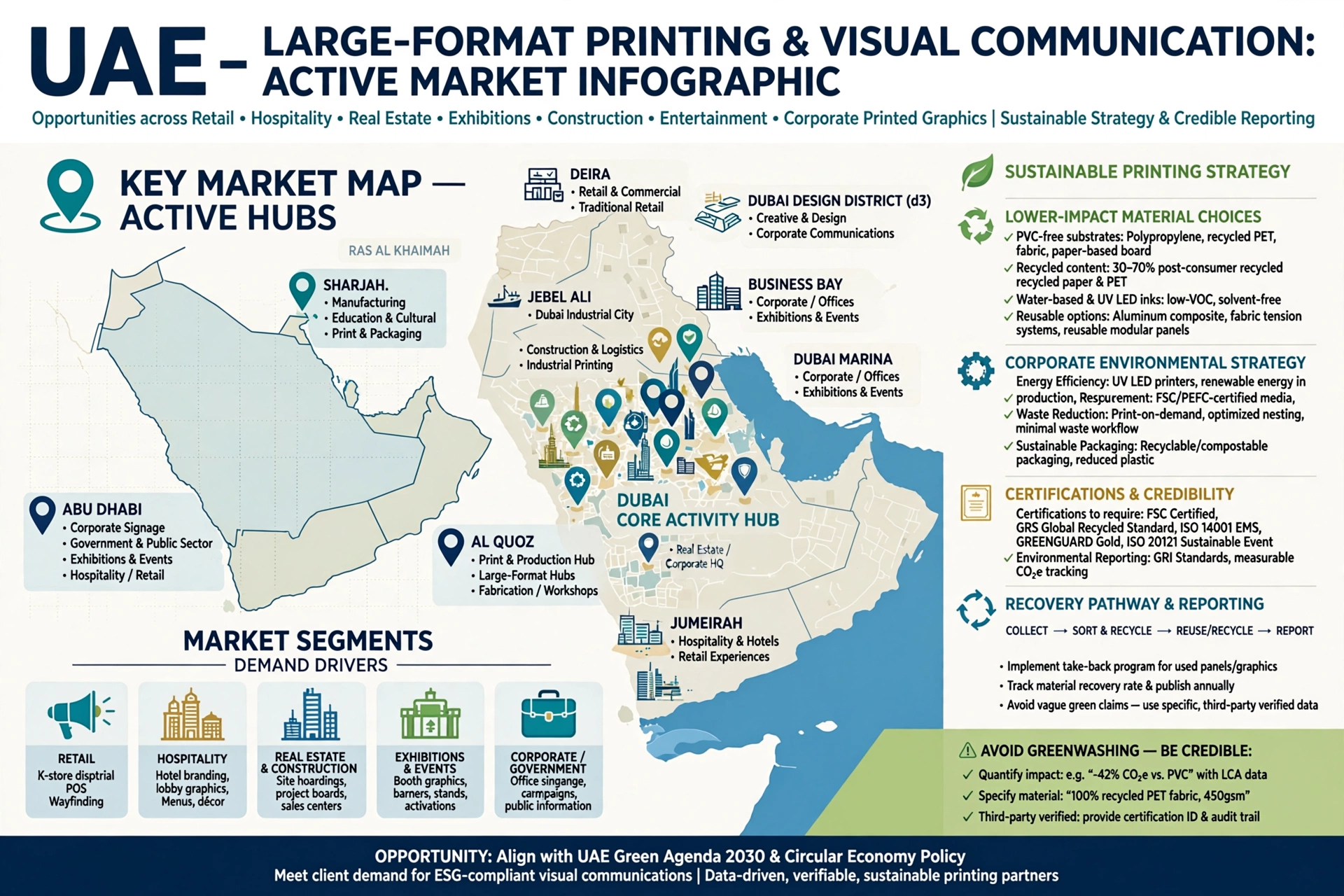
For businesses operating in the UAE, this subject is becoming increasingly relevant. Dubai, Abu Dhabi, Sharjah, and other Emirates have large commercial, retail, hospitality, exhibition, advertising, and construction sectors that depend heavily on printed graphics. From retail campaigns in Dubai Mall and Mall of the Emirates to exhibition graphics at Dubai World Trade Centre, wall graphics in Business Bay offices, and temporary event signage across Abu Dhabi, printed communication is everywhere.
Choosing more responsible print materials can therefore become part of a company’s broader environmental and procurement strategy.
What Is PVC-Free Print Media?
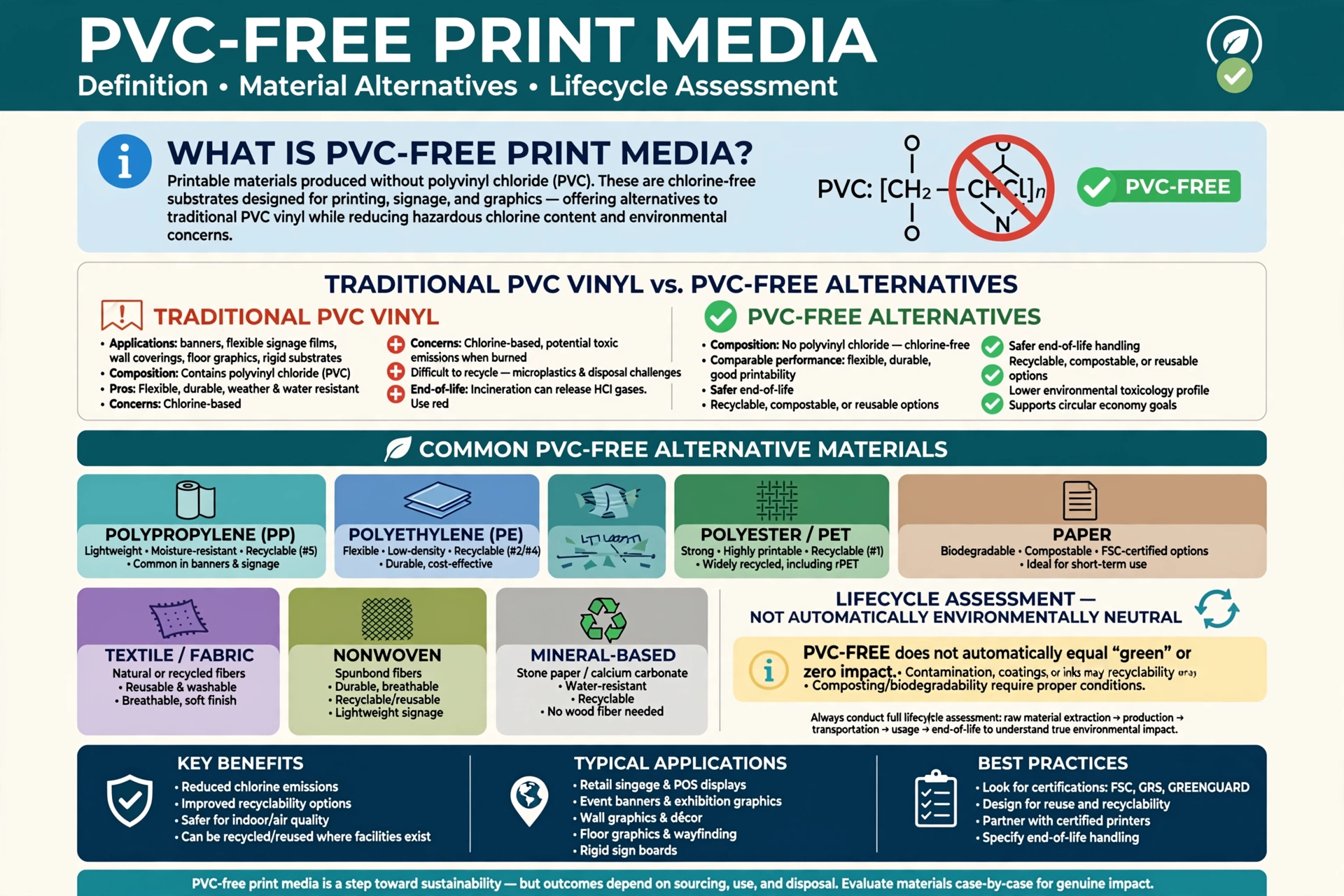
PVC-free print media refers to printable materials manufactured without polyvinyl chloride, commonly known as PVC.
Traditional signage and printing products can contain PVC because the material offers flexibility, durability, water resistance, dimensional stability, and relatively low production cost. It has therefore been widely used in products such as vinyl graphics, banners, flexible signage films, wall coverings, floor graphics, and rigid display substrates.
PVC-free alternatives use other material technologies to achieve similar application requirements.
Depending on the product, these alternatives may include polypropylene, polyethylene, polyester, paper-based substrates, PET, textile materials, nonwoven fabrics, and other polymer or mineral-based constructions.
The important point is that “PVC-free” does not automatically mean that a product is completely environmentally neutral. A responsible material assessment should consider the complete product lifecycle.
Why Are Printers Moving Toward PVC-Free Materials?
The demand for PVC-free print media is being influenced by several factors.
Brands are increasingly publishing environmental commitments and sustainability policies. Retailers and multinational corporations may have procurement requirements that restrict certain materials. Event organizers may seek reusable or recyclable graphics. Interior designers may specify alternative materials for commercial spaces.
At the same time, consumers are becoming more familiar with terms such as circular economy, responsible sourcing, recyclability, material reduction, low-VOC products, sustainable printing, and lifecycle assessment.
This does not mean every printed application should immediately eliminate PVC.
Instead, professional printers should evaluate where a PVC-free alternative can deliver the required performance without compromising the purpose of the application.
PVC-Free Does Not Mean Low Quality
One misconception is that environmentally preferable printing materials must sacrifice print quality.
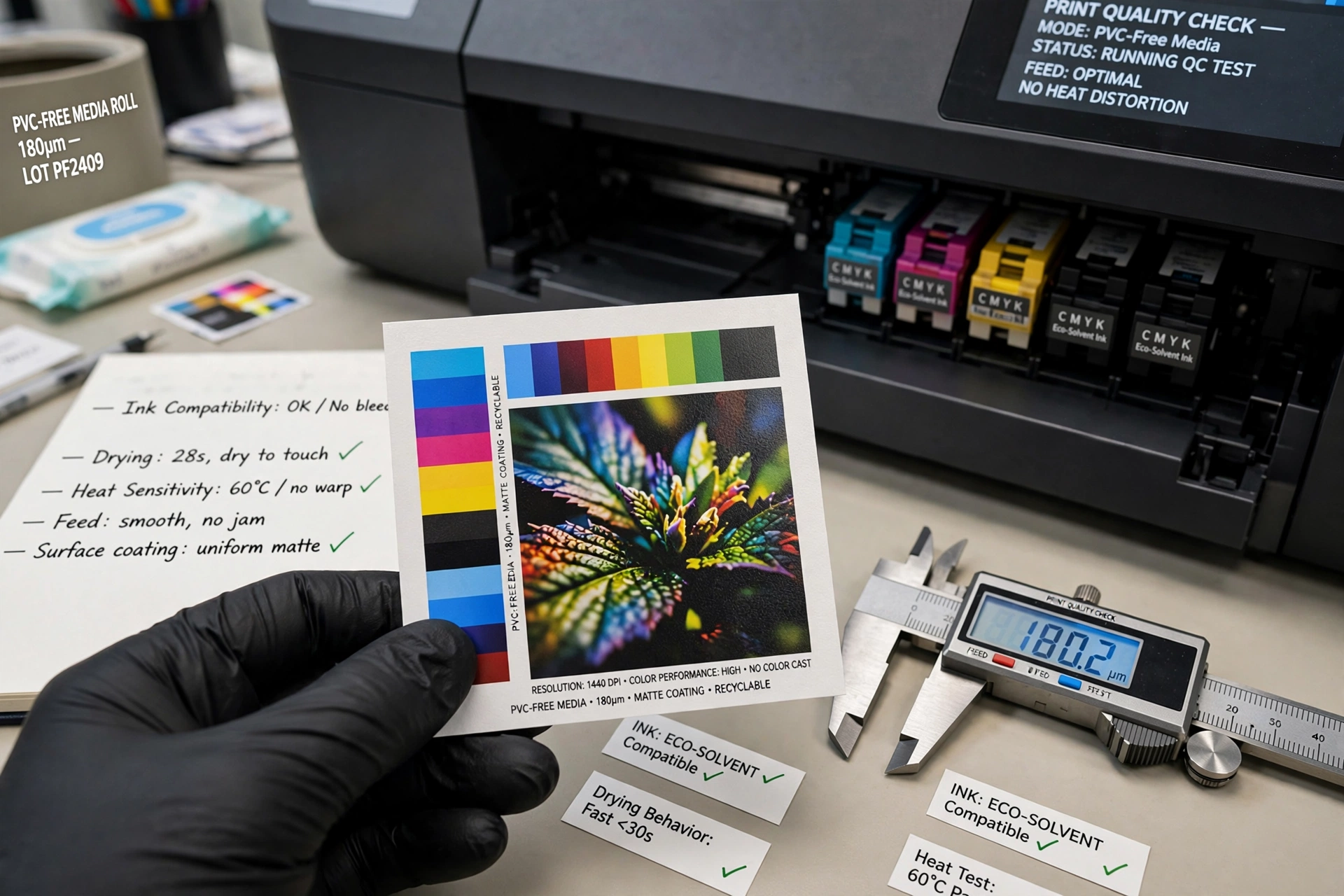
Modern PVC-free media can support high-quality digital printing when the substrate is correctly matched with the printer, ink technology, and application.
Depending on the material, PVC-free media can provide:
Sharp image reproduction, strong color performance, smooth surfaces, dimensional stability, suitable opacity, print adhesion, and professional finishing.
The actual result depends heavily on substrate construction and printer settings.
A printer should never assume that a PVC-free material can simply be loaded into the machine using the same profile as a conventional vinyl.
Ink compatibility, drying behavior, heat sensitivity, media thickness, surface coating, and feed characteristics should be checked before large-scale production.
PVC-Free Media and Digital Printing Technology
The printing method plays an important role in material selection.
Large-format digital printing may involve eco-solvent, latex, UV, UV-LED, or aqueous ink technologies, depending on the printer and application.
A substrate manufactured for one technology may not perform correctly with another.
For example, the surface energy and coating of a printable polyester or polypropylene material can influence ink adhesion and drying.
UV printing can provide excellent adhesion on many rigid and flexible substrates, but the substrate still needs to be compatible with the printer’s curing process.
Latex printing can be suitable for many indoor and outdoor applications, while aqueous systems may be preferred for certain photographic, fine-art, and indoor graphics applications.
Professional printers therefore evaluate the media profile, ICC profile, ink compatibility, curing or drying conditions, and manufacturer’s technical data before approving a new PVC-free product.
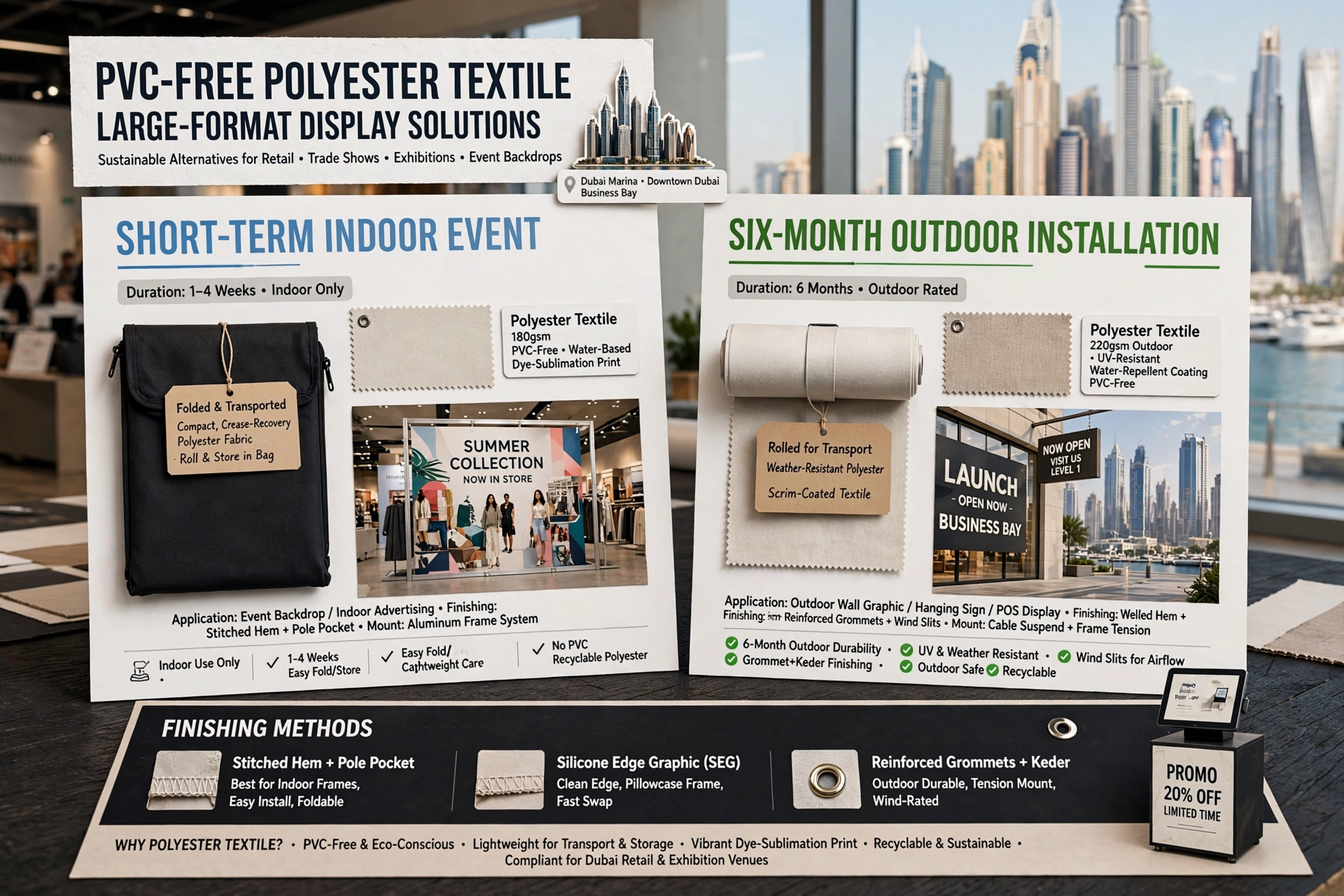
PVC-Free Banners for Advertising and Events
Large-format banners are one area where alternative materials can be particularly useful.
Traditional PVC banner materials have been widely used for outdoor advertising because of their flexibility and durability.
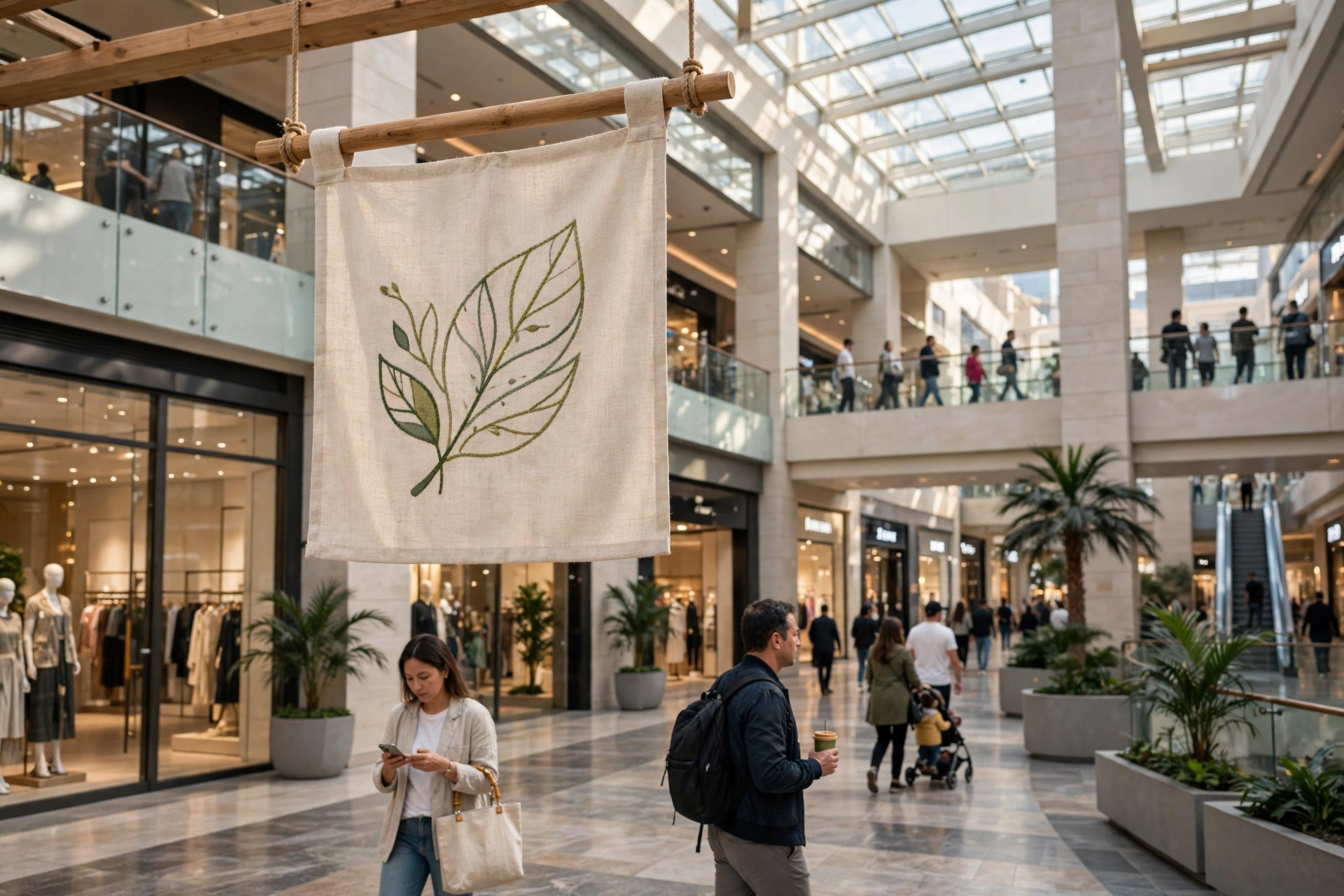
PVC-free banner alternatives may use polyester or other textile-based constructions depending on the intended application.
These materials can be useful for trade shows, exhibitions, retail promotions, event backdrops, indoor advertising, corporate displays, and temporary campaigns.
The correct choice depends on whether the banner needs to be used indoors or outdoors, how long it will remain installed, whether it needs to be folded or transported, and what finishing method is required.
A short-term indoor event graphic may have very different material requirements from a six-month outdoor advertising installation.
PVC-Free Materials for Retail Graphics
Retail environments generate significant quantities of temporary promotional graphics.
Campaigns change regularly, especially during seasonal promotions, product launches, shopping festivals, and sales events.
Retailers in Dubai Marina, Downtown Dubai, Business Bay, Jumeirah, Deira, and Abu Dhabi may require window graphics, wall graphics, promotional panels, hanging signs, point-of-sale displays, and temporary campaign materials.
PVC-free media can be considered for suitable applications where the required durability and installation method can be achieved.
The key is to select the material based on the actual retail environment.
A window graphic exposed to direct sunlight has different requirements from a temporary indoor wall graphic.
PVC-Free Window Graphics and Films
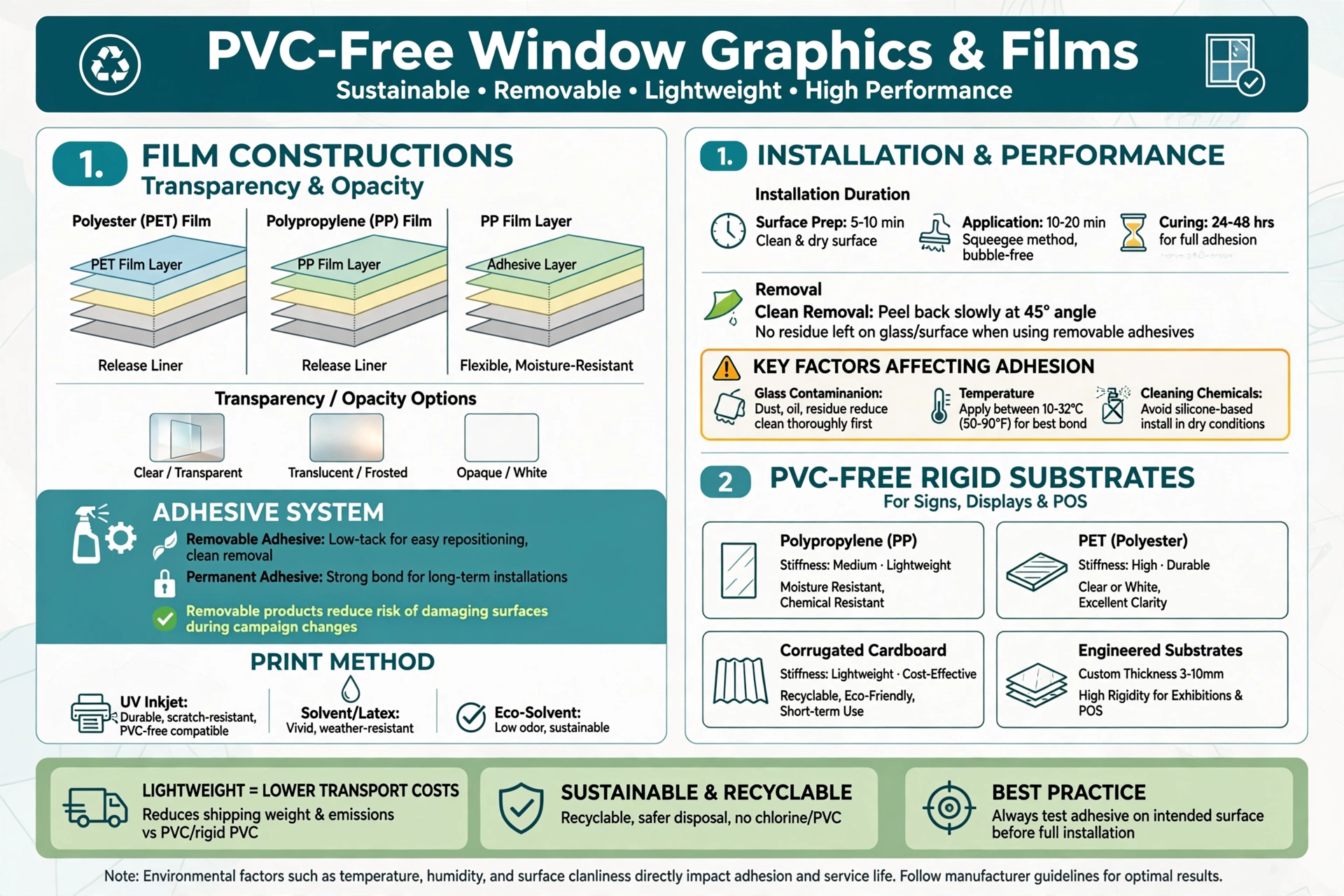
Window graphics are another application where material selection requires careful consideration.
Traditional self-adhesive vinyl films can contain PVC. PVC-free alternatives may use polyester, polypropylene, or other film constructions.
The choice depends on the window surface, required transparency, opacity, adhesive system, print method, installation duration, and removal requirements.
For temporary retail campaigns, removable products can be particularly useful because they can reduce the risk of damaging surfaces during campaign changes.
However, printers and installers should always test the adhesive on the intended surface before large-scale installation.
Glass may appear to be a simple substrate, but factors such as surface contamination, temperature, humidity, cleaning chemicals, and installation technique can affect adhesion.
PVC-Free Rigid Print Substrates
PVC-free alternatives are also available for rigid signage and display applications.
Materials such as polypropylene, PET, corrugated polypropylene, cardboard-based boards, and other engineered substrates can be used for certain signs, displays, packaging-related graphics, exhibition panels, and point-of-sale structures.
The appropriate substrate depends on stiffness, thickness, weight, moisture resistance, print compatibility, finishing requirements, and expected service life.
For example, a lightweight temporary exhibition panel may not need the same structural properties as a permanent outdoor sign.
Choosing the lightest suitable material can also reduce transportation and handling requirements.
The Role of Polypropylene in Sustainable Printing
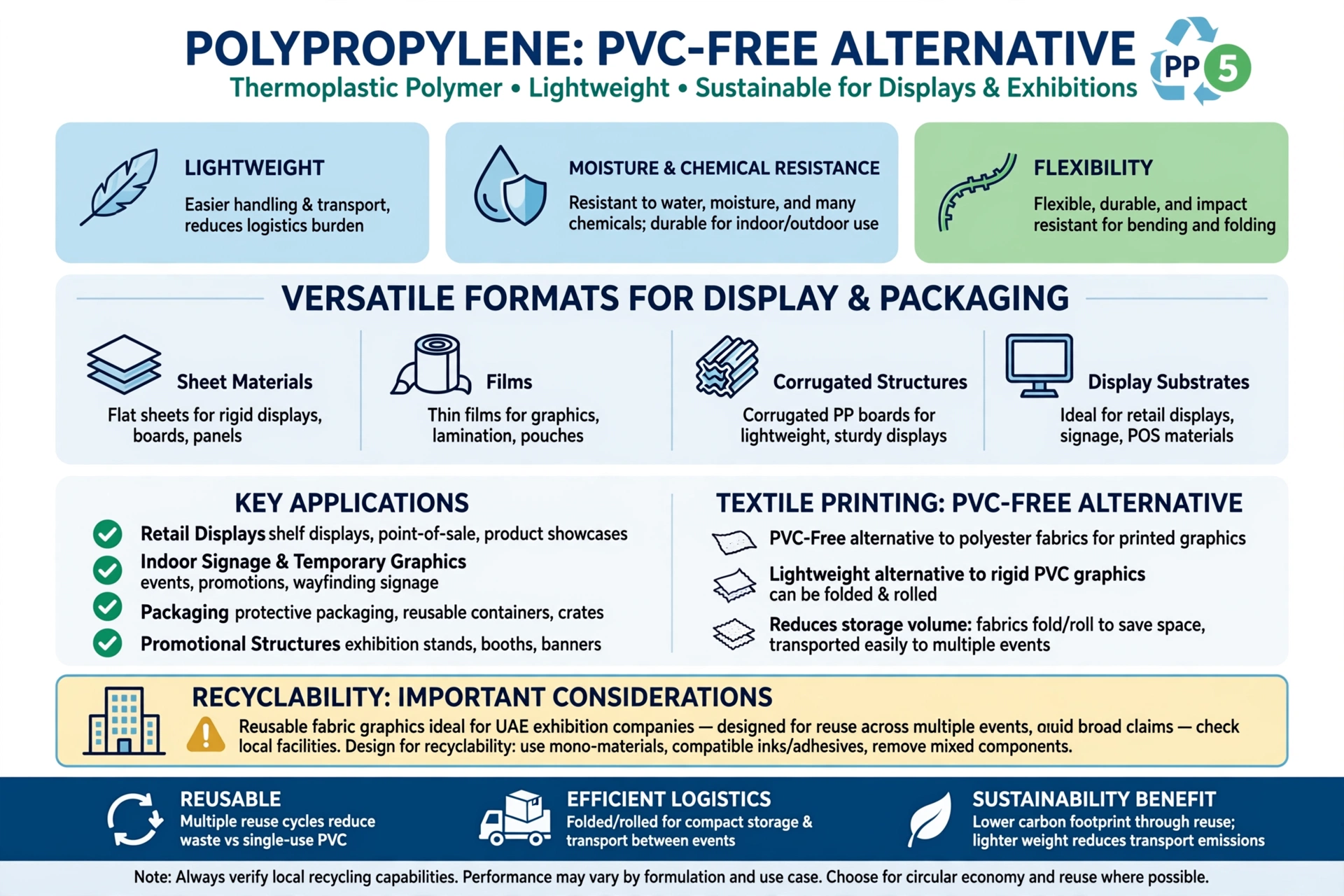
Polypropylene is an important alternative material in the wide-format printing sector.
It is a thermoplastic polymer used in various applications because of its lightweight construction, moisture resistance, chemical resistance, and flexibility.
Printable polypropylene products can be manufactured in different forms, including sheet materials, films, corrugated structures, and display substrates.
Depending on the product design, polypropylene can be suitable for retail displays, indoor signage, temporary graphics, packaging-related applications, and promotional structures.
However, recyclability depends on the specific product construction, additives, coatings, adhesives, inks, and local recycling infrastructure.
Therefore, printers should avoid making broad claims such as “all polypropylene is automatically recyclable everywhere.”
Textile Printing as a PVC-Free Alternative
Textile graphics have become increasingly popular in exhibitions, retail environments, corporate interiors, events, and advertising.
Polyester-based fabrics can provide a lightweight alternative to rigid or PVC-based graphics.
Fabric graphics can also offer logistical advantages because they can often be folded or rolled, reducing storage volume.
This can be particularly useful for exhibition companies operating across the UAE.
A reusable fabric graphic can potentially be transported to multiple events instead of manufacturing a completely new rigid display for every campaign.
The sustainability benefit becomes stronger when the graphic is actually reused multiple times rather than treated as a single-use product.
PVC-Free Printing for Exhibitions and Events
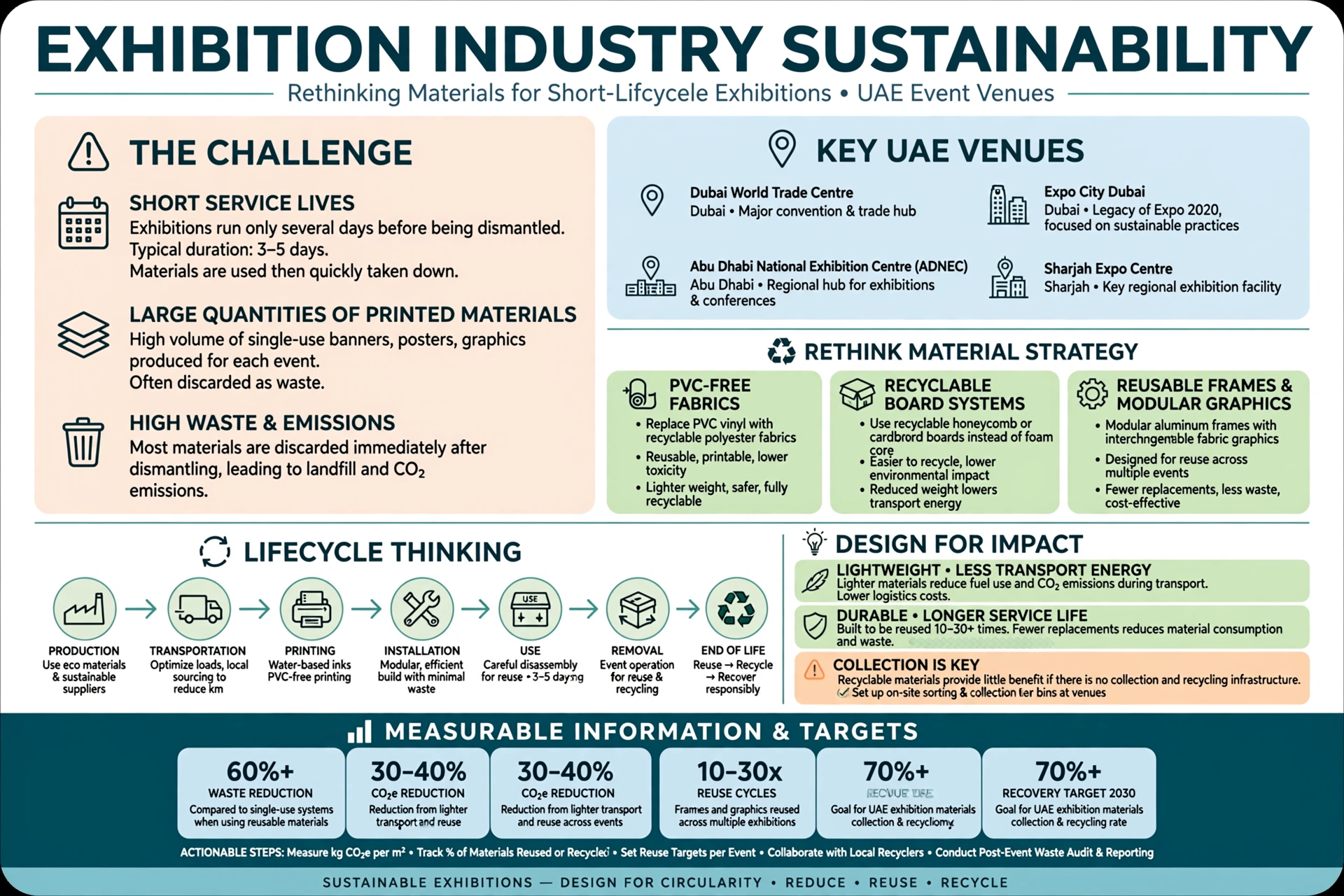
The exhibition industry is particularly relevant to sustainable print media because exhibition graphics can have very short service lives.
A display may be produced for an event lasting only several days before being dismantled.
Major exhibition venues such as Dubai World Trade Centre, Expo City Dubai, Abu Dhabi National Exhibition Centre, and Sharjah Expo Centre host events where large quantities of printed materials and display structures are used.
PVC-free fabrics, recyclable board systems, reusable frames, and modular graphics can help exhibitors rethink their material strategy.
The most sustainable exhibition graphic is not necessarily the material with the strongest environmental marketing claim. It may be the graphic system that can be reused, transported efficiently, repaired, updated, and eventually recovered through an appropriate recycling pathway.
Sustainability Should Be Measured Across the Lifecycle
One of the most important concepts in sustainable printing is lifecycle thinking.
A material should be evaluated from production through transportation, printing, installation, use, removal, and end of life.
For example, a lightweight substrate may require less transportation energy than a much heavier material.
A reusable graphic may reduce material consumption over several campaigns.
A durable substrate may have a longer service life and therefore require fewer replacements.
On the other hand, a material marketed as recyclable may provide little practical benefit if no appropriate collection or recycling infrastructure exists in the region where it is used.
This is why sustainability claims should be based on measurable information whenever possible.
Recyclability Is Not the Same as Recycling
This distinction is extremely important for professional printers.
A product can technically be recyclable but still be difficult to recycle in practice.
Printed media can contain multiple components, including the substrate, ink, adhesive, liner, laminate, eyelets, mounting hardware, and other materials.
A laminated graphic made from several permanently bonded materials can be more difficult to separate than a single-material product.
Similarly, adhesive-backed graphics may have different recovery options from uncoated rigid boards.
Therefore, when selecting PVC-free media, printers should investigate the actual end-of-life pathway rather than relying solely on a recycling symbol or marketing statement.
Choosing PVC-Free Media According to the Application
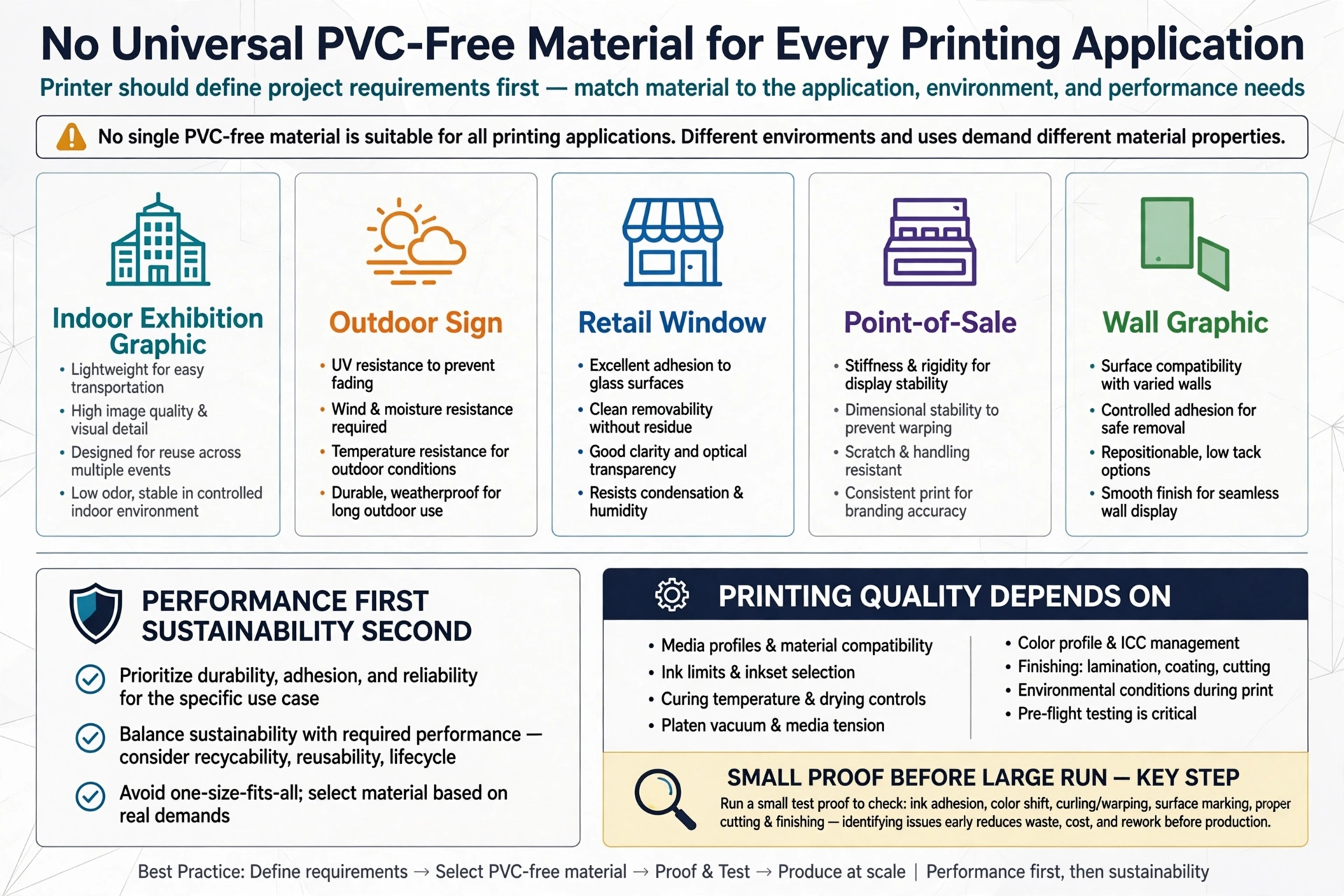
There is no universal PVC-free material that is suitable for every printing application.
A professional printer should first define the project requirements.
Consider an indoor exhibition graphic. It may prioritize lightweight construction, image quality, easy transportation, and reuse.
An outdoor sign may require resistance to UV radiation, wind, moisture, and temperature changes.
A retail window graphic may require excellent adhesion and clean removability.
A point-of-sale display may prioritize stiffness and dimensional stability.
A wall graphic may require surface compatibility and controlled adhesion.
The material should therefore be selected based on performance requirements first and sustainability objectives second, with both considered together.
Printing Quality Depends on Media Profiles
Even the best PVC-free substrate can produce disappointing results if the printer profile is incorrect.
The media manufacturer’s technical data should be reviewed before production.
Printers may need to adjust:
Ink limits, curing temperature, drying settings, platen vacuum, print speed, pass count, color profile, media tension, and finishing conditions.
Testing is particularly important when introducing a new material into a production environment.
A small proof can reveal issues such as ink adhesion, color shift, curling, surface marking, insufficient drying, or poor cutting performance before the company commits to a large print run.
This approach reduces material waste and protects production efficiency.
Installation Considerations for PVC-Free Print Media
A sustainable print material can still fail if installed incorrectly.
The installation environment should be evaluated before production.
Temperature, humidity, surface cleanliness, substrate condition, and installation technique can all affect performance.
For adhesive products, the installer should ensure that the surface is clean and compatible with the adhesive.
For fabric graphics, the tensioning system should be correctly sized.
For rigid boards, mounting hardware should account for the substrate’s mechanical properties.
Professional installation therefore forms part of the overall material performance.
PVC-Free Printing in Dubai and the UAE
The UAE is a particularly active market for large-format printing and visual communication.
Dubai combines retail, hospitality, real estate, exhibitions, construction, entertainment, and corporate sectors that regularly require printed graphics.
Areas such as Downtown Dubai, Business Bay, Dubai Marina, Jumeirah, Deira, Al Quoz, Dubai Design District, Jebel Ali, and Dubai Industrial City support different types of commercial and industrial activity.
Abu Dhabi also has extensive requirements for corporate signage, exhibitions, government projects, retail communication, hospitality graphics, and commercial displays.
Sharjah has a strong manufacturing, education, retail, and cultural environment where printed communication remains important.
This creates opportunities for printers and signage companies to introduce lower-impact material choices without sacrificing professional presentation.
Sustainable Printing and UAE Businesses
For UAE businesses, sustainable printing can become part of a broader corporate environmental strategy.
Companies may already be working on energy efficiency, responsible procurement, waste reduction, sustainable packaging, green building objectives, and environmental reporting.
Choosing appropriate print media can complement these initiatives.
However, businesses should avoid vague environmental claims.
Instead of simply saying that a campaign is “green,” companies can communicate specific information about the material, such as whether it is PVC-free, contains recycled content, is reusable, has documented environmental certifications, or has a practical recovery pathway.
Specific claims are more credible than generic sustainability language.
Certifications and Environmental Documentation Matter
When purchasing PVC-free print media, professional buyers should look beyond product descriptions and ask for supporting documentation.
Depending on the material, relevant information may include technical data sheets, Safety Data Sheets, environmental declarations, recycled-content information, chain-of-custody certifications, fire ratings, indoor-air-quality certifications, and recycling guidance.
Not every product needs every certification.
The relevant documentation depends on the application and procurement requirements.
For corporate and government projects, documentation can be particularly important because sustainability claims may need to be verified.
Reducing Waste During the Printing Process
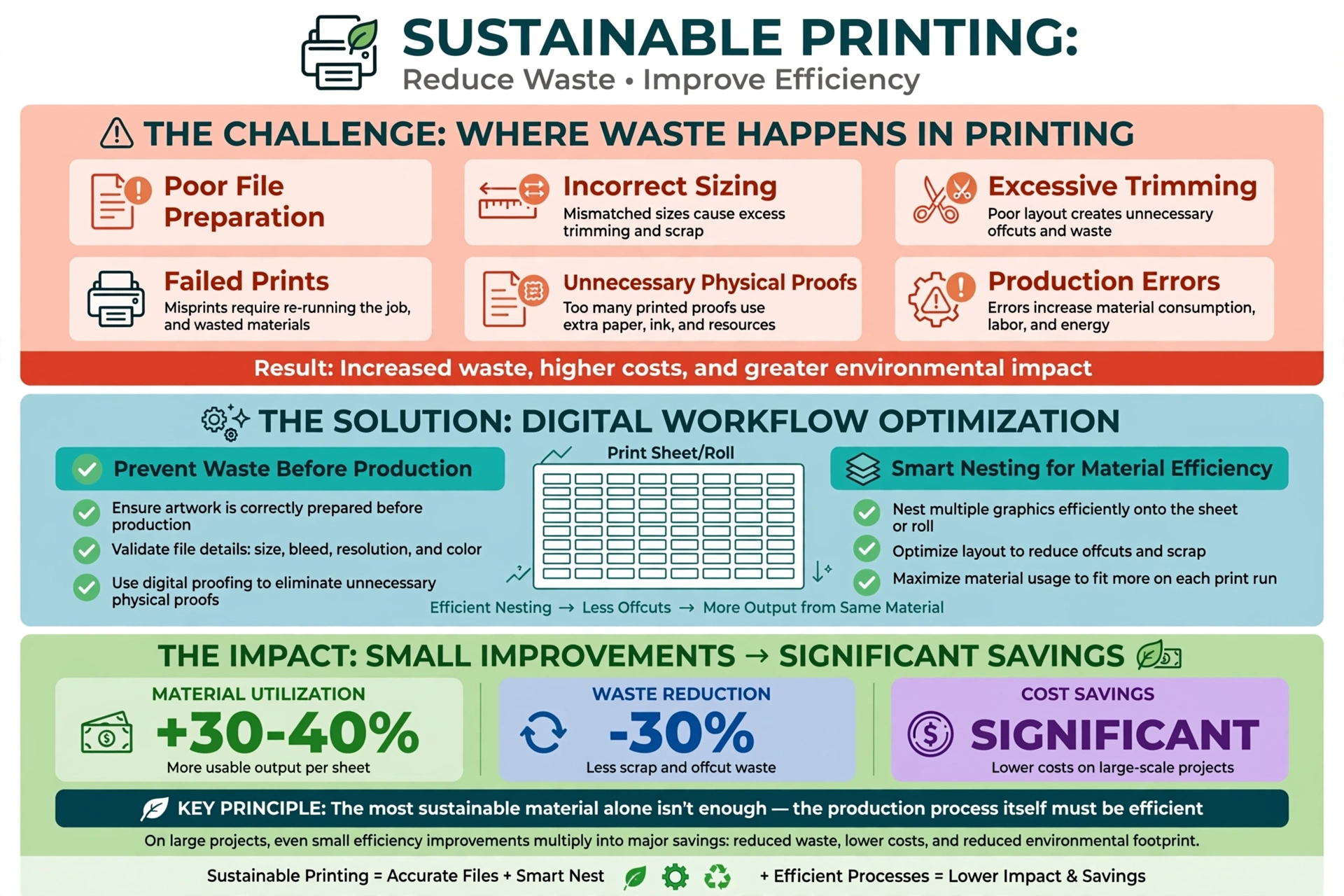
Sustainable printing is not only about the substrate.
Production waste can also have a significant impact.
Poor file preparation, incorrect sizing, excessive trimming, failed prints, unnecessary proofs, and production errors can all increase material consumption.
Digital workflow optimization can reduce waste by ensuring that artwork is correctly prepared before production.
Nesting multiple graphics efficiently onto a sheet or roll can also reduce offcuts.
When a project is large, a small improvement in material utilization can result in significant savings.
This demonstrates an important principle: the most sustainable material is not necessarily enough; the production process itself also needs to be efficient.
Reuse Can Be More Valuable Than Replacement
One of the strongest ways to reduce material consumption is to reuse existing graphics and display systems.
Modular exhibition frames can allow printed graphics to be replaced while keeping the structural hardware.
Fabric graphics can sometimes be stored and reused at future events.
Rigid display systems can be designed for campaign updates rather than complete replacement.
This approach supports the principles of the circular economy, where products and materials remain useful for as long as possible.
For businesses running repeated campaigns, reusable systems can also reduce long-term costs.
How Brands Can Make Better Printing Decisions
Businesses should start by identifying which printed applications create the largest material volumes.
They can then evaluate whether PVC-free alternatives are technically suitable.
A useful procurement conversation should address the intended service life, indoor or outdoor exposure, printing technology, installation method, reuse potential, recycling pathway, required certifications, and total cost.
The objective is not to eliminate every traditional material regardless of performance.
The objective is to make better-informed material decisions.
Sometimes a PVC-free material will be the best solution. In another application, a different material may provide a longer service life or better reuse potential.
Professional sustainability decisions are based on evidence rather than assumptions.
The Future of PVC-Free Print Media
The printing industry is moving toward more responsible material technologies as brands, printers, and consumers become more conscious of environmental impact.
Future development is likely to involve improvements in recyclable substrates, recycled content, bio-based materials, PVC-free films, textile graphics, water-based inks, low-VOC technologies, reusable display systems, and material recovery.
Digital printing technology will continue to evolve alongside these substrates.
The important opportunity for printers is to understand these developments before customers begin demanding them on a project-by-project basis.
Companies that can explain the technical differences between materials and provide realistic sustainability information can position themselves as more knowledgeable partners rather than simply material sellers.
Final Thoughts
Moving toward PVC-free print media is not about putting a sustainability label on every printed product. It is about understanding how materials perform and making better decisions based on the specific application.
Printers, signage companies, retailers, event organizers, interior designers, advertising agencies, and corporate procurement teams should evaluate the complete lifecycle of a printed product, including material composition, printing technology, durability, installation, reuse, transportation, waste generation, and end-of-life options.
For businesses operating in Dubai, Abu Dhabi, Sharjah, Jebel Ali, Al Quoz, Dubai Industrial City, Mussafah, and other UAE commercial and industrial areas, the growing demand for sustainable communication creates an opportunity to combine professional print quality with more responsible material selection.
PVC-free does not automatically mean sustainable, and traditional materials are not automatically the wrong choice for every application. The strongest approach is to select materials based on verified environmental characteristics, technical performance, application requirements, reuse potential, and realistic end-of-life pathways.
For printers looking to expand their sustainable material portfolio, working with a knowledgeable PVC sheets supplier in Dubai can also help when comparing conventional PVC products with alternative substrates and determining which material is technically appropriate for each signage, display, or printing application.
Ultimately, greener printing is not about compromising visual quality. It is about designing the entire print process more intelligently—from material selection and artwork preparation to production, installation, reuse, and responsible disposal.