

Blogs
How Acrylic Sheets Are Cut for Signage and Displays

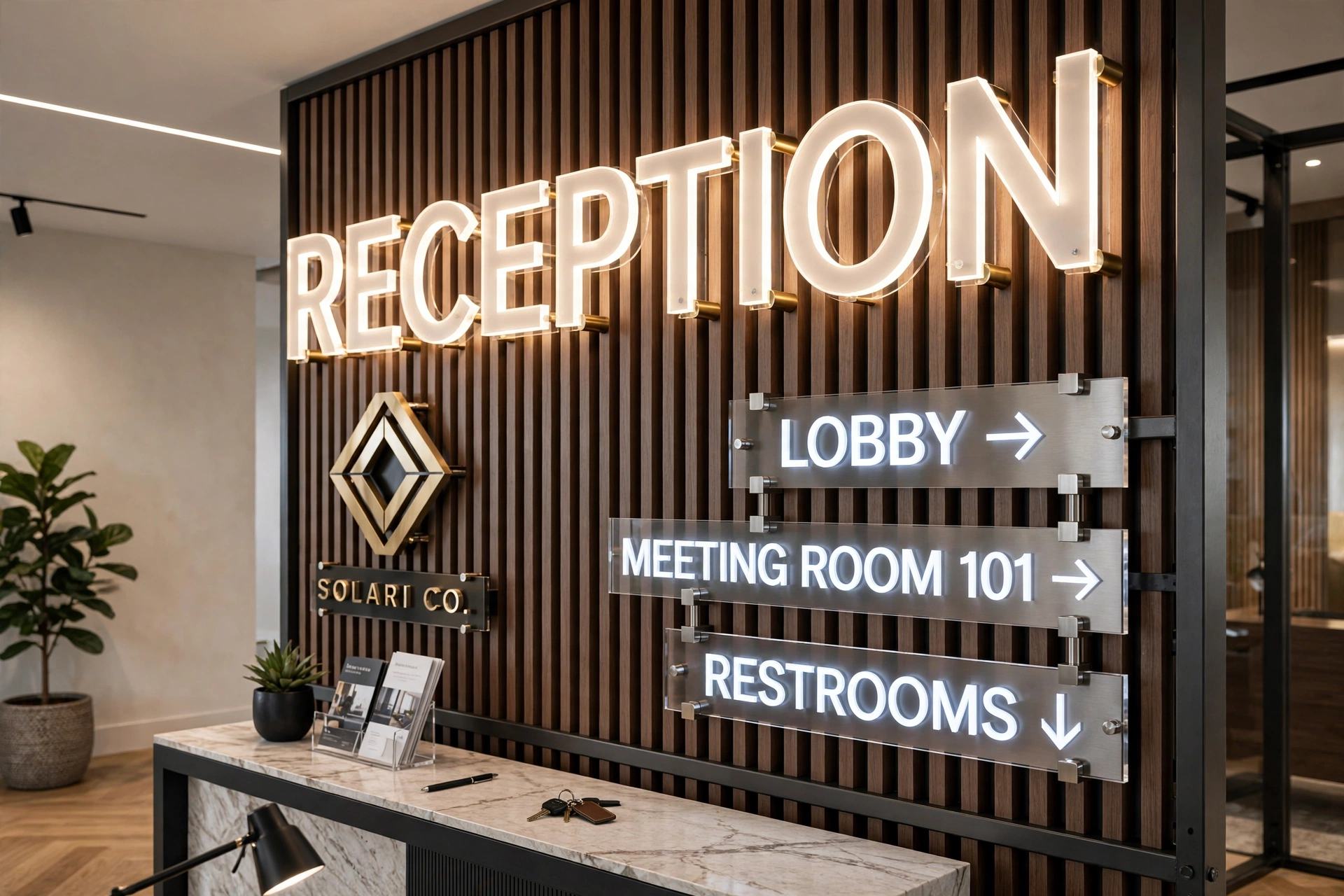
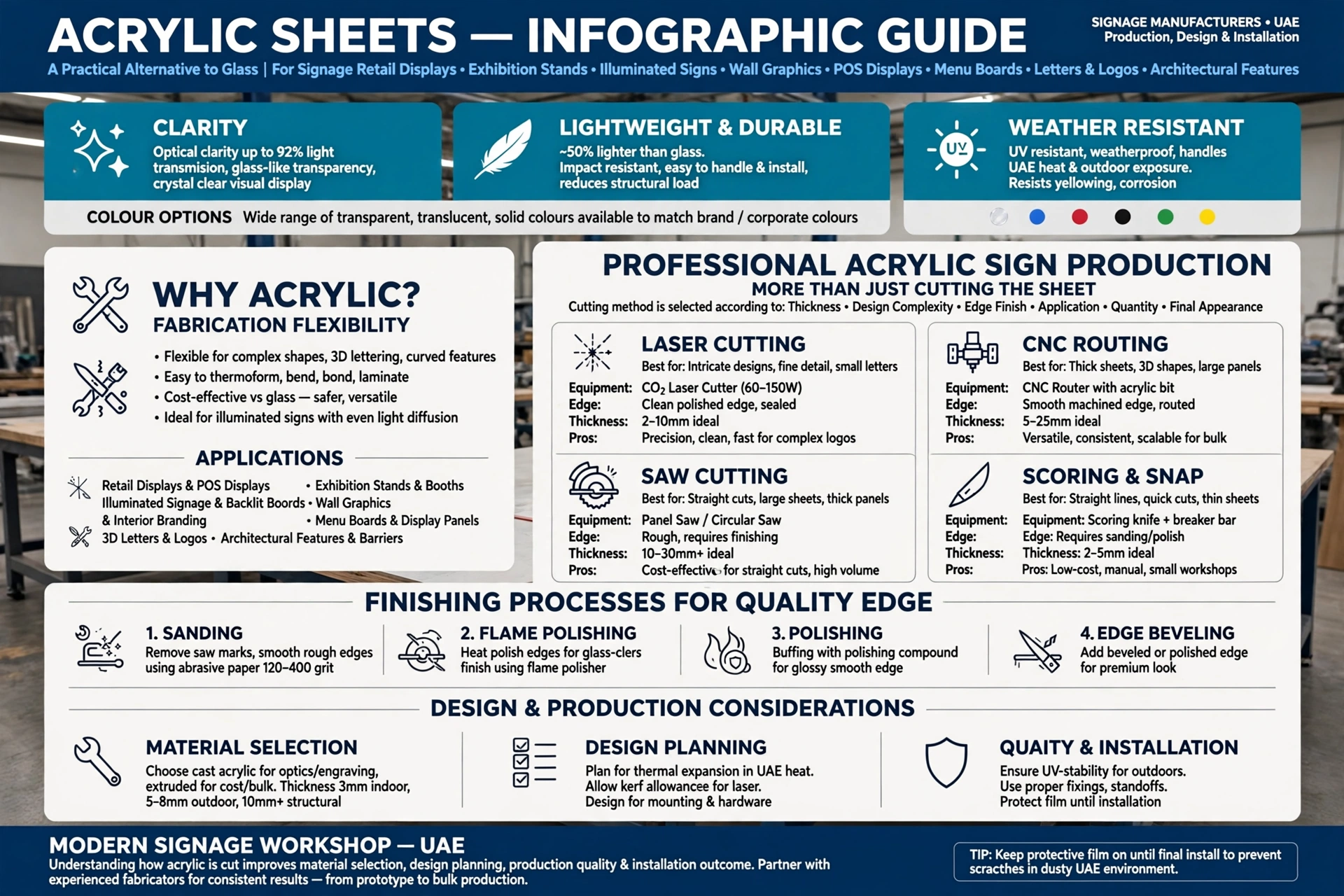
Acrylic sheets are widely used in signage, retail displays, exhibition stands, illuminated signs, wall graphics, point-of-sale displays, menu boards, letters, logos, and architectural features. Their combination of clarity, lightweight construction, weather resistance, colour options, and fabrication flexibility makes acrylic a practical alternative to glass for many commercial applications.
However, producing a professional acrylic sign involves more than simply cutting a sheet to size. The cutting method must be selected according to the acrylic thickness, design complexity, edge finish, application, quantity, and final appearance.
For signage manufacturers and businesses in the UAE, understanding how acrylic is cut can help with material selection, design planning, production quality, and installation. This guide explains the main acrylic cutting methods, equipment, finishing processes, design considerations, and applications for signage and displays.
What Is Acrylic Sheet?
Acrylic is a transparent thermoplastic commonly known as PMMA (polymethyl methacrylate). It is available in a wide range of thicknesses, colours, finishes, and surface treatments.
Compared with conventional glass, acrylic is generally lighter and easier to fabricate. It can also be cut, drilled, engraved, polished, thermoformed, and bonded using appropriate fabrication techniques.
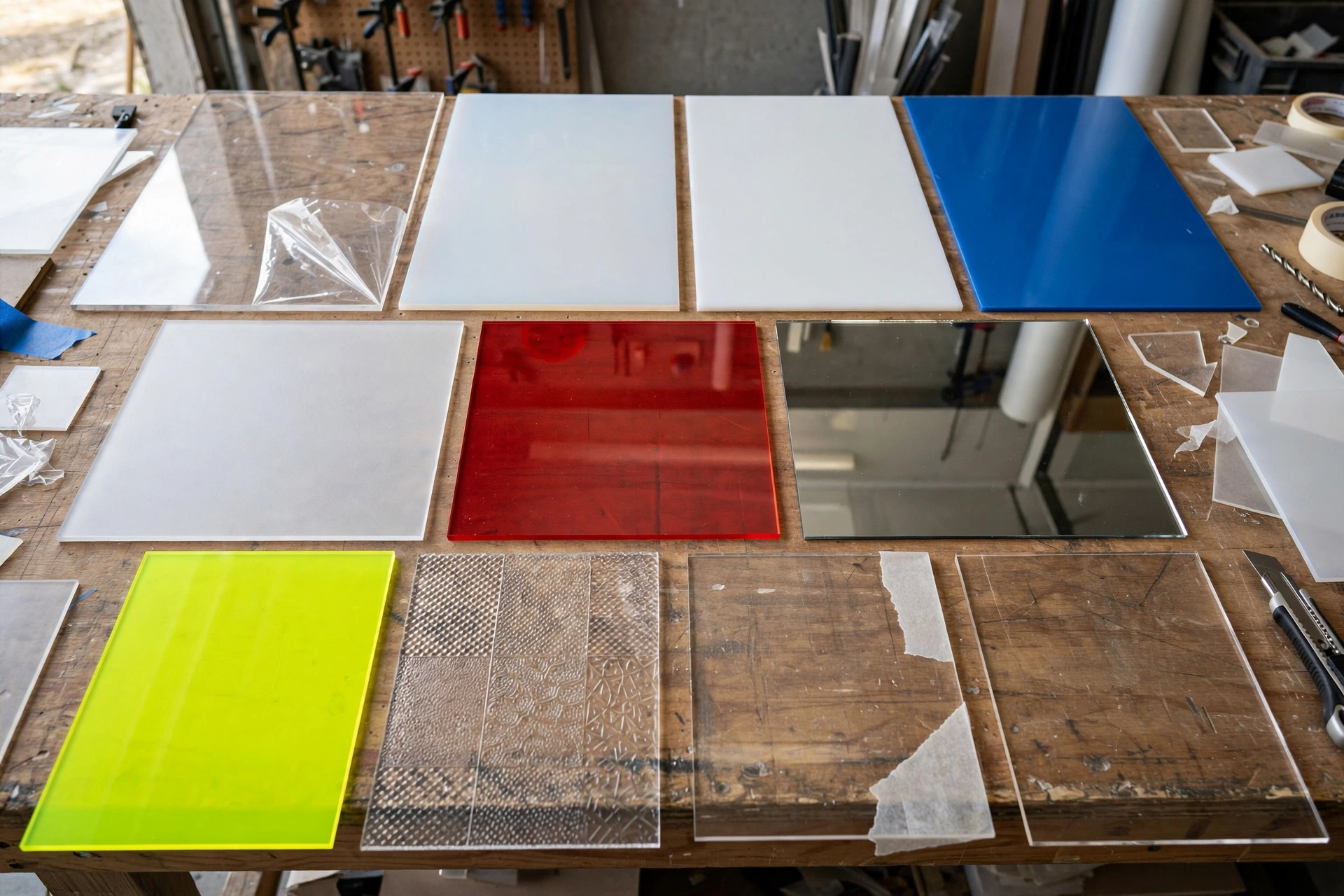
Common acrylic sheet types used in signage include:
- Clear acrylic
- Opal acrylic
- White acrylic
- Coloured acrylic
- Frosted acrylic
- Transparent coloured acrylic
- Mirror acrylic
- Fluorescent acrylic
- Textured acrylic
- Cast acrylic
- Extruded acrylic
The correct material depends on the intended application and fabrication method.
Why Acrylic Is Popular for Signage
Acrylic is particularly useful for signage because it can be fabricated into precise shapes.
Sign makers can produce:
Letters, logos, arrows, numbers, panels, symbols, display holders, menu boards, illuminated faces, decorative elements, and custom shapes.
Clear acrylic can be combined with LED lighting to create illuminated signs, while opaque and coloured sheets can provide strong visual contrast.
Its relatively low weight can also simplify handling and installation compared with heavier materials.
Choosing Acrylic Thickness Before Cutting
Sheet thickness is one of the first considerations in acrylic fabrication.
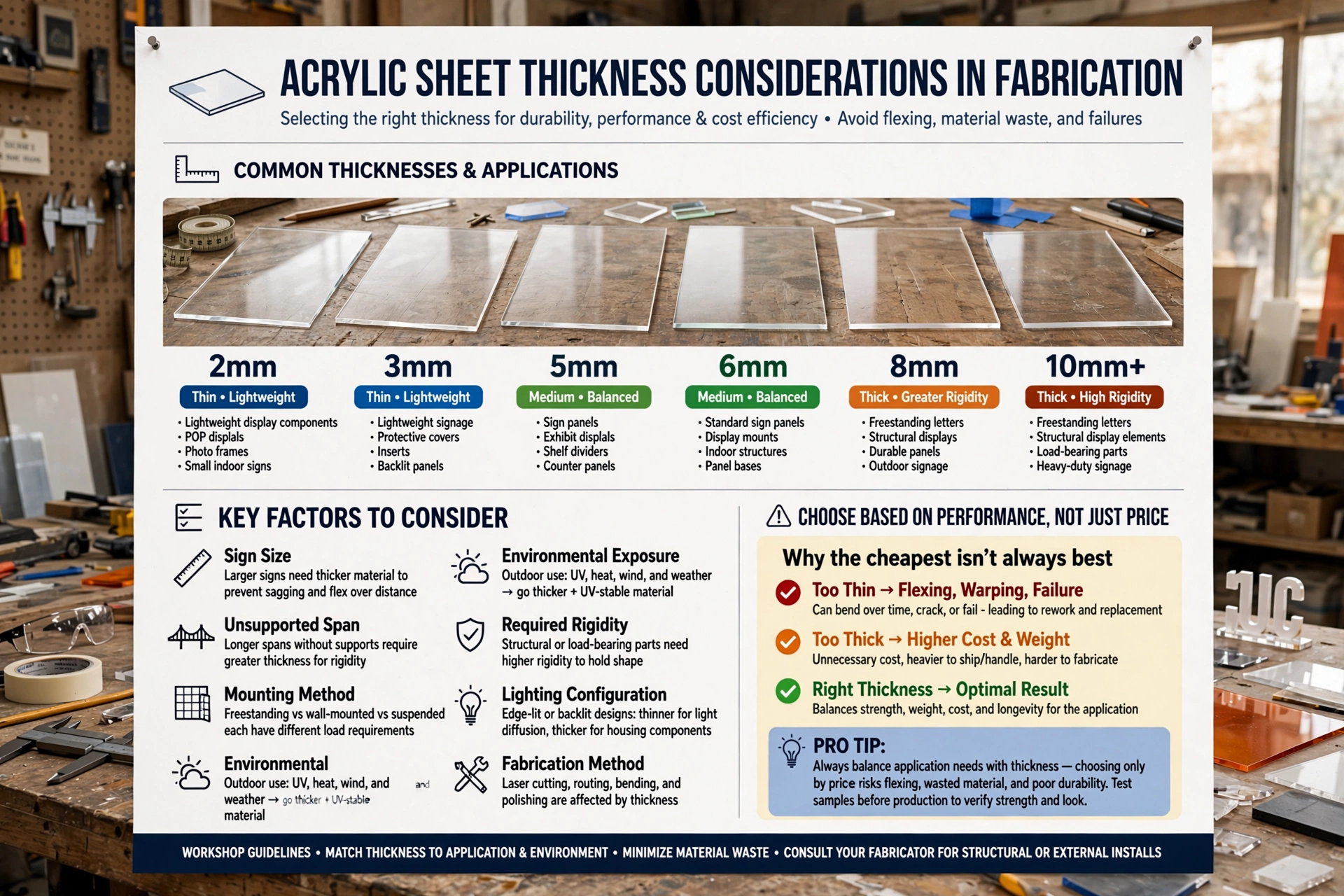
Common thicknesses may include approximately 2 mm, 3 mm, 5 mm, 6 mm, 8 mm, 10 mm, and thicker sheets, depending on the project.
Thin sheets can be suitable for lightweight display components, while thicker acrylic can provide greater rigidity for freestanding letters, sign panels, and structural display elements.
The correct thickness depends on:
Sign size, unsupported span, mounting method, environmental exposure, required rigidity, lighting configuration, and fabrication method.
Choosing thickness based only on price can lead to unnecessary flexing or material waste.
How Acrylic Sheets Are Cut
Acrylic can be cut using several techniques.
The most common methods for signage and display fabrication include:
Laser cutting, CNC routing, table saw cutting, scoring and snapping for suitable thin sheets, and specialized cutting equipment.
Each method has advantages and limitations.
The correct process depends on the material, thickness, geometry, edge requirements, and production quantity.
Laser Cutting Acrylic
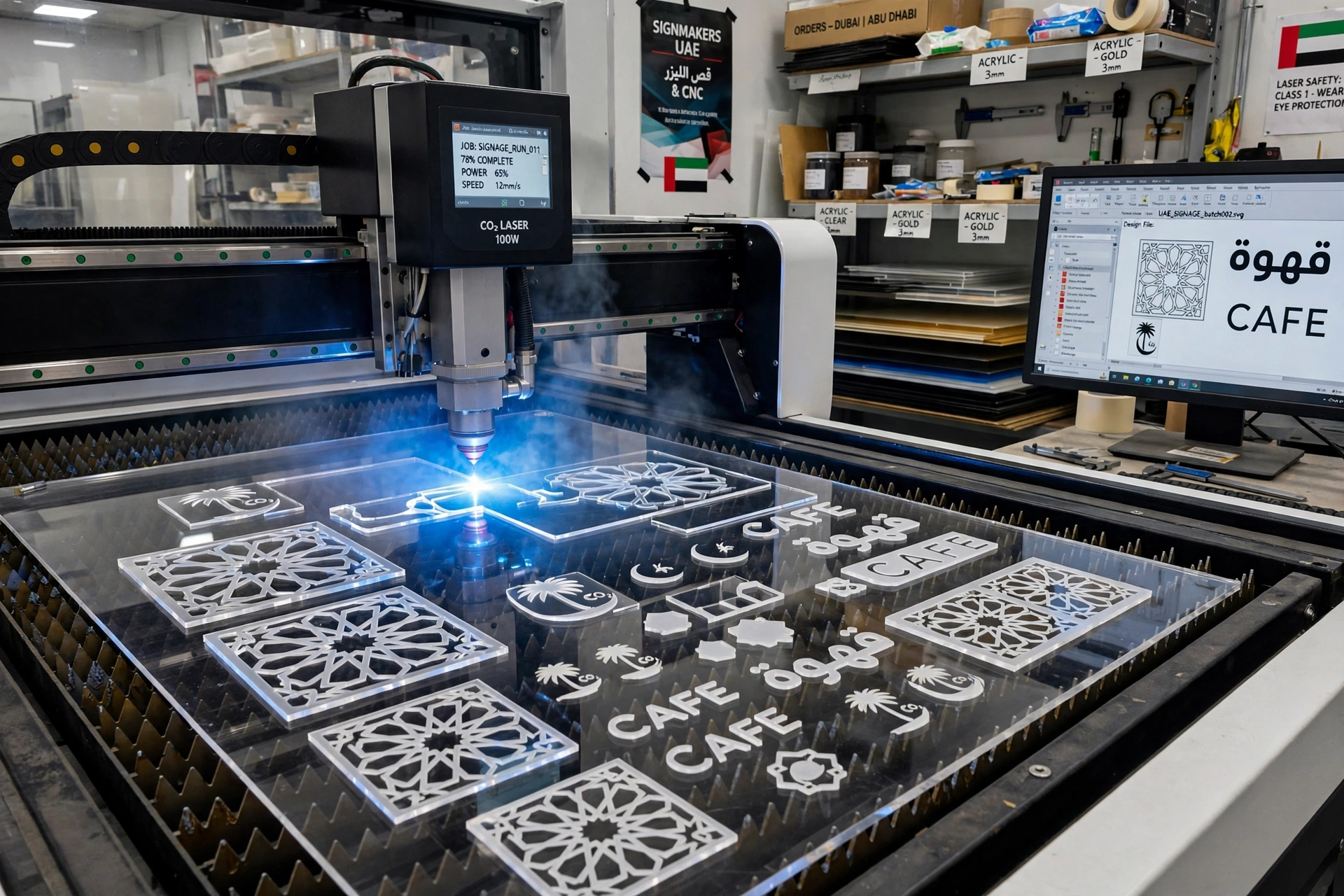
Laser cutting is one of the most popular methods for producing detailed acrylic signage.
A focused laser beam follows a digital design and cuts through the acrylic sheet.
Laser cutting is particularly useful for:
- Intricate lettering
- Logos
- Small shapes
- Decorative patterns
- Stencils
- Display components
- Custom signage
- Small production runs
Cast acrylic is commonly preferred for laser applications because it can produce clean, visually attractive edges.
One advantage of laser cutting is that the digital design can be reproduced accurately across multiple pieces.
How Laser Cutting Works
The process generally begins with a digital vector design.
The artwork may be prepared using software such as Adobe Illustrator, CorelDRAW, AutoCAD, or other compatible CAD/vector applications.
The design is then converted into cutting paths.
The laser machine uses controlled power, speed, and focus settings according to the acrylic type and thickness.
The laser heats and vaporizes the material along the programmed path.
Correct settings are essential.
Excessive heat can cause unwanted melting, while insufficient power may result in incomplete cuts.
CNC Routing Acrylic
CNC routing is another important acrylic fabrication method.
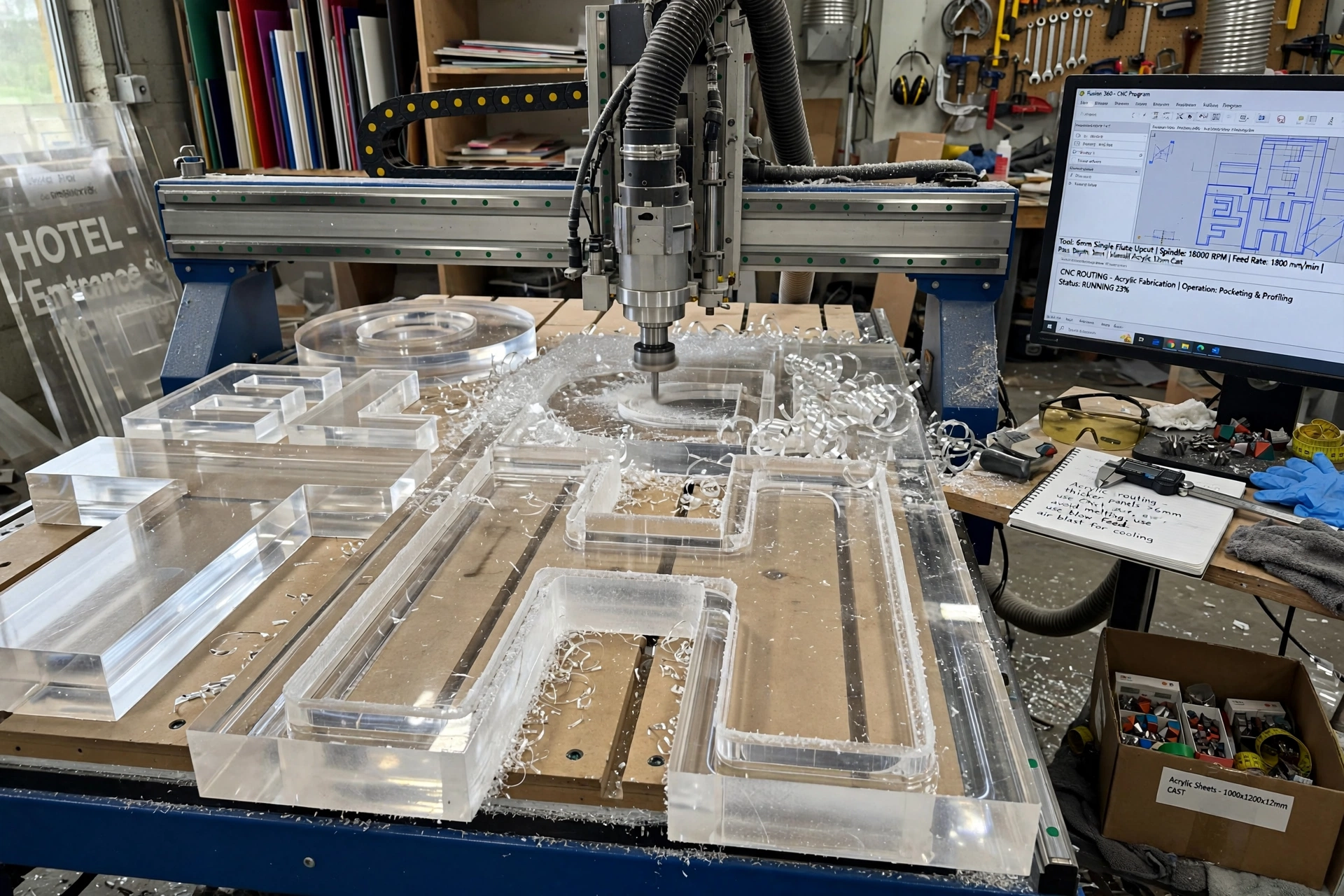
A computer numerical control (CNC) router uses a rotating cutting tool to machine the acrylic according to a programmed design.
CNC routing is particularly useful for:
Large panels, thicker acrylic, oversized letters, deep cuts, grooves, pockets, and applications where laser cutting may not be appropriate.
It can also produce larger-format signage components.
The final edge appearance depends on the cutter, feed rate, spindle speed, material, and finishing process.
Laser Cutting vs CNC Routing
The two methods serve different production requirements.
Laser cutting is particularly effective for intricate shapes, fine lettering, and smaller detailed components.
CNC routing can be advantageous for thicker materials, larger pieces, and deeper machining operations.
The best method depends on the project rather than one technology being universally superior.
For example, a small decorative acrylic logo may be efficiently laser cut, while a large 20 mm acrylic panel may be more appropriate for CNC machining.
Scoring and Snapping Acrylic
Thin acrylic sheets can sometimes be cut manually using a scoring technique.
A scoring knife is used to create a controlled groove along the intended cutting line. The sheet can then be carefully snapped along the scored line.
This technique is generally more suitable for simple straight cuts in thinner acrylic.
It is less appropriate for intricate signage, curved designs, thick sheets, or applications requiring highly precise edges.
For professional signage production, powered cutting methods are usually preferred when precision and repeatability are important.
Saw Cutting Acrylic Sheets
Acrylic can also be cut using suitable saw equipment.
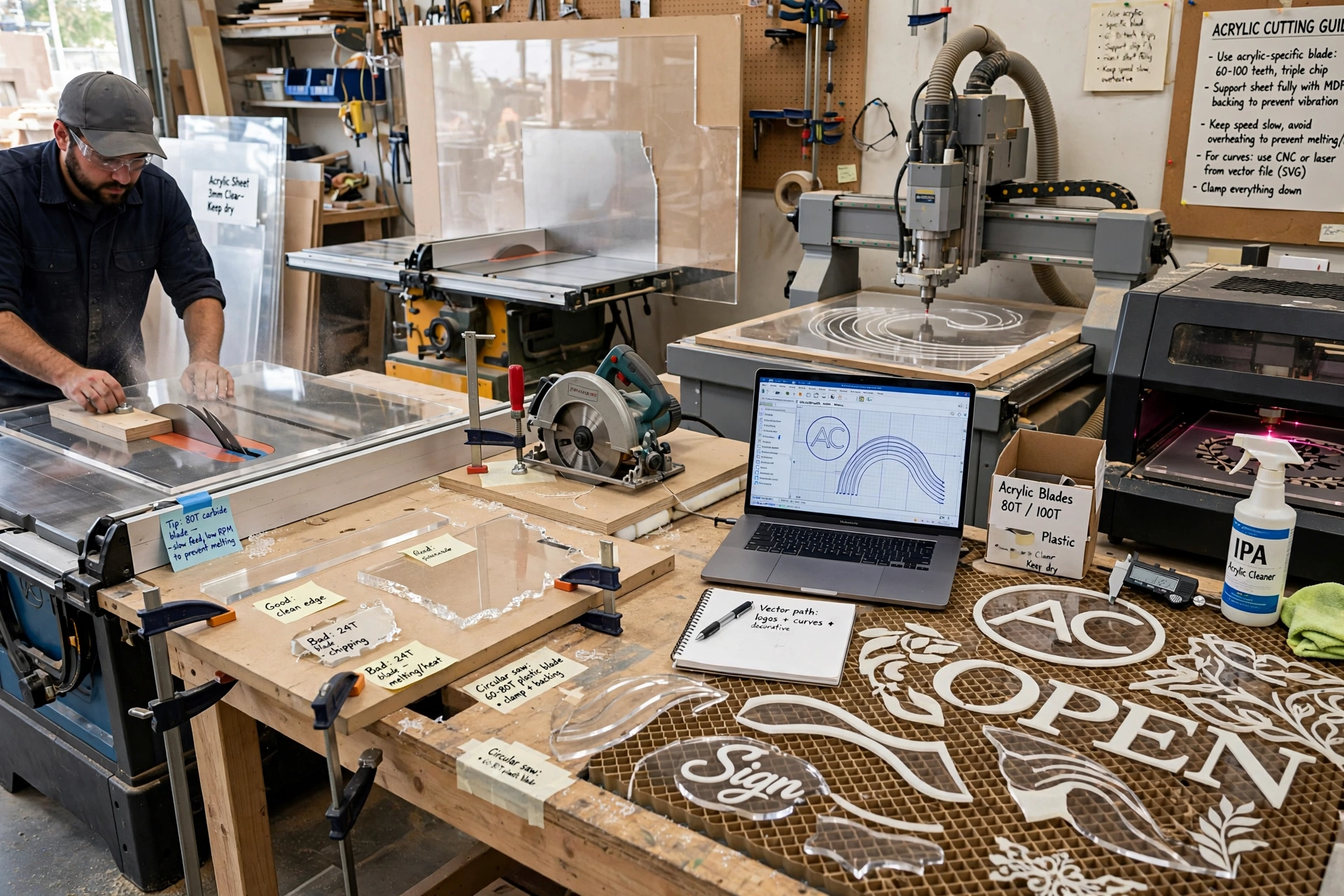
Table saws, panel saws, and circular saws fitted with appropriate blades can produce straight cuts.
Blade selection is important because acrylic can chip, melt, or crack if cutting conditions are unsuitable.
The sheet should be properly supported during cutting to reduce vibration.
For large signage panels requiring straight dimensions, saw cutting can be efficient.
Cutting Curved Acrylic Shapes
Curved shapes require different fabrication techniques from straight cuts.
CNC routers and laser cutters can follow programmed curves precisely.
For complex signage designs, the artwork is converted into vector paths before cutting.
This allows manufacturers to reproduce:
Circular logos, curved letters, custom symbols, waves, arches, decorative patterns, and organic shapes.
Accurate vector preparation is important because even a small error in the artwork can be reproduced across every manufactured component.
Cutting Acrylic Letters
Acrylic letters are commonly used for:
- Reception signage
- Corporate logos
- Retail branding
- Directional signs
- Office signs
- Hotel signage
- Restaurant branding
- Event displays
- Exhibition stands
Letters can be cut individually and mounted directly onto a wall or sign panel.
They may also be combined with spacers, backing panels, LEDs, or metal structures.
Acrylic for Illuminated Signage
Acrylic is particularly popular for illuminated signs because certain grades allow light to pass through the material.
Opal acrylic is commonly used where even light diffusion is required.
LED modules or LED strips can be installed behind or within the sign structure.
The acrylic face then distributes the light across the visible surface.
Correct material selection and diffuser thickness can help minimize visible LED hotspots.
Acrylic and LED Lighting
Acrylic signage can be combined with different LED configurations.
These may include:
Front illumination, edge lighting, backlighting, halo illumination, and internal LED illumination.
Clear acrylic can be edge-lit, while translucent acrylic can distribute light across a face.
The relationship between acrylic thickness, LED spacing, brightness, diffuser characteristics, and sign depth should be considered during design.
Simply installing brighter LEDs does not necessarily produce better illumination.
Edge Finishing After Cutting
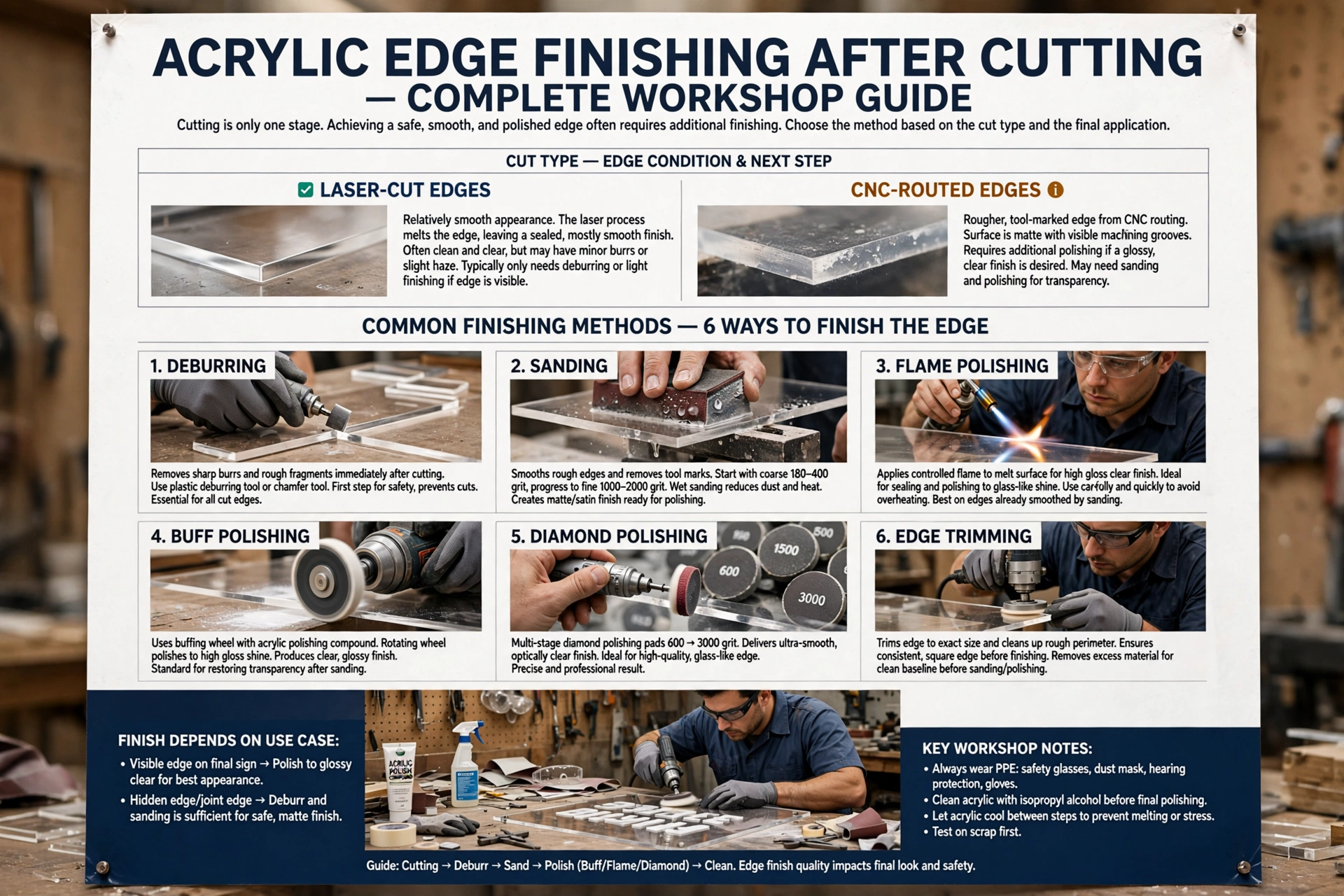
Cutting is only one stage of acrylic fabrication.
The edge may require additional finishing depending on the application.
Common finishing methods include:
- Sanding
- Flame polishing
- Buff polishing
- Diamond polishing
- Edge trimming
- Deburring
Laser-cut edges can have a relatively smooth appearance, while CNC-routed edges may require additional polishing if a glossy finish is desired.
The required edge finish depends on whether the edge will be visible in the final sign.
Flame Polishing Acrylic
Flame polishing uses controlled heat to create a smooth, glossy edge on suitable acrylic surfaces.
It requires experienced handling because excessive heat can deform the material or create internal stress.
Flame polishing should therefore be performed carefully, particularly around thin components or detailed shapes.
For premium signage and display work, edge finishing can significantly affect the final appearance.
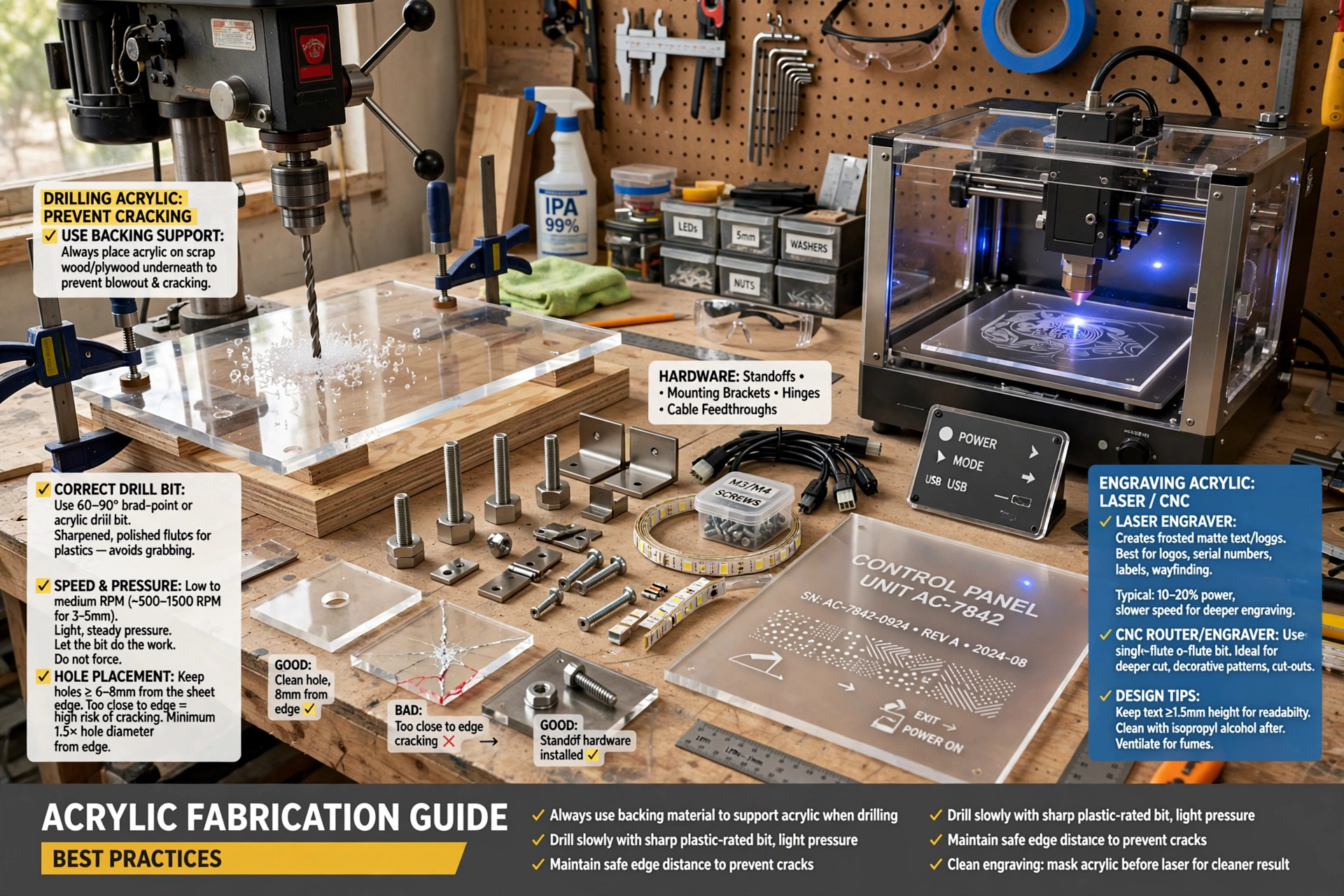
Drilling Acrylic Sheets
Acrylic often needs holes for:
Screws, standoffs, mounting brackets, display hardware, hinges, cables, and LED components.
Drilling must be performed carefully to prevent cracking.
The correct drill bit geometry, speed, pressure, and support can help produce cleaner holes.
Holes should not be positioned too close to the sheet edge because insufficient edge distance can increase the risk of cracking.
Engraving Acrylic
Acrylic can also be engraved using laser or CNC equipment.
Engraving can create:
- Text
- Logos
- Serial numbers
- Decorative patterns
- Wayfinding information
- Product labels
- Control panels
Clear acrylic can produce distinctive engraved effects, particularly when combined with edge lighting.
Acrylic Display Fabrication
Acrylic is extensively used for retail and point-of-sale displays.
Examples include:
Product stands, brochure holders, shelf displays, cosmetic displays, menu holders, countertop displays, literature racks, jewellery displays, and promotional stands.
Cutting accuracy is particularly important because display components often need to fit together precisely.
Slots, tabs, holes, and bends can be incorporated into the digital design before fabrication.
Thermoforming Acrylic
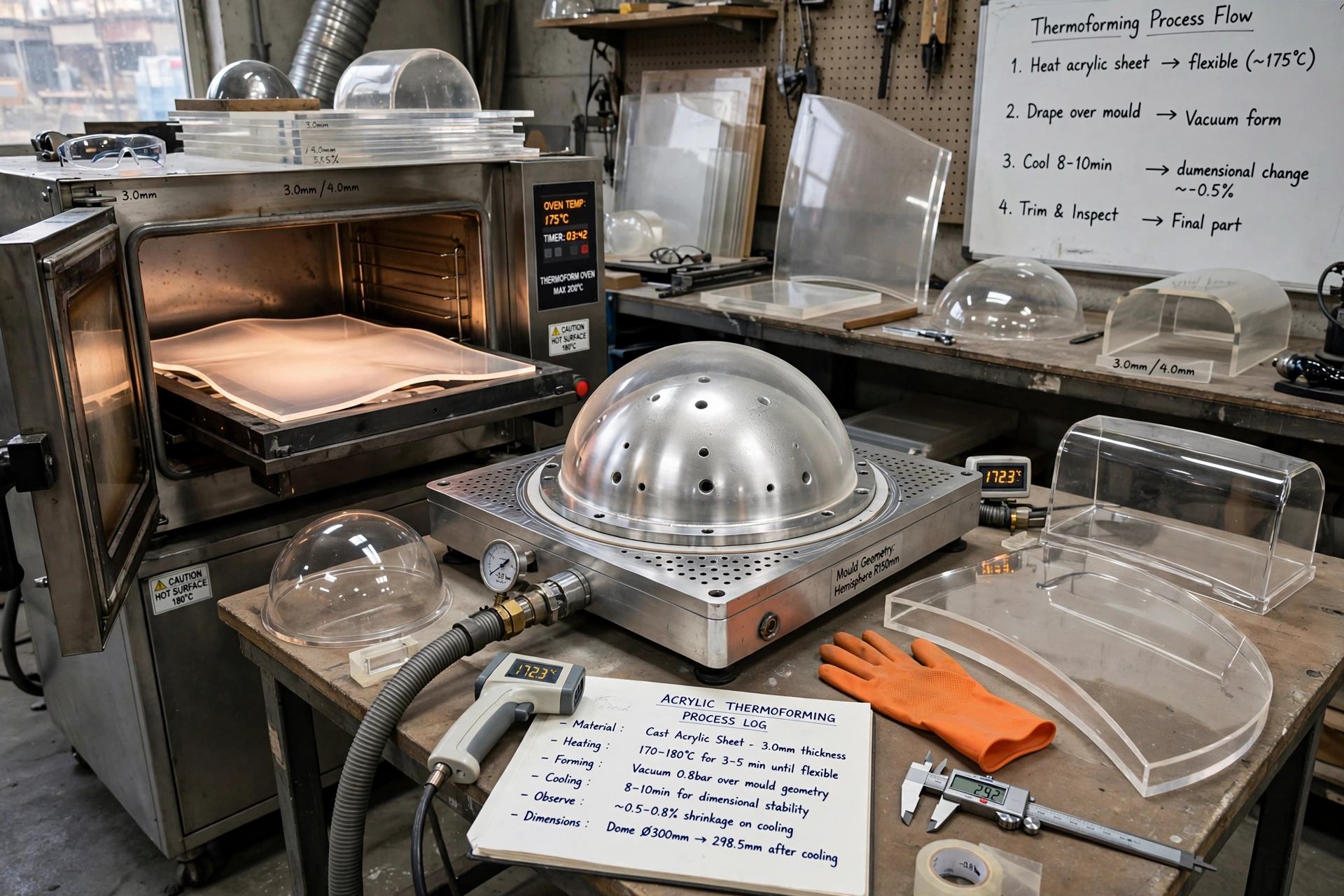
Some acrylic products require shaping rather than simply cutting.
Thermoforming involves heating the acrylic until it becomes sufficiently flexible and forming it over a mould.
This can create:
Curved panels, domes, protective covers, display components, and custom architectural shapes.
The process must account for material thickness, heating temperature, mould geometry, cooling, and dimensional changes.
Acrylic Signage for Retail Stores
Retail environments often use acrylic for branded and promotional elements.
Acrylic can be used for:
- Storefront signs
- Product displays
- Promotional panels
- Shelf talkers
- Price holders
- Directional signage
- Logo displays
- Illuminated branding
Its clean appearance makes it suitable for modern retail environments.
Dubai’s retail sector, including locations such as Dubai Mall, Mall of the Emirates, City Walk, Dubai Marina, Business Bay, and Downtown Dubai, contains a wide range of retail and hospitality applications where custom signage and displays are required.
Acrylic Signage for Offices
Businesses can use acrylic for professional workplace signage.
Applications include:
Reception logos, room identification signs, meeting-room displays, directional signs, department signs, and corporate branding.
Clear, frosted, or coloured acrylic can be combined with vinyl graphics, printed elements, stainless steel, aluminium, or LED lighting.
Acrylic Signage for Hotels and Hospitality
Hotels and hospitality venues often use acrylic for both decorative and functional signage.
Applications can include:
- Room numbers
- Wayfinding
- Restaurant signs
- Reception branding
- Event signage
- Menu displays
- Spa signage
- Promotional displays
In locations such as Palm Jumeirah, Downtown Dubai, Dubai Marina, Jumeirah, and Abu Dhabi, acrylic can be incorporated into premium hospitality environments.
Acrylic Displays for Jewellery Stores
Jewellery retailers often require precise display fabrication.
Clear acrylic can provide a minimalist appearance while allowing products to remain visually prominent.
Custom-cut acrylic can create:
Ring displays, necklace stands, earring holders, product risers, branded trays, and illuminated showcases.
Edge finishing becomes particularly important in premium retail environments because customers can see the display material from multiple angles.
Acrylic Signage in the UAE
The UAE has a strong commercial signage and retail-display market.
Businesses in Dubai, Abu Dhabi, Sharjah, Ajman, and other emirates use acrylic for indoor and outdoor branding.
However, outdoor signage requires careful consideration of:
UV exposure, temperature, wind loading, mounting, sheet thickness, colour stability, and structural support.
Not every acrylic grade is equally suitable for every outdoor application.
Outdoor Acrylic Signs
Acrylic can be used outdoors when the material and construction are appropriately specified.
The sign design should consider the local climate.
Direct sunlight can affect some materials over time, while high temperatures can influence dimensional stability.
For large outdoor signs, structural support is also critical.
The acrylic sheet should not be expected to function as a structural element unless it has been specifically designed for that purpose.
Reducing Acrylic Cutting Waste
Good digital planning can significantly reduce material waste.
Manufacturers can arrange multiple components on a single sheet using nesting software.
This is particularly useful for:
Large letter sets, repeated logos, display components, and high-volume signage.
Nesting should consider kerf, spacing, sheet dimensions, grain or finish direction where applicable, and safe cutting margins.
Better material utilization can reduce project costs and unnecessary waste.
Why Vector Artwork Matters
Professional acrylic cutting generally begins with accurate digital artwork.
Vector files are preferred because they define shapes using mathematical paths rather than pixels.
Suitable formats can include:
AI, EPS, SVG, DXF, and compatible CAD files, depending on the machine and production workflow.
The artwork should clearly distinguish between cutting paths, engraving areas, holes, and other fabrication instructions.
Common Acrylic Cutting Mistakes
Several mistakes can affect the quality of a finished sign.
Incorrect Cutting Settings
Too much heat can melt acrylic edges.
Too little power can result in incomplete cuts.
Poor Material Selection
Different acrylic grades behave differently during fabrication.
The sheet should be selected according to the cutting method and application.
Insufficient Support
Large sheets can vibrate or move during cutting if they are not adequately supported.
Ignoring Edge Finishing
A technically accurate cut can still look unfinished if visible edges are not properly polished.
Incorrect Measurements
Even small dimensional errors can cause problems during assembly and installation.
How to Choose Acrylic Sheets for Signage
When selecting acrylic, consider:
Thickness, colour, transparency, finish, UV exposure, indoor or outdoor application, cutting method, lighting requirements, structural requirements, and budget.
For illuminated signage, light transmission and diffusion characteristics are particularly important.
For premium displays, surface quality and edge finish may be more important.
For large outdoor panels, thickness and structural support require greater attention.
Businesses looking for suitable material for signboards, displays, letters, and custom fabrication can explore Acrylic Sheets for Signage when selecting acrylic for a signage project.
Frequently Asked Questions
What is the best method for cutting acrylic signage?
Laser cutting and CNC routing are two common professional methods. Laser cutting is particularly suitable for detailed shapes and lettering, while CNC routing is useful for thicker sheets and larger components.
Can acrylic be cut with a laser?
Yes. Acrylic is widely used in laser cutting applications. The correct laser settings depend on the acrylic type, thickness, and machine.
Can acrylic be cut with a CNC router?
Yes. CNC routing is suitable for many acrylic sheets and is particularly useful for thicker materials, large components, grooves, and deeper cuts.
What thickness of acrylic is best for signs?
There is no universal thickness. The appropriate thickness depends on sign size, mounting, rigidity, lighting, location, and fabrication requirements.
Can acrylic be used for outdoor signage in Dubai?
Yes, when an appropriate acrylic grade, thickness, mounting method, and overall sign construction are selected for outdoor conditions.
How are acrylic letters made?
Acrylic letters are generally designed digitally and then cut using laser, CNC, or other suitable fabrication equipment. The edges may then be polished before the letters are painted, layered, illuminated, or installed.
Does laser cutting acrylic leave a smooth edge?
Laser cutting can produce relatively smooth edges, particularly with suitable cast acrylic and properly optimized machine settings. The final appearance depends on the material and cutting process.
Conclusion
Acrylic sheet cutting is an important part of professional signage and display fabrication. From simple rectangular panels to complex logos, illuminated letters, retail displays, and decorative architectural components, the cutting method influences accuracy, edge quality, production time, and final appearance.
Laser cutting, CNC routing, saw cutting, and scoring each have appropriate applications. The choice depends on the acrylic type, thickness, design complexity, production volume, and required finish.
Professional fabrication also involves more than cutting. Drilling, engraving, polishing, thermoforming, bonding, LED integration, mounting, and finishing may all be required to transform a raw acrylic sheet into a completed sign or display.
For businesses in Dubai, Abu Dhabi, Sharjah, and across the UAE, acrylic remains a versatile material for retail signage, corporate branding, hospitality displays, exhibition graphics, illuminated signs, and point-of-sale applications.
The best results come from selecting the right acrylic grade, preparing accurate vector artwork, choosing an appropriate cutting method, controlling heat and machining conditions, and completing the necessary finishing work.
Whether the project involves a small countertop display or a large illuminated storefront sign, understanding how acrylic is cut helps businesses make better decisions about material selection, design, fabrication quality, durability, and overall project cost.