

Blogs
Common Polycarbonate Sheet Installation Mistakes and How to Avoid Them

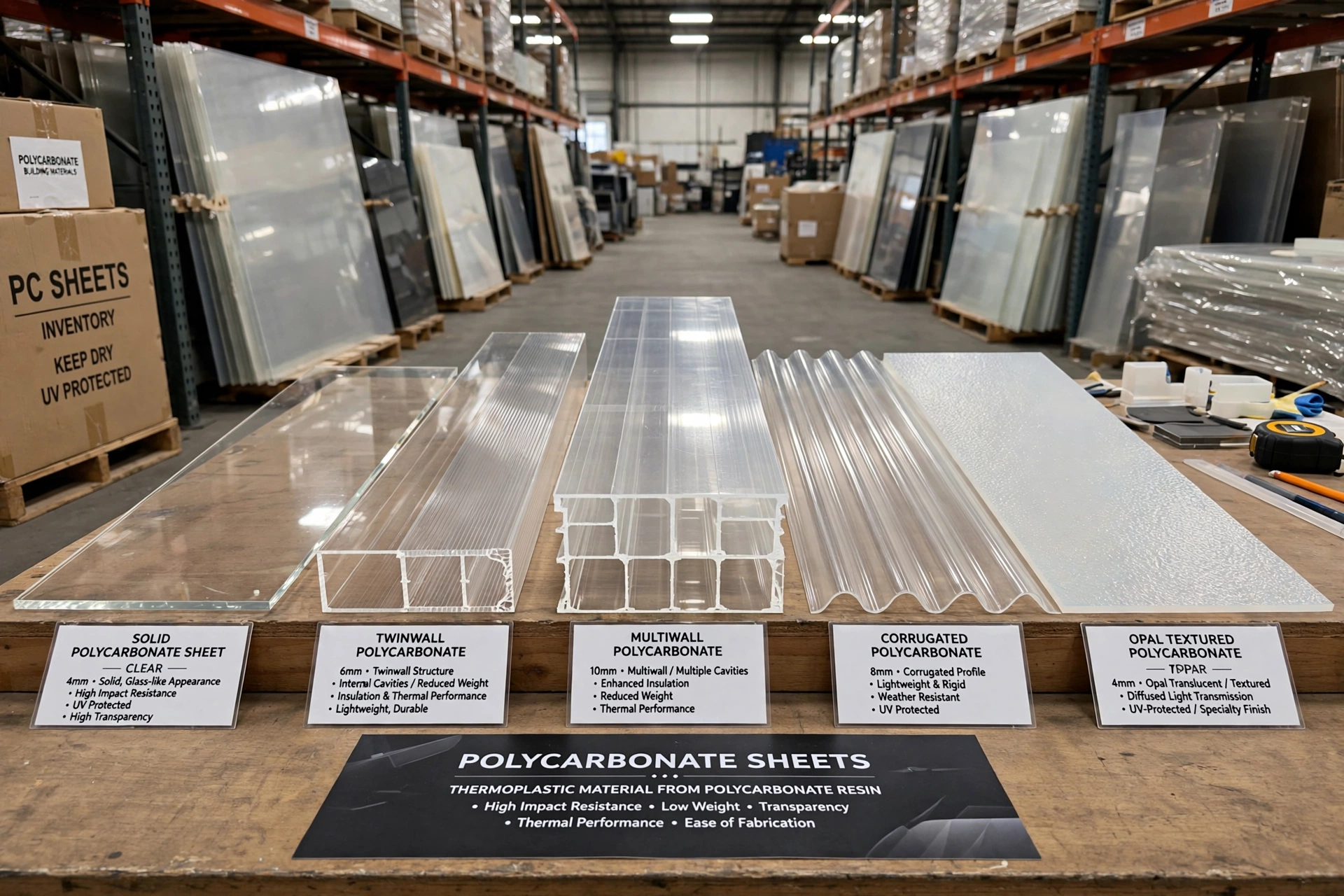
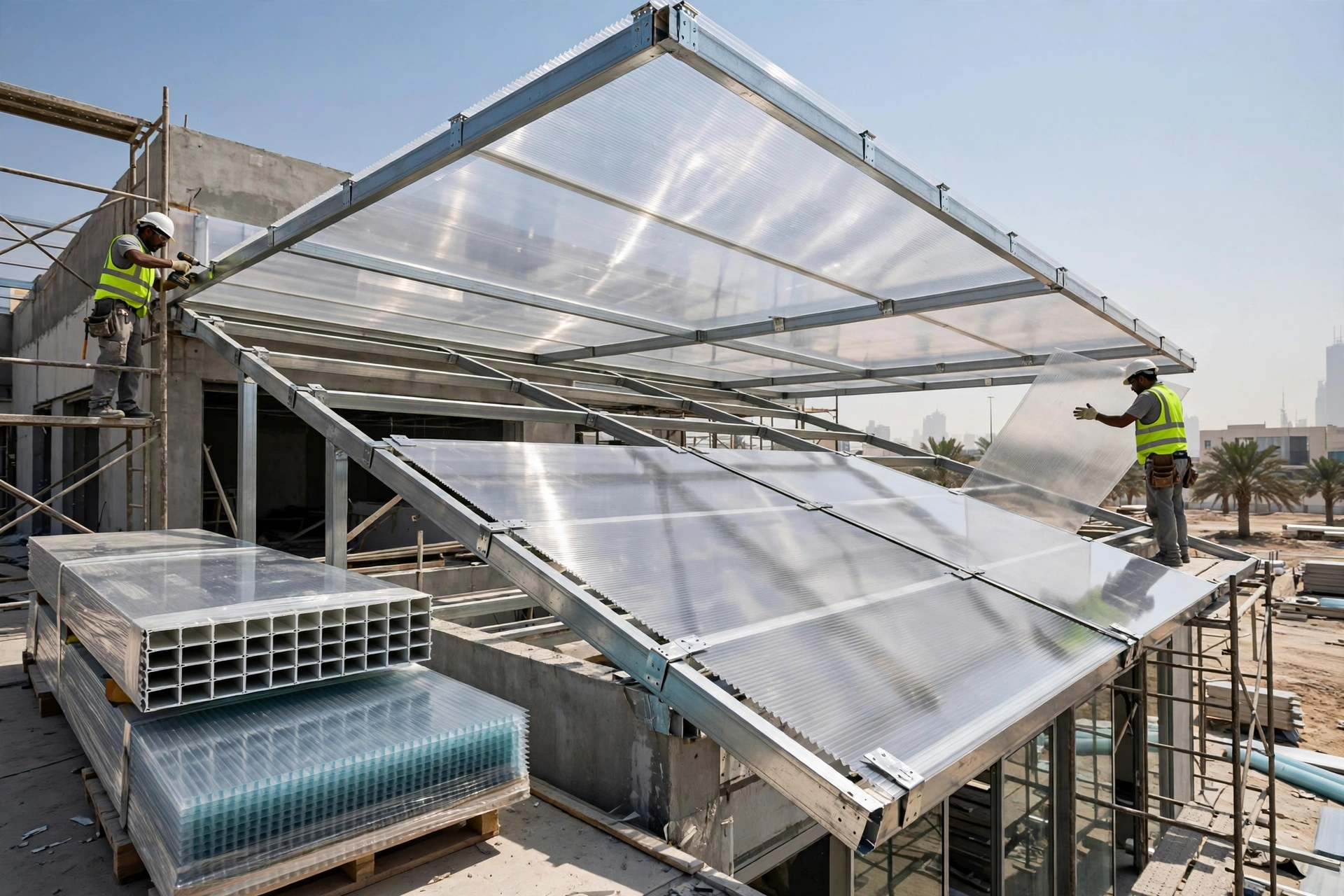
Polycarbonate sheets are widely used for roofing, skylights, partitions, canopies, greenhouse structures, commercial buildings, industrial facilities, signage, protective barriers, and architectural applications. Their combination of impact resistance, lightweight construction, light transmission, weather resistance, and fabrication flexibility makes them a practical alternative to glass and other sheet materials.
However, even a high-quality polycarbonate sheet can perform poorly when it is installed incorrectly. Problems such as cracking, leaking, condensation, excessive thermal movement, discoloration, panel deformation, and premature deterioration are often related to installation practices rather than the material itself.
This is particularly important in the UAE, where intense sunlight, high temperatures, dust, humidity, and seasonal weather conditions can place additional demands on building materials.
Whether you are installing solid polycarbonate sheets, twinwall polycarbonate, multiwall polycarbonate, corrugated polycarbonate roofing, or UV-protected panels, understanding common installation mistakes can help improve durability and appearance.
What Makes Polycarbonate Sheets Different?
Polycarbonate is a thermoplastic material made primarily from polycarbonate resin. It is valued for its high impact resistance, relatively low weight, transparency, thermal performance, and ease of fabrication.
Polycarbonate sheets are available in several configurations, including:
- Solid polycarbonate sheets
- Twinwall polycarbonate sheets
- Multiwall polycarbonate sheets
- Corrugated polycarbonate sheets
- Clear polycarbonate
- Opal and translucent polycarbonate
- UV-protected polycarbonate
- Textured and specialty sheets
Each construction has different characteristics.
For example, multiwall sheets contain internal cavities that improve insulation and reduce weight, while solid sheets provide a more glass-like appearance and strong impact resistance.
Because these products behave differently, installation techniques should follow the manufacturer’s specifications for the particular sheet.
Mistake 1: Choosing the Wrong Polycarbonate Sheet
One of the most common mistakes happens before installation even begins.
A sheet may look suitable for a project but have characteristics that are inappropriate for the application.
For example, a project may require:
UV resistance, thermal insulation, high impact resistance, transparency, privacy, rigidity, or specific light transmission.
Choosing a sheet based only on thickness or price can result in poor performance.
How to Avoid It
Start by identifying the purpose of the installation.
Consider:
- Indoor or outdoor use
- Roof or vertical application
- Required light transmission
- Exposure to sunlight
- Expected wind loads
- Required thermal insulation
- Sheet dimensions
- Support spacing
- Colour and finish
- Required service life
For commercial and architectural projects, specifications should be reviewed with the manufacturer or experienced material supplier before installation.
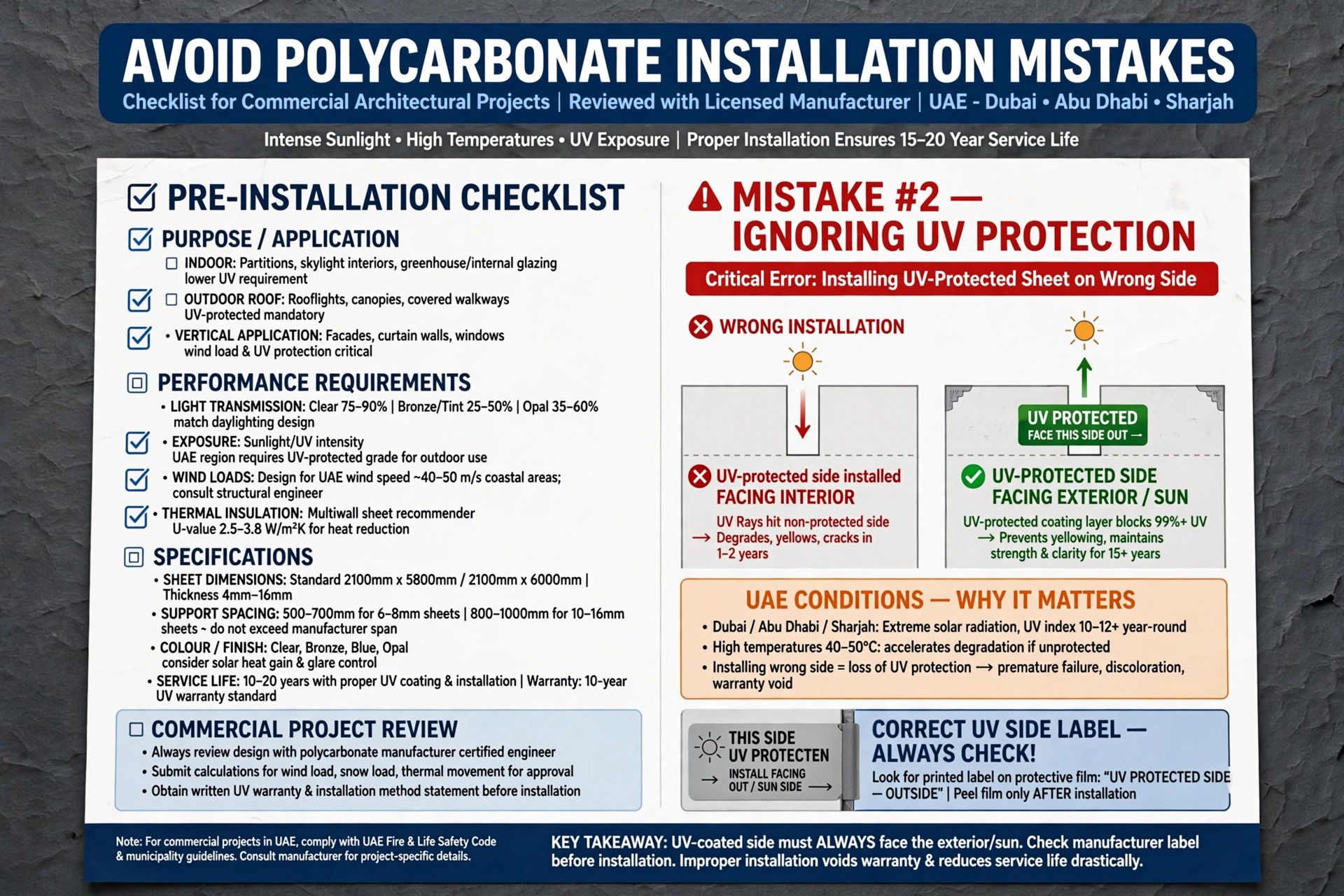
Mistake 2: Ignoring UV Protection
Polycarbonate can be exposed to intense ultraviolet radiation when used outdoors.
A UV-protected sheet is designed to provide improved resistance against the effects of prolonged solar exposure.
This is particularly relevant in Dubai, Abu Dhabi, Sharjah, and other parts of the UAE, where outdoor surfaces can experience intense sunlight and high temperatures.
Installing the wrong side of a UV-protected panel toward the exterior can reduce the intended protection.
How to Avoid It
Always check the manufacturer’s markings and installation instructions.
Some sheets have a designated UV-protected side that must face outward.
Do not assume that both surfaces have identical UV protection.
Mistake 3: Installing the Sheet Upside Down
This mistake is particularly relevant to multiwall and UV-protected polycarbonate sheets.
The sheet may have a specific orientation for:
UV protection, surface treatment, internal structure, drainage channels, or appearance.
Installing it incorrectly can compromise its intended performance.
How to Avoid It
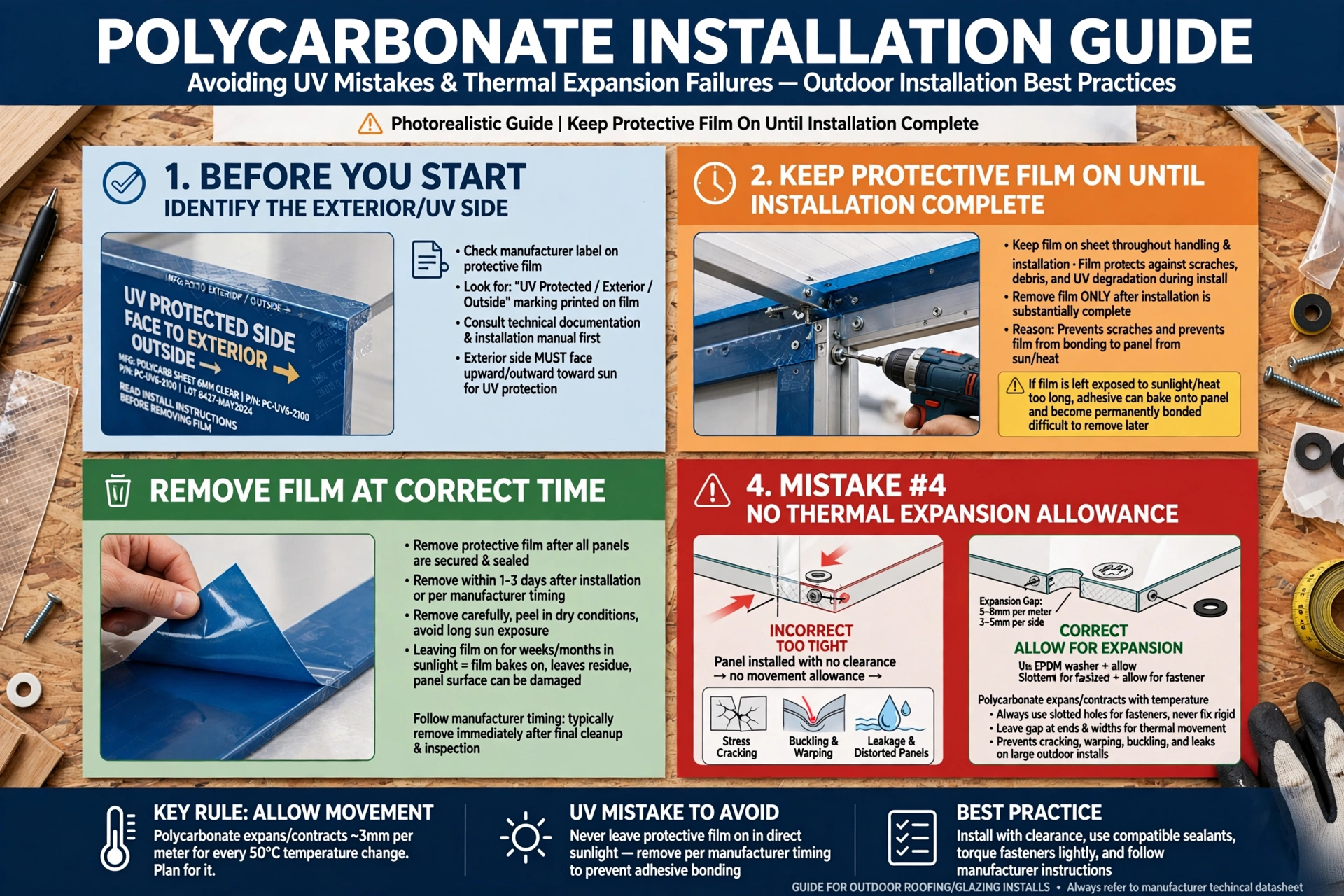
Before removing protective film, identify the exterior side.
Check:
- Manufacturer labels
- Protective film markings
- Technical documentation
- Product installation instructions
Keep the protective film on the sheet until the installation is substantially complete, but remove it according to the manufacturer’s recommended timing so that it does not become permanently bonded by heat or sunlight.
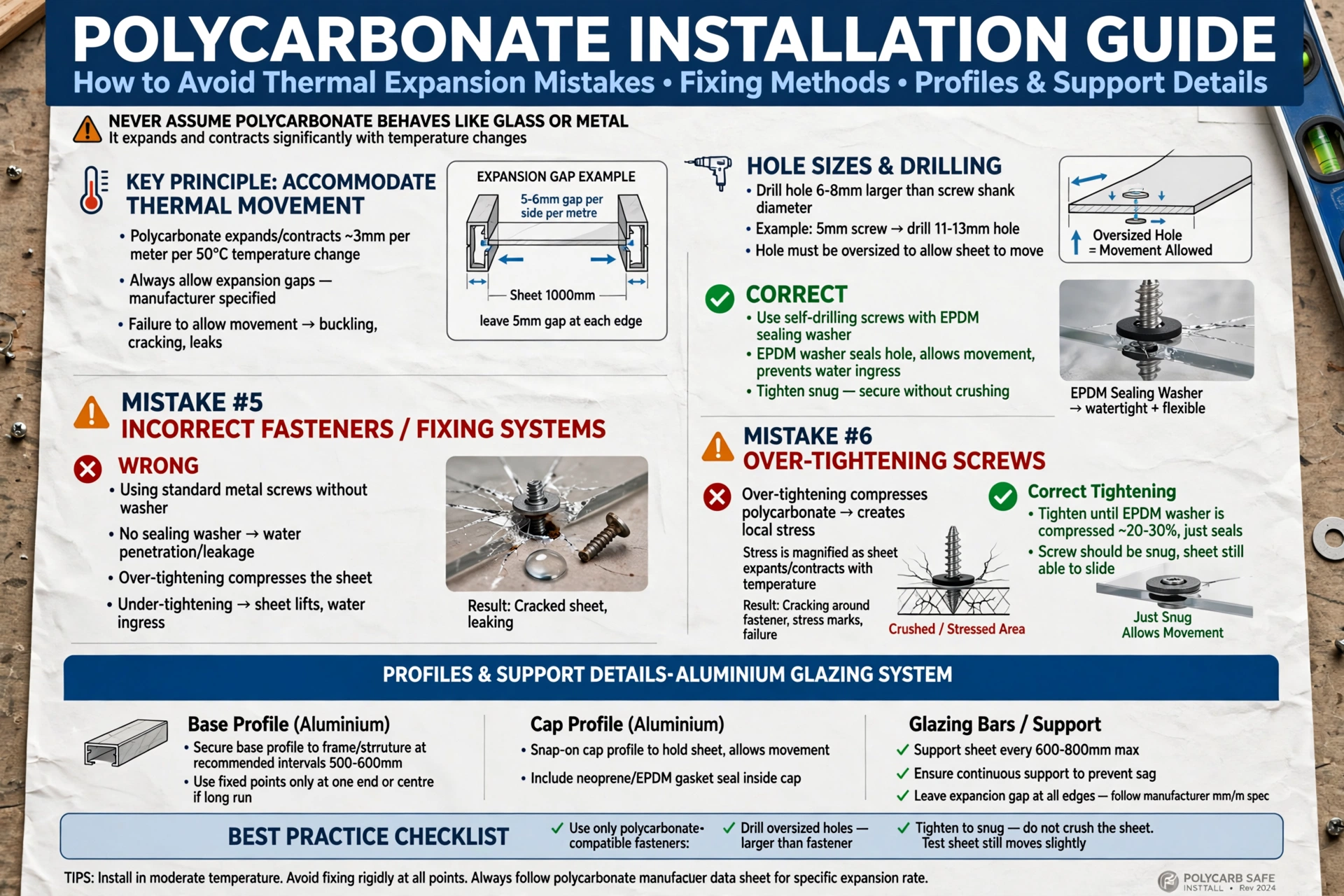
Mistake 4: Not Allowing for Thermal Expansion
Polycarbonate expands and contracts with temperature changes.
This is one of the most important installation considerations.
A panel installed tightly between rigid structures without adequate movement allowance can experience stress when temperatures change.
This can contribute to:
- Cracking
- Buckling
- Warping
- Fastener stress
- Distorted panels
- Leakage
The problem can become more significant on large outdoor installations.
How to Avoid It
Installation should accommodate the manufacturer’s specified thermal movement.
Expansion gaps, fixing methods, hole sizes, profiles, and support details should be designed accordingly.
Never assume that a polycarbonate panel behaves like glass or metal.
Mistake 5: Using Incorrect Fasteners
Fasteners are critical to the performance of a polycarbonate installation.
Using unsuitable screws, washers, or fixing systems can damage the sheet or create leakage points.
Over-tightening fasteners can compress the material excessively.
Under-tightening can allow movement or water penetration.
How to Avoid It
Use fasteners and sealing components recommended for polycarbonate applications.
Depending on the installation, systems may include:
Self-drilling screws, compatible washers, EPDM sealing washers, aluminium profiles, glazing bars, base profiles, and cap profiles.
Fasteners should be tightened enough to secure the sheet without crushing it.
Mistake 6: Over-Tightening Screws
Over-tightening is one of the simplest mistakes to make.
When a screw is tightened excessively, the washer can compress the polycarbonate.
This may create local stress around the fixing point.
Over time, thermal movement can increase the stress.
How to Avoid It
The fastener should secure the panel while still allowing appropriate movement.
Avoid deforming the sheet around the screw.
For large installations, follow the manufacturer’s recommended fixing torque and spacing.
Mistake 7: Drilling Holes Too Close to the Edge
Holes positioned too close to the edge can weaken the panel around the fixing point.
Thermal movement and wind loads can then increase stress in that area.
How to Avoid It
Maintain the minimum edge distance specified by the sheet manufacturer.
The required distance depends on:
Sheet thickness, fixing system, panel size, loading conditions, and application.
Never establish a universal measurement without checking the product’s technical documentation.
Mistake 8: Using the Wrong Drill Bit
Polycarbonate can be drilled, but unsuitable tools or excessive pressure can create rough holes, cracking, or localized damage.
How to Avoid It
Use an appropriate drill bit and controlled drilling speed.
The sheet should be properly supported underneath.
Avoid excessive force.
For production environments, CNC machining or other controlled fabrication methods may be preferable when many precise holes are required.
Mistake 9: Blocking the Channels in Multiwall Sheets
Multiwall polycarbonate contains internal channels.
These channels are important to the sheet’s construction and can also require drainage and ventilation management.
If the channels are improperly sealed, moisture or condensation can become trapped.
How to Avoid It
The ends of multiwall sheets should be finished using appropriate breather tape, solid tape, end profiles, or manufacturer-approved systems, depending on the application.
The design should allow appropriate drainage and prevent unwanted dust and insects from entering the channels.
Mistake 10: Installing Multiwall Sheets Without Proper Channel Orientation
Multiwall panels are generally installed with their internal channels oriented according to the manufacturer’s recommendations.
For many applications, channels are positioned vertically or along the slope to facilitate drainage.
Incorrect orientation can interfere with moisture management.
How to Avoid It
Follow the product-specific installation guide.
For sloped roofing applications, confirm the recommended direction of the internal flutes or channels before cutting and fixing the panels.
Mistake 11: Ignoring Roof Slope
Polycarbonate roofing requires appropriate slope to encourage water drainage.
A nearly flat panel can allow water to remain on the surface.
Standing water can increase maintenance requirements and create opportunities for leakage.
How to Avoid It
Design the roof according to the manufacturer’s recommended minimum slope.
Consider:
Panel length, rainfall, drainage paths, structural design, flashing, gutters, and local building requirements.
Even in relatively dry climates, proper drainage remains important.
Mistake 12: Poor Joint and Profile Installation
Many polycarbonate installations use aluminium or compatible glazing profiles.
Incorrect profile installation can create:
- Water leakage
- Panel movement
- Poor alignment
- Edge damage
- Visible gaps
- Premature seal failure
How to Avoid It
Profiles should be selected according to the sheet thickness and installation system.
The installation should account for thermal movement while maintaining a weather-resistant connection.
Avoid improvising incompatible profile systems.
Mistake 13: Using Incompatible Sealants
Not every sealant is suitable for polycarbonate.
Certain chemicals can interact negatively with thermoplastic materials.
How to Avoid It
Use sealants specifically confirmed as compatible with polycarbonate by the manufacturer.
Common project considerations may include:
Neutral-cure silicone, compatible glazing sealants, EPDM components, and manufacturer-approved tapes.
Always verify compatibility before applying a chemical product to a large area.
Mistake 14: Removing the Protective Film Too Early
Polycarbonate sheets commonly arrive with protective film on their surfaces.
The film helps protect the material from scratches during transportation and installation.
Removing it too early can expose the panel to:
Dust, scratches, fingerprints, sealant marks, construction debris, and accidental surface damage.
How to Avoid It
Keep the protective film in place during most installation activities.
However, do not leave it exposed to intense sunlight for longer than the manufacturer’s recommended period because heat can make removal difficult.
Mistake 15: Cutting Panels Without Proper Measurement
Incorrect measurements create unnecessary material waste and can cause installation problems.
This becomes especially important for large roofing panels and custom architectural applications.
How to Avoid It
Measure the structure carefully before cutting.
Account for:
- Panel overlap
- Expansion allowance
- Profiles
- Flashings
- Edge conditions
- Fixing points
- Drainage
- Thermal movement
Measure twice and cut once.
For complex projects, create a cutting plan before fabrication begins.
Mistake 16: Using the Wrong Cutting Method
Polycarbonate can be cut using different tools depending on the product.
Suitable methods may include:
Fine-tooth saws, circular saws, jigsaws, CNC routers, specialized cutting equipment, or other manufacturer-approved methods.
Using a dull blade or excessive cutting speed can produce rough edges or heat damage.
How to Avoid It
Select the cutting method based on:
Sheet type, thickness, design complexity, production quantity, and required edge quality.
Clean the cut edge before installation.
Mistake 17: Ignoring Support Spacing
Polycarbonate panels should be adequately supported.
If support spacing is excessive, panels may flex more than intended under wind or other loads.
This is especially important for:
Roofing, canopies, large skylights, and commercial structures.
How to Avoid It
Structural support spacing should be determined according to:
- Sheet thickness
- Panel dimensions
- Wind loads
- Snow loads where applicable
- Installation orientation
- Manufacturer specifications
- Structural design
Do not use a generic support spacing for every polycarbonate product.
Mistake 18: Poor Substructure Alignment
The supporting frame must be properly aligned before the polycarbonate is installed.
Uneven supports can cause stress and visible distortion.
For roofing and glazing applications, the supporting structure may consist of:
Aluminium profiles, steel framing, timber supports, purlins, glazing bars, or other structural systems.
How to Avoid It
Check the structure for:
Level, alignment, spacing, rigidity, and drainage direction before installing panels.
Correct structural problems first rather than forcing panels into position.
Mistake 19: Walking Directly on Polycarbonate Roofing
Polycarbonate roofing panels should not automatically be treated as walkable surfaces.
Even strong sheets can be damaged or displaced when subjected to concentrated loads.
How to Avoid It
Use appropriate temporary access equipment, walk boards, or structural supports where necessary.
Workers should follow the project’s safety procedures and the manufacturer’s recommendations.
Mistake 20: Poor Cleaning During Installation
Construction dust, metal filings, sealant residue, and other debris can scratch the sheet surface.
Using abrasive cleaning materials can create permanent marks.
How to Avoid It
Use appropriate cleaning methods and soft materials.
Avoid:
- Abrasive powders
- Harsh solvents
- Rough brushes
- Unapproved chemicals
- Aggressive scraping
For routine maintenance, clean water and a mild compatible cleaning solution are commonly preferable, subject to manufacturer recommendations.
Mistake 21: Ignoring Condensation
Condensation can occur when warm, humid air meets a cooler surface.
This can be particularly relevant to multiwall sheets and enclosed structures.
Condensation does not necessarily indicate a defective panel.
It can be related to:
Ventilation, temperature differences, humidity, channel orientation, sealing, and building design.
How to Avoid It
The overall installation should provide appropriate ventilation and moisture management.
For enclosed structures, consider the internal environment as well as the panel itself.
Mistake 22: Failing to Consider Dubai’s Climate
Polycarbonate installations in Dubai face unique environmental conditions.
High solar radiation, elevated temperatures, dust, humidity, and occasional heavy rainfall can all affect building materials.
The design should therefore account for:
UV exposure, thermal expansion, drainage, sealing, ventilation, dust accumulation, and wind loading.
Areas such as Dubai Marina, Downtown Dubai, Business Bay, Jumeirah, Palm Jumeirah, Dubai Hills Estate, Al Barsha, and Arabian Ranches contain different property types and structural applications.
A canopy installation in a villa should not necessarily use the same specifications as a large commercial roof.
Mistake 23: Choosing Price Over Material Quality
Cheap material may appear attractive during initial purchasing, but the lowest-cost sheet may not provide the required performance.
Important specifications include:
- Sheet thickness
- UV protection
- Light transmission
- Impact resistance
- Thermal performance
- Colour stability
- Manufacturer warranty
- Fire-performance characteristics where applicable
How to Avoid It
Compare products according to technical specifications rather than price alone.
For businesses purchasing material for construction, signage, roofing, or architectural projects, working with an experienced Polycarbonate Sheet Supplier can help with product selection based on the intended application.
Mistake 24: Not Considering Fire Performance
Polycarbonate products can have different fire-performance characteristics.
For certain commercial and architectural projects, fire performance may be an important specification.
How to Avoid It
Check the product’s technical documentation and relevant certifications before specifying the material.
For larger commercial projects, requirements should be reviewed by the project consultant and relevant authorities.
Mistake 25: Ignoring Structural and Building Requirements
A polycarbonate sheet is only one part of an installation.
Large roofs, façades, canopies, skylights, and architectural structures require appropriate structural design.
Important considerations may include:
Wind pressure, fixing loads, panel spans, frame strength, drainage, thermal movement, safety, and local building requirements.
How to Avoid It
For substantial commercial or structural applications, involve qualified design and engineering professionals.
Do not rely solely on a material supplier’s generic installation diagram for a project-specific structural design.
Polycarbonate Installation for Commercial Buildings
Commercial projects often require greater attention to durability, appearance, maintenance, and compliance.
Polycarbonate can be used for:
Skylights, warehouse roofing, shopping-centre structures, partitions, canopies, walkways, architectural glazing, protective barriers, and signage.
In Dubai International City, Dubai Investment Park, Jebel Ali, Dubai Silicon Oasis, Business Bay, and Downtown Dubai, different building types create different material requirements.
The correct installation system should be selected based on the project’s environment and function.
Polycarbonate Sheets for Signage
Polycarbonate can also be used in signage and display applications.
It can provide impact resistance where signs may be exposed to physical contact.
Applications include:
- Safety signage
- Industrial signs
- Protective sign faces
- Illuminated displays
- Retail displays
- Advertising structures
- Information panels
Cutting, drilling, printing, mounting, and finishing should all be considered during design.
Solid vs Multiwall Polycarbonate Installation
Solid and multiwall polycarbonate sheets require different installation considerations.
Solid polycarbonate is dense and resembles a flat transparent sheet.
Multiwall polycarbonate contains internal chambers that provide insulation and reduce weight.
Multiwall panels require particular attention to:
Channel direction, end sealing, ventilation, condensation, profiles, and drainage.
Solid panels may require greater attention to thermal movement, glazing details, drilling, and structural support.
Polycarbonate Sheet Maintenance After Installation
Good installation should be followed by proper maintenance.
Maintenance may include:
Surface cleaning, checking fasteners, inspecting seals, clearing drainage paths, checking profiles, examining joints, and inspecting for damage.
For roofing installations, gutters and surrounding drainage should also be kept clear.
Regular inspection can identify small problems before they become major repair issues.
A Practical Polycarbonate Installation Checklist
Before installation, confirm:
Material: Correct polycarbonate type and thickness.
UV protection: Correct exterior surface identified.
Measurements: Panels accurately measured and cut.
Structure: Supports are aligned and sufficiently strong.
Thermal movement: Expansion allowance provided.
Fasteners: Compatible screws and washers selected.
Profiles: Correct profiles and seals available.
Channels: Multiwall channels correctly oriented.
Drainage: Adequate roof slope and drainage provided.
Sealants: Chemically compatible products selected.
Protection: Surface film maintained appropriately.
Safety: Suitable access and working procedures established.
Inspection: Completed installation checked before handover.
Frequently Asked Questions
What is the biggest mistake when installing polycarbonate sheets?
One of the most significant mistakes is failing to account for thermal expansion. Polycarbonate expands and contracts with temperature, so rigidly fixing panels without appropriate movement allowance can create stress and deformation.
Can polycarbonate sheets be installed directly against a frame?
They can be installed using appropriate framing and fixing systems, but the exact detail depends on the sheet type, thickness, application, and manufacturer specifications.
Which side of polycarbonate faces outside?
For UV-protected sheets, the designated UV-protected side generally faces outward. Always check the manufacturer’s markings because products can differ.
Can polycarbonate sheets be screwed directly?
Many polycarbonate applications use mechanical fasteners, but fixing details should allow thermal movement and avoid excessive compression.
Do polycarbonate sheets need expansion gaps?
Polycarbonate expands and contracts with temperature. Appropriate movement allowance is therefore an important part of professional installation.
Can polycarbonate sheets be used for roofing in Dubai?
Yes. Polycarbonate is commonly used for suitable roofing, skylight, canopy, and architectural applications. The sheet specification and installation system should be selected for the project’s solar exposure, temperature, wind conditions, drainage, and structural requirements.
How long can polycarbonate sheets last?
Service life varies according to product quality, UV protection, installation, environmental exposure, maintenance, and application. Manufacturer specifications and warranties should be checked for the particular product.
Conclusion
Polycarbonate sheets are versatile materials that can deliver excellent performance when correctly specified and installed. However, installation quality is just as important as material quality.
The most common problems come from incorrect sheet selection, poor thermal-expansion allowance, wrong fasteners, excessive screw pressure, improper drilling, blocked multiwall channels, inadequate drainage, incompatible sealants, poor structural support, and ignoring UV protection.
Dubai and the wider UAE present additional considerations because of high temperatures, intense sunlight, dust, humidity, and strong seasonal environmental conditions. Polycarbonate installations should therefore be designed with the local environment in mind.
A successful installation starts with selecting the right product and continues through accurate measurement, appropriate cutting, correct fixing, proper sealing, thermal movement management, and regular maintenance.
For contractors, fabricators, architects, facility managers, and property owners, choosing the appropriate material from an experienced Polycarbonate Sheet Supplier can also help ensure that the sheet type, thickness, finish, and application are properly matched.
Whether you are installing polycarbonate roofing, skylights, canopies, partitions, commercial structures, industrial panels, greenhouse glazing, or signage, avoiding these common installation mistakes can improve appearance, reliability, weather resistance, and long-term performance.