

Blogs
LED Strip Placement for Uniform Lighting: Expert Guide for Perfect Illumination

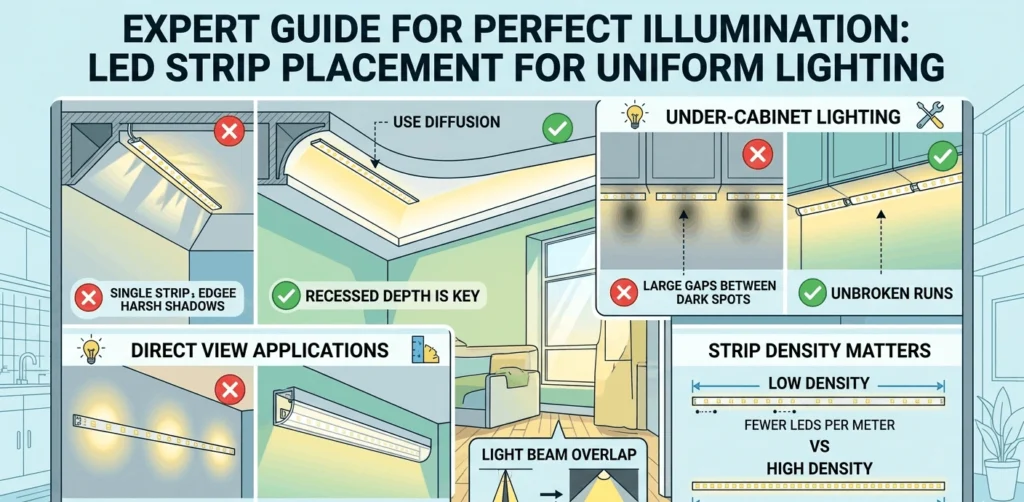
LED strip lighting has become one of the most versatile and widely used lighting solutions in modern interiors and commercial environments. However, many people install LED strips incorrectly, which leads to uneven brightness, visible light dots, harsh shadows, or poorly illuminated spaces. Achieving uniform lighting with LED strips requires careful planning, correct placement, proper mounting surfaces, and the right accessories.
This expert guide explains how to place LED strips properly to achieve smooth, even lighting. It covers common problems people face, practical installation strategies, and professional techniques used in residential, retail, and architectural lighting design.
Why Uniform Lighting Matters
Uniform lighting means light is distributed evenly across a surface without dark spots, bright hotspots, or distracting shadows.
Poor LED strip placement often causes:
- visible LED dots
- uneven brightness across walls or ceilings
- harsh shadows under cabinets
- glare that makes spaces uncomfortable
Uniform lighting improves:
- visual comfort
- interior aesthetics
- product visibility in retail stores
- workspace productivity
When installed correctly, LED strips create smooth continuous light that enhances architectural features rather than exposing the lighting source itself.
Common Problems People Face With LED Strip Lighting
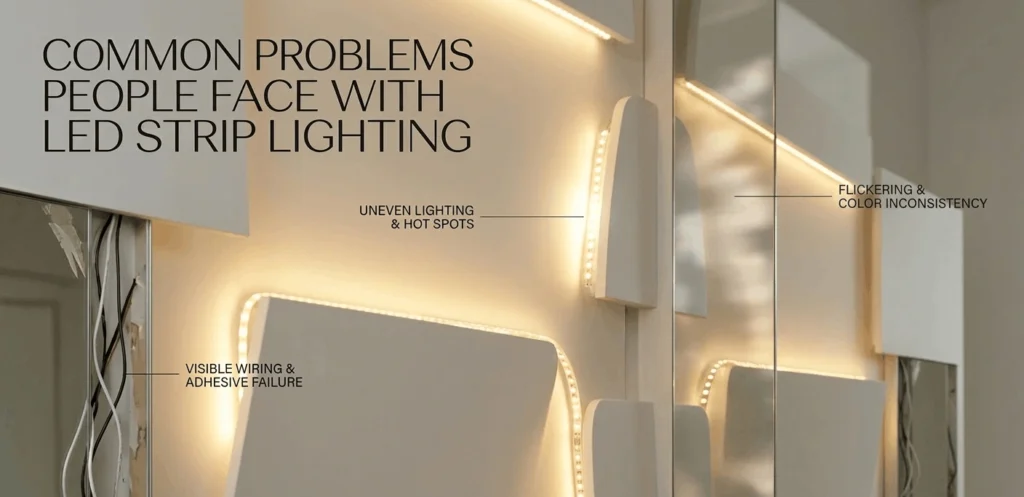
Many installations fail because people focus only on buying the lights and ignore placement strategy.
Here are the most common mistakes.
Visible LED Dots
One of the biggest frustrations is seeing individual LED points instead of a continuous glow.
This happens when:
- LED strip lights are installed too close to the visible edge
- there is no diffuser or channel
- low-density LED strips are used
Uneven Light Distribution
Sometimes one area appears bright while another looks dim.
This often occurs due to:
- incorrect spacing between strips
- improper mounting angles
- obstacles blocking light spread
Harsh Shadows
Incorrect strip placement can create shadows under cabinets, shelves, or display units.
Excessive Glare
Direct LED exposure can cause glare, especially in kitchens, offices, and retail environments.
These issues are all related to placement technique rather than the quality of the LED strip itself.
Understanding LED Strip Lighting Basics
Before placing LED strips, it is important to understand the core components.
LED strip systems usually include:
- LED strip tape
- power supply
- aluminum channel
- diffuser cover
- controller (for dimming or color change)
Each component plays a role in achieving uniform illumination.
Professional installers always use aluminum channels and diffusers to soften the light output.
Best Locations for LED Strip Placement
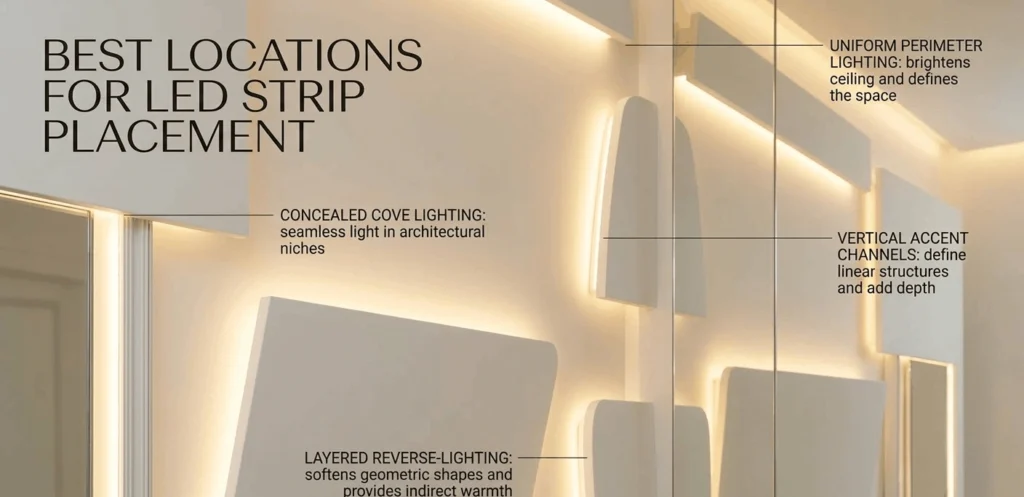
LED strips can be installed in multiple locations depending on the lighting goal.
Each placement requires a slightly different approach.
Ceiling Cove Lighting
Cove lighting is one of the most effective methods to achieve uniform ambient lighting.
LED strips are installed inside recessed ceiling edges so light reflects off the ceiling.
Key placement tips:
- place the strip at least 5–10 cm away from the wall edge
- aim the light toward the ceiling rather than directly downward
- use high-density LED strips for smooth glow
This reflection technique eliminates visible LED dots and produces soft ambient lighting.
Under Cabinet Lighting
Under-cabinet lighting is common in kitchens and workspaces.
Incorrect placement often results in visible strip lights or shadowed work surfaces.
Professional approach:
- install the strip toward the front edge of the cabinet
- angle the light toward the countertop
- use aluminum channels with diffusers
This ensures the entire counter surface is illuminated evenly.
Shelf Lighting
Shelves require balanced lighting so objects are clearly visible.
Recommended placement:
- install strips toward the front edge pointing backward
- or place them at the top rear shining forward
This technique prevents glare while highlighting items on the shelf.
Wall Grazing Lighting
Wall grazing emphasizes textures such as stone, wood, or decorative panels.
Placement strategy:
- position the LED strip very close to the wall surface
- maintain consistent spacing along the wall
This creates dramatic shadow effects that enhance textures.
Wall Washing Lighting
Wall washing is different from grazing.
The goal is to illuminate the wall evenly.
For this:
- install LED strips at least 20–30 cm away from the wall
- ensure wide beam spread
This technique produces smooth vertical illumination.
How Distance Affects Lighting Uniformity
The distance between the LED strip and the illuminated surface greatly affects the final result.
Short distance leads to:
- visible LED dots
- harsh light gradients
Greater distance allows light to spread evenly.
Professional designers calculate distance based on:
- LED density
- beam angle
- diffuser type
For example:
Low-density LED strips require more distance to blend properly.
Importance of LED Density
LED strip density refers to how many LED chips are placed per meter.
Common densities include:
- 30 LEDs per meter
- 60 LEDs per meter
- 120 LEDs per meter
- 240 LEDs per meter
Higher density strips produce smoother illumination.
For uniform lighting, professionals usually recommend 120 LEDs per meter or higher.
Using Aluminum Channels for Better Light Distribution
Aluminum channels play an important role in professional installations.
They provide:
- heat dissipation
- structural support
- mounting precision
- compatibility with diffusers
Channels also improve durability and appearance.
Without channels, LED strips may peel off or overheat.
Why Diffusers Are Essential
Diffusers soften LED light and eliminate visible dots.
Types of diffusers include:
- frosted diffusers
- milky diffusers
- opal diffusers
Milky diffusers are best for achieving uniform light.
When combined with high-density strips, diffusers create continuous light lines.
Choosing the Right Color Temperature
Lighting uniformity also depends on color temperature.
Common options include:
- 2700K warm white
- 3000K soft white
- 4000K neutral white
- 6000K cool white
For residential spaces, warm tones create comfortable environments.
Retail and workspaces often use neutral white for clarity.
Avoiding Light Gaps
Another common mistake is leaving small gaps between LED strips.
Even tiny gaps can create visible dark sections.
Professional installation tips:
- use continuous strips whenever possible
- plan wiring carefully
- hide connectors inside channels
Power Supply Considerations
Uniform brightness also depends on proper power supply.
If the power supply is insufficient, lights may dim at the far end.
Solutions include:
- using higher capacity drivers
- injecting power at multiple points
- using shorter strip runs
Professional installers often power long strips from both ends.
LED Strip Placement for Different Environments
LED strip lighting is used in many environments.
Placement strategies change depending on the application.
Residential Lighting
Homes use LED strips for:
- ceiling coves
- kitchen cabinets
- bedroom accent lighting
- staircase illumination
Focus on soft, comfortable lighting.
Retail Stores
Retail lighting requires strong but uniform illumination.
LED strips highlight:
- shelves
- display racks
- wall panels
Proper placement ensures products appear vibrant and clearly visible.
Office Lighting
Offices require glare-free illumination.
LED strips are often integrated into:
- ceiling panels
- desk lighting
- architectural features
Balanced brightness improves productivity and visual comfort.
Hotels and Hospitality
Hotels use LED strips to create luxury environments.
Placement areas include:
- bed headboards
- ceiling recesses
- reception desks
- hallway walls
Uniform lighting enhances the overall guest experience.
Smart Control Integration
Modern LED strip systems often include smart control features.
These allow users to:
- adjust brightness levels
- change color temperatures
- schedule lighting scenes
Smart lighting systems can improve energy efficiency and user comfort.
Maintenance Tips for Long-Term Performance
Proper maintenance ensures LED strip lighting continues to perform well.
Important tips include:
- keeping strips free from dust
- checking connectors periodically
- ensuring power supplies remain stable
High-quality LED strips can last 30,000 to 50,000 hours.
When to Hire a Professional Installer
While DIY installations are possible, complex lighting layouts benefit from professional design.
Professionals can:
- calculate proper lighting angles
- determine correct LED density
- design wiring layouts
- ensure electrical safety
This reduces the risk of uneven lighting and installation errors.